


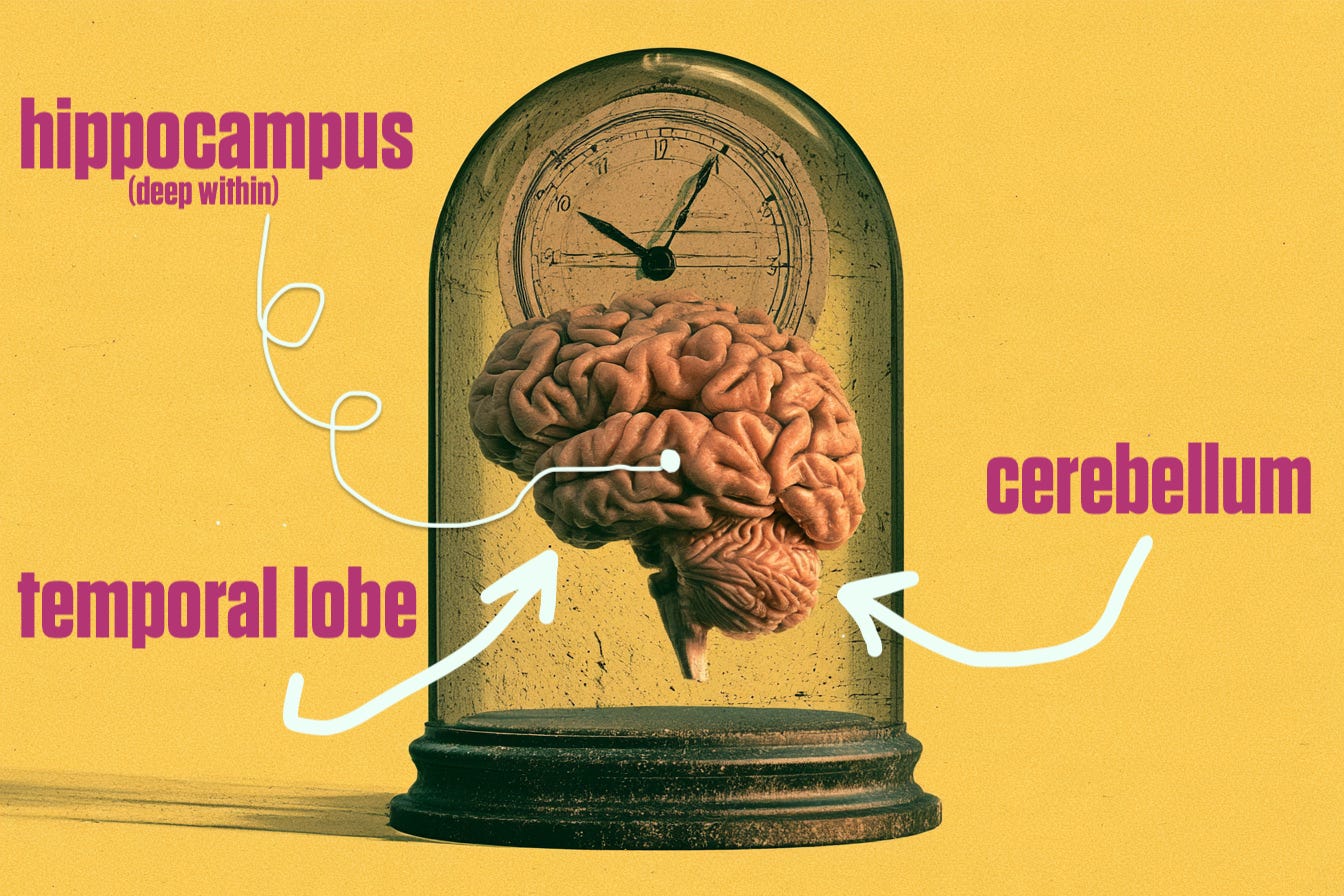

Memory changes that come with healthy aging are a designed stage of development, shaped by evolution. That’s the thesis of a new paper in Perspectives on Psychological Science. That argument applies a healthy dose of evolutionary biology to theories about why memory loss occurs in older age.
A new theory about age-related memory decline
Scientists agree that, as you age, your brain relies less on the hippocampus, a small structure deep within the frontal lobe that records the specifics of events, and more on the front of the brain, which handles general knowledge and meaning. They disagree about why.

One week left to lock in your lower subscription price:
This newsletter’s subscription price will go up in a week. Yours doesn’t have to.
Subscribe and lock in today’s lower rate for life. That comes out to just $1.23 per week for an annual subscription. Here’s everything you get for your investment in 1) healthy, science-based longevity, 2) weekly strength, fitness & nutrition recommendations, and 3) critical reporting on the Longevity Industrial Complex:

Background: For decades, the aging mind has been described as a leaking vessel. In 1982 the psychologist Gisela Labouvie-Vief argued that thinking in later life changes in kind, moving from precise analysis toward meaning, context and lessons learned.1 In 1990, the psychologists Paul and Margret Baltes described how older people adapt to losses by focusing on what matters most and finding new ways to accomplish those things.2 Brain-scan studies from 2000 onward, by Patricia Reuter-Lorenz of the University of Michigan and others, found that older adults use more of the front of the brain, and often both sides of it, during memory functions.34
Context: Most researchers have interpreted those results as the brain working harder to make up for losses. In 2002, the neuroscientist Yaakov Stern coined a phrase you may have heard of—“cognitive reserve”—to describe the cushion that education and demanding work seem to give against decline.5 Twenty years later, two reviews found that older adults tend to remember the gist of events better than the details, and that shift can help with creativity and judgment.67 Both reviews, however, treated those benefits as side effects of age-related decline.
What’s new: The new paper argues that this shift is designed—that evolution has incorporated it to allow older people to hold on to what they’ve learned and pass it on to younger people. As one of the paper’s three authors, Fabian-Xosé Fernandez, a University of Arizona associate professor of psychology and neurology, told AGING with STRENGTH in an emailed statement:
“Some changes in healthy aging may reflect a continuation of development that paves the way to day-to-day changes in cognitive priorities better suited to the goals of later life. As people accumulate decades of experience, the brain may have evolved to naturally place less emphasis on rapidly encoding the precise details of individual events, especially when those events are already similar to the many variations that have been experienced.
“Instead, increasing emphasis may be placed on integrating information (e.g., extracting gist) across lived experiences into stable knowledge, general principles, and meaningful narratives so as to support important later-life functions such as mentoring and the transmission of knowledge to younger generations.
“A younger brain,” Fernandez added, “may (indeed) be optimized to build an archive of information about the outside world; alternatively, an older brain may be optimized to curate and use that archive once it’s been enriched.”
The argument distilled (by me) into a sentence: An older brain’s function may evolve away from the encoding of data—especially if that information becomes less novel over time—to instead become a curator of those accumulated cognitive years into knowledge, principles and, as Fernandez says, “meaningful narratives.”
Method: To make their case, Fernandez and his two co-authors reviewed existing research: studies of brain chemistry, brain scans of young and old adults, memory tests, and experiments in rats, mice and monkeys. They ran no experiments of their own and don’t say in the paper how they chose the studies, so readers can’t tell whether contrary evidence was left out. They do report some of it, including studies showing that older adults’ word knowledge is less connected and mixed evidence that older people are more generous.
They end with a list of tests that could prove them wrong, such as studies that track the same people for years. That list, along with a clearer way to tell normal memory aging from early Alzheimer’s, may well be the paper’s most useful contribution.
The bona-fides: The three authors are respected researchers. Lynn Nadel, a University of Arizona emeritus professor and National Academy of Sciences member, shared the 2006 Grawemeyer Award for identifying the brain’s mapping system. Professor Sara Burke leads Arizona’s neuroscience department.
How you can put these brain-aging theories to work
You don’t have to wait for this theory to be proven to make it useful. Most of the practical advice below holds whether the authors are right about evolution or the older view is right about the brain making up for losses. Some of it comes from the authors, and some from the research they draw on. (Where an idea is the authors’ untested suggestion, I flag it.)
Actionable intelligence: 7 things you can do now
Protect your brain, no matter what. Whatever the reason for the shift, the authors write that keeping the brain healthy is the best-supported route to aging well. That means regular exercise and keeping blood pressure and blood sugar under control. They cite the 2020 Lancet Commission on dementia8 and a two-year Finnish trial that combined diet, exercise, brain training and monitoring of heart risks in older people.9 Reuter-Lorenz, quoted in a Washington Post article about this paper, also mentions the importance of nutrition, sleep and an active social life.
Know which memory changes are normal & which aren’t. Forgetting the name of a restaurant from last week, while still being able to recall what happened at the dinner, fits normal aging by the authors’ account. Warning signs are different: