



A medical license may be the final frontier of longevity credibility, but as more doctors abuse public trust, what—or who—is left to believe?
For most of the past year, a Substack account called Doctor Klover published detailed longevity advice almost daily, and sometimes three times a day, under an impressive credential: board-certified MD/PhD at Stanford Medicine. On July 26, I reached out to the physician behind it, Kelly Cogan-Yoo, a postdoctoral researcher in genetics with a German medical degree, to ask when and where she earned the board certification.
“I am board-certified in neurosurgery,” Cogan-Yoo wrote in a July 26 email.
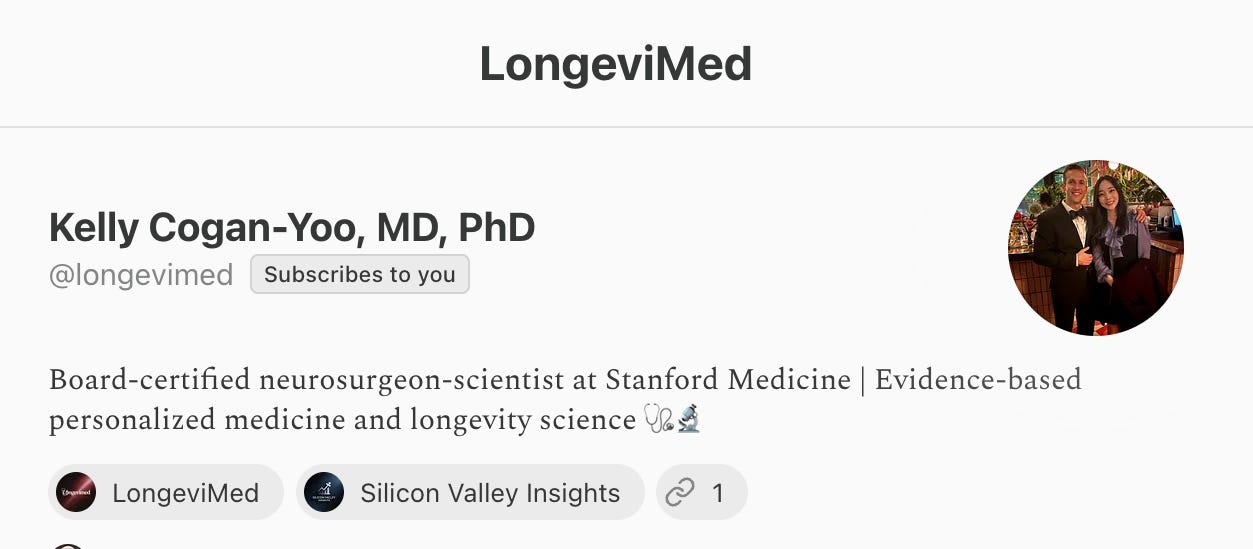
The next day her Substack bio changed to say she is a “board-certified neurosurgeon-scientist at Stanford Medicine.” I also emailed questions to Stanford, where, on her university profile page, Cogan-Yoo claimed she held a California medical license and a “United States Medical License.”
I found no evidence that any of these assertions are true. The federal government does not issue medical licenses, and no one with Cogan-Yoo’s name or any variation of it holds a California medical license or a U.S. board certification, according to the Medical Board of California and a database run by the American Board of Medical Specialties. (Cogan-Yoo did not respond to my request for proof of a board certification, which she told me she received in October 2023.)
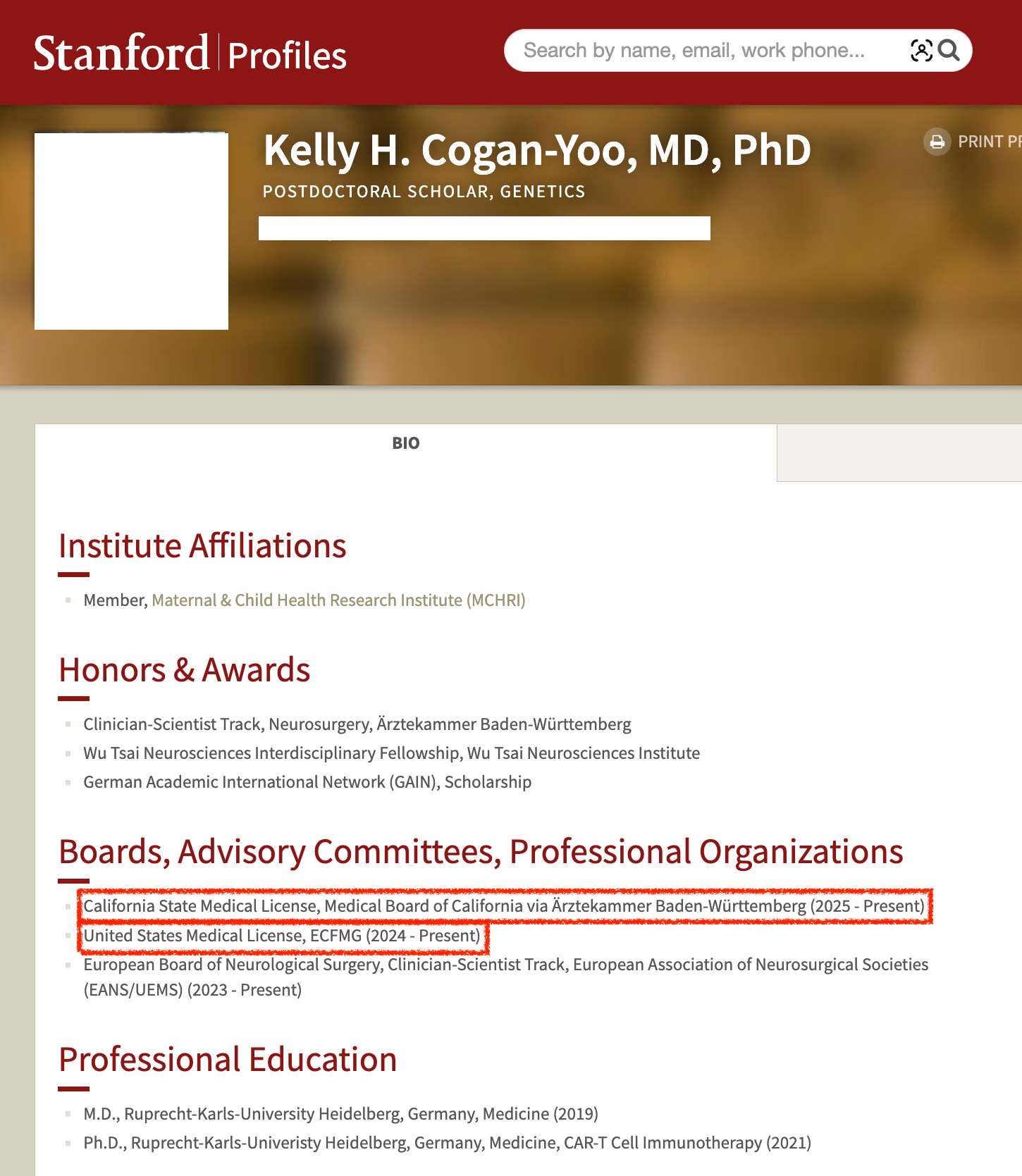
After I sent questions to Stanford about rules governing how postdocs use their university affiliation to sell products on social media, Cogan-Yoo’s board-certified neurosurgeon claim on Substack vanished. Soon after, the reference to a California medical license was deleted from her Stanford Profiles page, and the reference to a “United States Medical License” changed. Her Instagram, where she promoted wellness or beauty products and offered discount codes, was taken down.
Playing a primary care doctor on social media
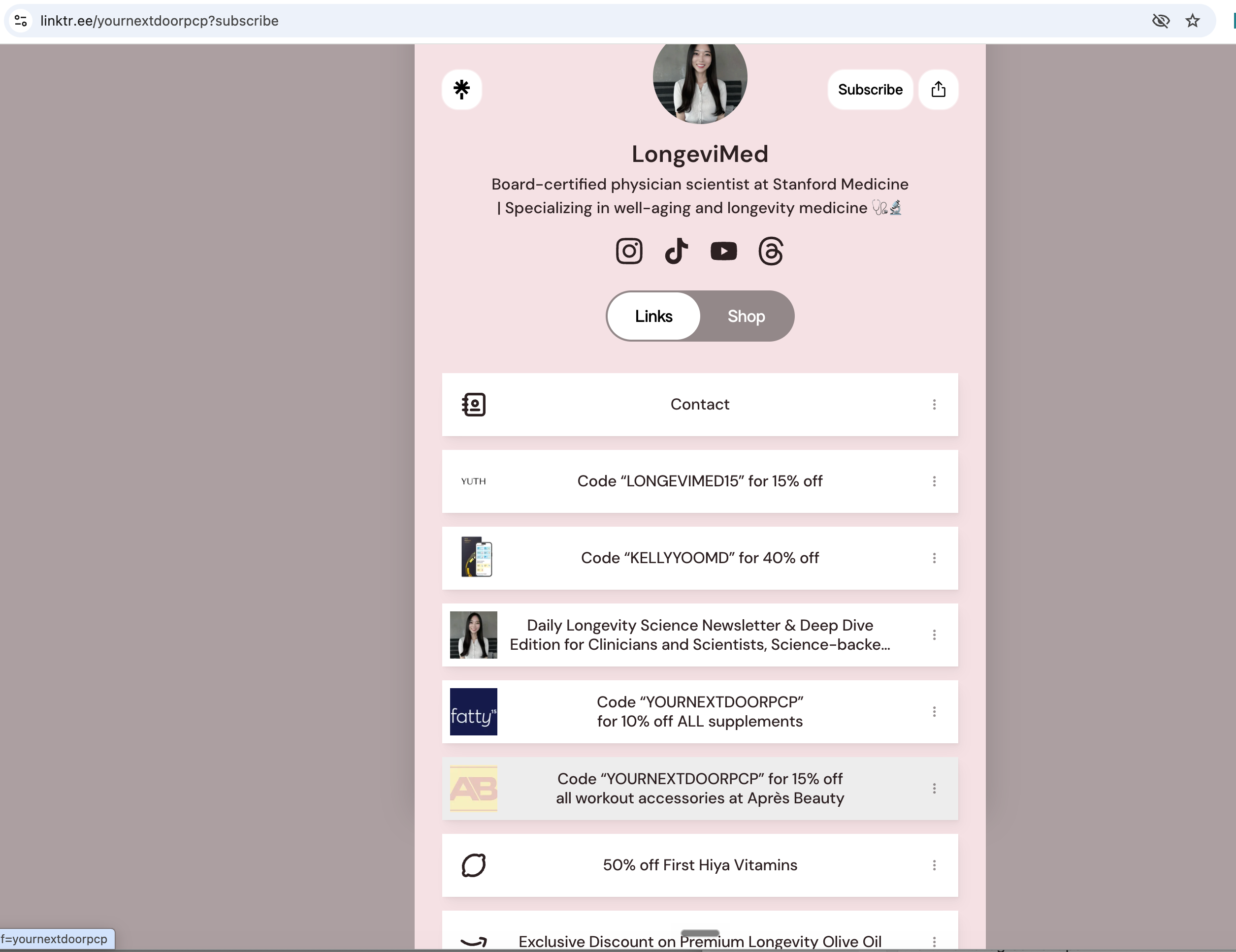
On Instagram and TikTok, Cogan-Yoo referred to herself as “Your Nextdoor PCP” and advertised her Stanford Medicine affiliation to sell products like Japanese skin cream and post videos of herself working out. (PCP is shorthand for primary-care physician.) On her page on Linktr.ee, an online shopping platform that she said she doesn’t maintain, Cogan-Yoo refers to herself as a “Board-certified physician scientist at Stanford Medicine Specializing in well-aging and longevity medicine,” offers “YOURNEXTDOORPCP” and KELLYYOOMD discount codes and promotes 16 “anti-aging” supplements like drinkable olive oil, choline, urolithin A and, for good measure, titanium cutting boards.
At Stanford, Cogan-Yoo is part of a new research initiative, MySuppleHub, to gather information from consumers of supplements of all kinds. The initiative, led by Michael Snyder, a genetics professor, lists her as a postdoctoral scholar. Cogan-Yoo promotes MySuppleHub, and Snyder, on Substack.
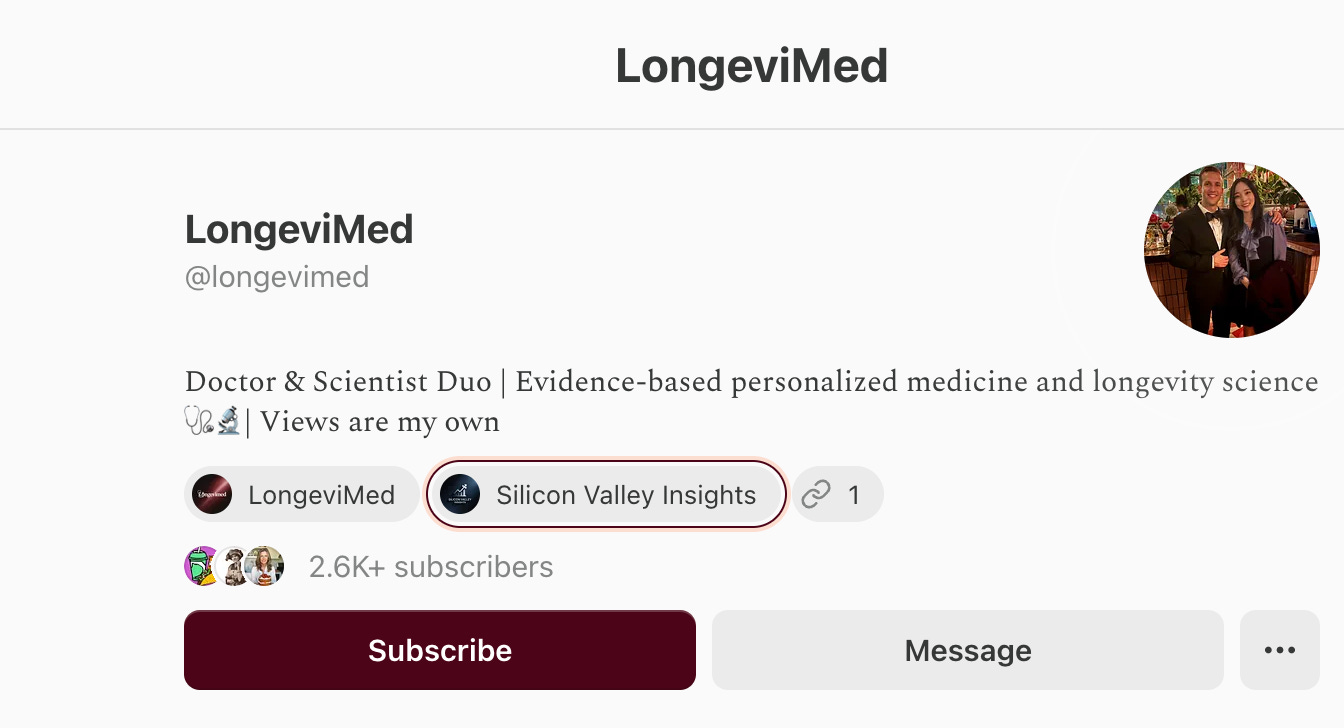
LongeviMed also publishes a second Substack page, called “Silicon Valley Insights,” which gives paying subscribers “thoughtful insights on technology, business, and the economic shifts shaping the world.” That blog, which has nothing to do with medical science or aging and seems to be AI produced, is produced under the LongeviMed banner by “a group of Stanford students and postdocs,” Cogan-Yoo told me by email.
Stanford and the postdoc’s responses to questions
I asked Stanford officials, including the dean of Stanford’s medical school, whether Cogan-Yoo’s use of her Stanford credential to sell supplements, and using social media and Substack accounts to publish AI-generated longevity advice and promote herself as a primary-care physician, violates university regulations or medical ethics. They did not provide answers to any of those questions.
“Stanford expects all members of our community to represent their credentials and professional qualifications accurately and truthfully,” said a university spokeswoman, Cecilia O. Arradaza, in an email. “We take any concerns about potential misrepresentation very seriously and conduct thorough reviews, taking appropriate action when warranted.”
Stanford's Administrative Guide 1.5.4, section 4, prohibits use of the university's name or trademarks in any way that endorses or implies endorsement of a non-Stanford entity or its products or services, and separately prohibits their use by faculty, staff, students or alumni “in association with any commercial activity or outside venture” or in a way that would damage the university’s reputation.
In a July 26 email exchange, Cogan-Yoo told me Stanford was aware of her posts on her Substack page, which she said she maintained with “a few friends” and her husband, “to share helpful information that we come across through our daily work.” She said she used the “Dr. Klover” pseudonym because “I have never managed a public social media account before” and didn’t feel comfortable using her real name.
A “top 0.1%” doctor relying on AI-generated advice
It would be easy to conclude that Cogan-Yoo, who said on Substack that she’s a Korean citizen and German resident living in the United States, is just another longevity chiseler, willing to lie about her clinical background to sell products for a commission. Her blatantly misleading clinical claims and use of social media to promote herself as a longevity doctor and sell things are worth scrutinizing, as is the claim that she’s been a naive member of a group effort on Substack that her Stanford bosses knew about.
On one hand, the reason I know her identity is because she readily gave me her name when I asked, in a Substack chat I’d initiated to find out who was behind the Doctor Klover persona. (Doctor Klover has since been renamed twice, first to her full name and, one day later, to LongeviMed, reflecting her Instagram persona.) After responding to emailed questions with a mixture of real answers and false facts, she briefly became the third doctor on Substack to block me for asking unwelcome questions—the other two being Laurie Marbas and Howard Luks1— before unblocking me a day or so later.
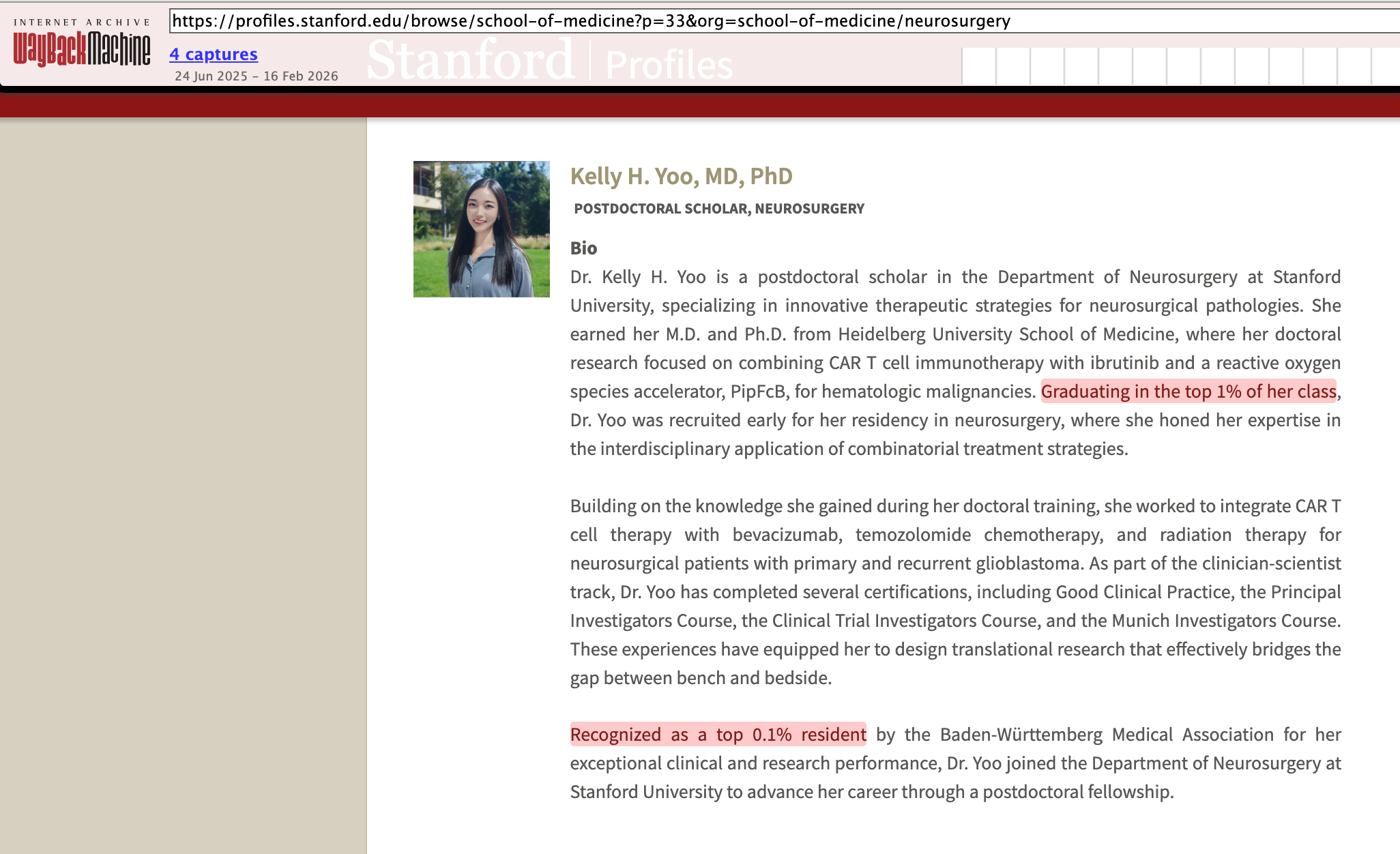
But on the other hand, Cogan-Yoo’s professional embellishments are not new. In a now-archived Stanford profile page, she claimed to have graduated in the top 1% of her Heidelberg University School of Medicine class, and to have been “recognized as a top 0.1% resident by the Baden-Württemberg Medical Association.”
The latter claim is false, the German medical association told me. “The Baden-Württemberg State Medical Association does not, as a matter of principle, evaluate the medical competence/performance of its members,” its press office told me by email, responding to questions about Cogan-Yoo. It also said she was not a current member of the association and that the claim on her revised Stanford Profile page that the German medical association had issued her medical license was incorrect. (The page was updated a second time, after I asked Stanford for comment on the German medical association’s statement, to correct those errors.)
Michael Snyder, the genetics professor running Stanford’s new supplements research lab and the only person at Stanford to respond to my specific questions, said Cogan-Yoo had been vetted by the Stanford fellowship program. “I personally have found Kelly to be highly reliable and with high integrity,” he said in an email, responding to my questions, “but we will fix anything that is misleading or inappropriate.”
Defining misleading/inappropriate
Snyder, a serious scientist, deserves to be taken at his word. Who reading this would not want to see Stanford Medicine, and its highly regarded genetics department, transparently confront clinical legerdemain by one of its postdocs? The problem doesn’t lie in identifying the deception—this article offers a head start—but figuring out where to draw the line between merely misguided and blatantly unprofessional.
For instance, Cogan-Yoo’s Substack, now renamed LongeviMed, has a history of masquerading what is clearly AI-generated slop as first-person articles and generic commentary on other longevity-related posts. The words don’t always add up to much, but they represent LongeviMed as the work of one “physician-scientist” even though Cogan-Yoo told me by email that it was a collaboration among her and others (the number of collaborators she mentioned changed from one email to another.)


Is that misleading and inappropriate, in Stanford Medicine’s view?
Her (and her apparent collaborators’) rebranded Substack seems more concerned with getting attention than actually helping people understand and solve health issues. A week ago, her account posted AI-generated comments on 13 different Substack posts, including my post about FDA peptide votes, using the same formulaic response, including a second paragraph that begins, “As a physician-scientist….”
The author of one such post deemed her commentary AI “blather.”
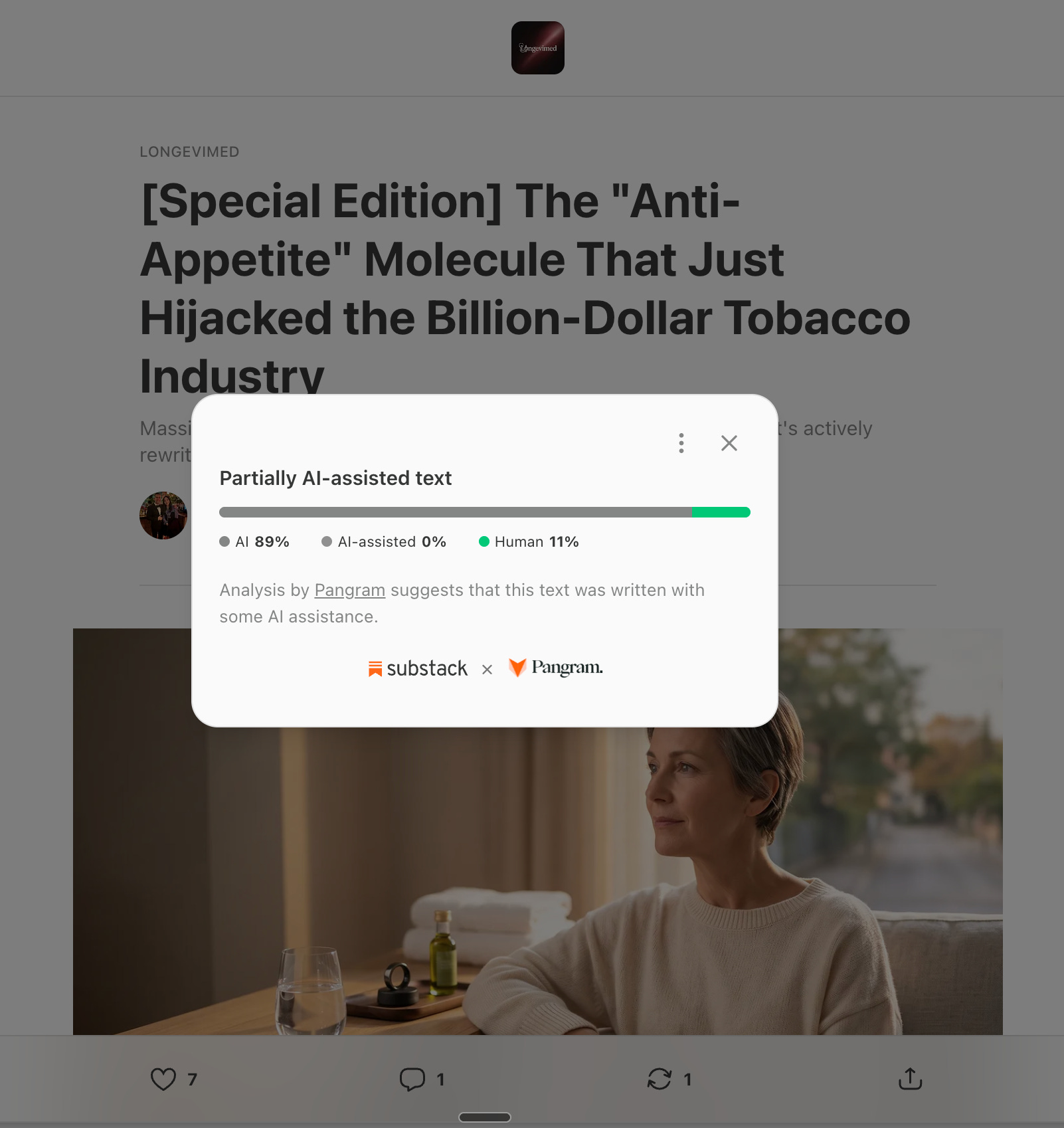
Also, there’s something unseemly about representing oneself as a primary care doctor when one is, in fact, no such thing. Though Cogan-Yoo’s Substack has changed its name several times, it apparently began, deceptively, as Your Nextdoor PCP (an acronym for primary care physician). The Substack’s url remains yournextdoorpcp.substack.com and its content has traded heavily on that name (see video below), even though there is no evidence Cogan-Yoo is licensed to practice medicine in the U.S. or is a primary care doctor at all.
Stanford Medicine did not answer my questions about whether it considers those misrepresentations misleading or inappropriate.
Who cares about one manipulative longevity Substacker?
At this point, I’d like to go back to my opening question: Who, exactly, is left to trust in an era when even doctors at Stanford feel they can get away with misrepresenting, if not outright lying about, their clinical qualifications and abusing their university credentials to make a buck on social media?
Why should we care, when many if not most of us are smart enough to sniff out truth-shading cons or avoid them altogether?
I put that question to Arthur Caplan, professor emeritus of medical ethics at NYU Grossman School of Medicine and a recognized authority on ethics in wellness and longevity. For one thing, he told me in an interview, Cogan-Yoo’s actions are designed to draft off Stanford Medicine’s reputation.
“People trust in them, and their credibility depends on that trust,” he said. “If someone says, ‘Hey I’m Stanford-affiliated and I have this vitamin line and i’m a vitaminologist,’ a lot of people will say, ‘Okay, I need that.’”
Potential harm to consumers
A doctor with a substantial Substack following said Stanford’s lax standards, or enforcement of standards that Cogan-Yoo has exploited, impacts consumers.
“As an academic physician, what troubles me is not only that her credentials appear borrowed, but that platforms like Substack and Instagram offer almost no friction against it,” this doctor, speaking only on condition of anonymity, told me. “Most people reasonably expect that a hospital or university affiliation stated on a major platform has been verified at least to some extent. But when it is used loosely to sell longevity advice or supplements, the audience has no easy way to tell where the institution’s judgment ends and the seller’s begins.
“That asymmetry gets exploited,” the doctor went on, “and it makes the harm hard to see until someone has already made a purchase or a clinical decision based on it. I find it hard to believe that Stanford would let people post anything on their bio without vetting. If true that is not acceptable.”
A regulatory ‘free-for-all’
The Longevity Industrial Complex is now worth more than $1 trillion, according to some estimates. “It’s growing superfast because you can make such money from it,” Caplan said. “There’s no regulation. No one’s going to jail. So you got a free-for-all for something that looks very desirable, with a lot of claims that don’t have to be proven.”
When I asked him how a postdoctoral scholar manages to get away with claiming to be a licensed California doctor on her Stanford Profiles page, Caplan said, “There’s enough money out there to get them to be a little slow on the website corrections.”
On Aug. 6, with a rewritten bio referencing a “Doctor & Scientist Duo,” LongeviMed published its first new post in more than two weeks. It’s almost entirely AI-generated.
Marbas blocked me last year after I asked her whether her lengthy Substack posts and book intro were AI-generated, as several AI-detection tools had indicated. Luks, an orthopedic surgeon, blocked me after I disputed a claim in a post he’d published saying weight training produces no aerobic benefit.
I wrote this little piece of satire as a reflection on a certain Stanford-affiliated podcaster. Can you guess who it is?
My name is Dr. Alexander Harrison. I am a neuroscientist and PhD researcher with a degree in ophthalmology from Soapbox University* deserving of your time, attention and unquestioned trust. And I have an impressive beard. I wear tight t-shirts over my muscular shoulders so that straight women will be distracted by their desire to have sex with me and men will buy my supplements in an effort to be me.
Pay no regard to the multiple public allegations of dating-related misogyny that have been reported about me. Women should know that men like me are only as faithful as our options. And with my enormous brain and t-shirt muscles, my options are unlimited, sweetheart.
I love hearing myself talk and believe that everyone else in the world wants to spend hours of their lives listening to me talk. Why waste a moment in contemplative silence when you can listen to me drone on about my superior intellect? I love to interview other fascinating professionals about how my physician colleagues are woefully uninformed and untrustworthy. Then I pitch my supplements. I love the unregulated suppliment business! And all the delicious money they use to fill the void of my spiritual emptiness. That money also keeps me driving exotic cars and keeps straight women fawning for my attention. Gawd, I love supplements!
To be clear, I know everything there is to know about neuroscience, womanizing and supplements. And using my impressive, muscly, bearded persona to make money. Come to think of it, I probably should have been an actor. But my intelligence is far too superior to be a mere entertainer. The world needs and deserves my superior intellect.
In next week’s episode of the Harrison Podcast, sponsored by Active Collagen Brain Juice, I’ll be talking with a lady doctor about lady parts. I know, I know. We never should have let lady doctors become a thing because now they won’t shut up about perimenopause. But this is important because I need to not look like such an asshole to the women in my audience. Women are a great market for supplements. Pandering to them keeps me getting paid (and laid).
Anyway, Lady Doctor What’s-Her-Name is going to explain women’s anatomy to me because no one in the history of medicine thought it was important enough to study until 2019. Now the women folk are wanting to have orgasms. So I should probably figure out how the clitoris works. Not that any of my 200 oblivious Hinge dates ever complained about my superior sexual prowess. This lesson is for other guys.
Anyway, the legal team at Soapbox requires me to say that this podcast is separate from my Position of Intellectual Superiority at Soapbox University and none of the information contained in my hourslong tirades should be taken as a reflection on them. I want to use their Elite Reputation to make myself appear more credible but they don’t want to pay their lawyers to defend me against allegations of spreading misinformation. So don’t take any of this as medical advice because the whole point of this podcast is self-aggrandizement and a sales pitch for various products and supplements.
Today’s episode is sponsored by Grow Big Always Vitality Serum. Just rub Grow Big Always onto your earlobes twice daily and you too can have superior intellect, an impressive beard, muscles to fill out your t-shirts and women clamoring to get you in their bedrooms. But your intellect will never be as superior as mine.
Well done! Very impressive research and a great reminder not to take claims at face value.