


What’s News? is a critical look into the latest aging and longevity news & ideas.
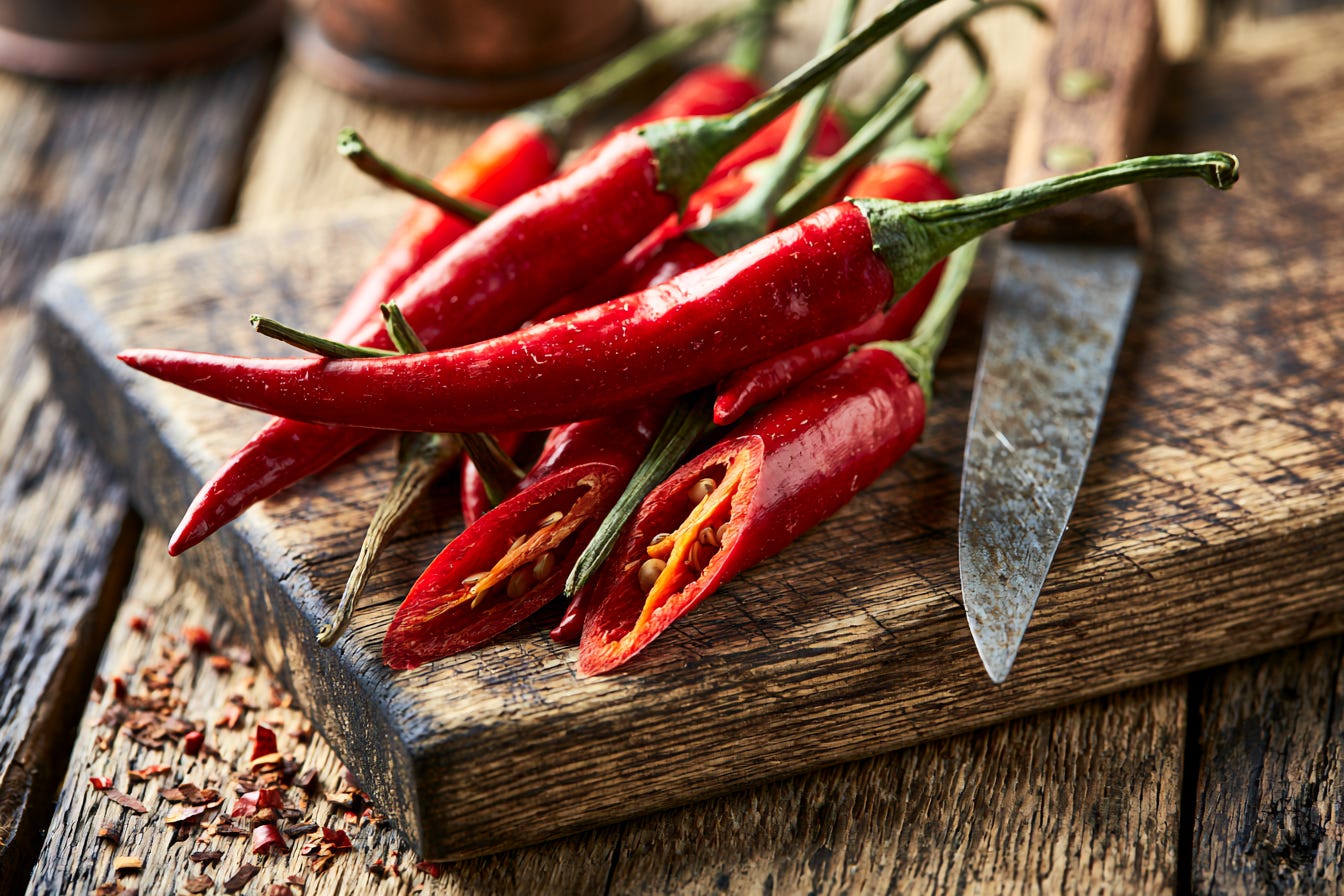
Summary: A July 13 Washington Post column, written by a gastroenterologist, begins by saying claims about the health benefits of spicy food have “a strong scientific basis,” but then spends most of its remaining words hedging on how much. The ingredient at play here is capsaicin, the compound that makes red chili peppers hot.
The column’s headline misleadingly suggests spicy food “could lead to greater longevity”—a claim unsupported by the research cited below it. Though inconclusive and sometimes contradictory, the data is still worth understanding.
The column cites two sets of research: A 2015 Chinese study that found near-daily chili eaters had a 14 percent lower risk of death, and a 2017 U.S. study indicating hot-red-chili eaters were about 13 percent less likely to die. The Chinese study asked broadly about spicy food, most of it fresh or dried chili; the U.S. study asked specifically about hot red chili peppers (or, for Gen X readers, red hot chili peppers). Neither paper looked at hotter varieties like habaneros or ghost peppers. And, it’s worth repeating, neither proves chili is the reason those people lived longer.
The column describes what red chili’s active compound does to, and for, us:
capsaicin works on so-called heat receptors, called TRPV1, scattered all over the body, from skin to gut
on the topic of heart health, the column points to observational links between capsaicin and reduced heart disease and stroke
it mentions some early evidence that capsaicin may increase “good” HDL cholesterol (small 2017 trial) and help burn a few extra calories (2024 trial)
it refers to a 2017 study finding that people who routinely eat spicy foods ate about half a teaspoon less salt a day and had lower blood pressure, in part because capsaicin makes food taste saltier
it overwhelms pain nerves (which is why capsaicin topical creams ease pain), doesn’t hurt a healthy stomach, and, at everyday doses, actually lowers acid and may even protect against ulcers.
A 2006 trial even exonerated chili as a cause of hemorrhoid flare-ups, and though the published evidence of it as either a protector or potential risk magnifier of gut-cancer picture is mixed, that evidence seems to lean toward it being more protective.
Context: Spices have been used as folk medicine for centuries, but data connecting them to how long people actually live is recent. The 2015 Chinese study above was the first large one to link regular chili eating to lower death rates; the 2017 U.S. study was the first to test whether that finding held outside Asia. A 2019 Italian study of nearly 23,000 adults pointed the same way, finding that people who ate chili four or more times a week had roughly a 23 percent lower risk of death overall. The benefit held regardless of how healthy the rest of their diet was. Pool these studies together and regular chili eaters again show lower overall and heart-related death rates, though the individual studies vary quite a bit (see this 2021 meta-analysis).
Insight: What’s still missing in this body of chili research is a study that randomly assigns people to eat chili or not and then follows their health metrics. Everything so far is observational, which means researchers can see the pattern but can’t confirm chili is driving it. Chili eaters may simply differ from non-eaters in ways no one measured. On the plus side, heavy chili eating correlates to lower death rates, and small trials hint it may increase energy burn and help the stomach lining heal at ordinary doses. On the negative side, heavy chili eating has been linked to much higher stomach-cancer risk in some populations; the stomach-protective effect reverses at very high doses; and big concentrated doses can make, to put it bluntly, your butt hurt—a trial found chili worsened acute anal fissures.
Takeaways:
If you already like spicy food, keep eating it. In the Chinese study, the benefit maxed out around 3-5 days a week.
If chilis aren’t your thing, don’t force it. There’s still no proven longevity benefit.
The most practical, testable payoff is that chili makes food taste saltier, which may help reduce high blood pressure.
Fresh or dried whole chilis beat concentrated capsaicin pills. The longevity data cited above is from people eating chili in food; the downsides (stomach irritation, worse anal fissures) tend to come from big, concentrated doses.
The eating pattern most reliably tied to a longer life remains the Mediterranean diet—whole foods, plants, healthy fats—of which chili is an optional part.
# # #
What did you think of this post? Leave a comment.
Appreciated the honest read here. Observational pattern, no proof of cause, and the advice lands where it should: keep the chili if you like it, skip the capsaicin pills. More health writing should hedge this well.
Very nice article.