


I spent the last couple weeks thinking—and the last few days researching and writing—about sex. Specifically, sex after 50 and everything it offers and doesn’t offer. (If you’re in your 40s, you are, of course, welcome. There is plenty for you here, too.)
Sex after 50 is a vast and complicated subject, and writing about it wrong is incredibly easy. So I did what any self-respecting reporter with a perfectionist streak and a hearty interest in continual, lifelong sex would do: I dove into the data, all the data I could find, to see what grand portrait would emerge about how people have sex in midlife and beyond, how they fail to have sex and how they adapt—when they can’t get what they want—to at least get what they need.
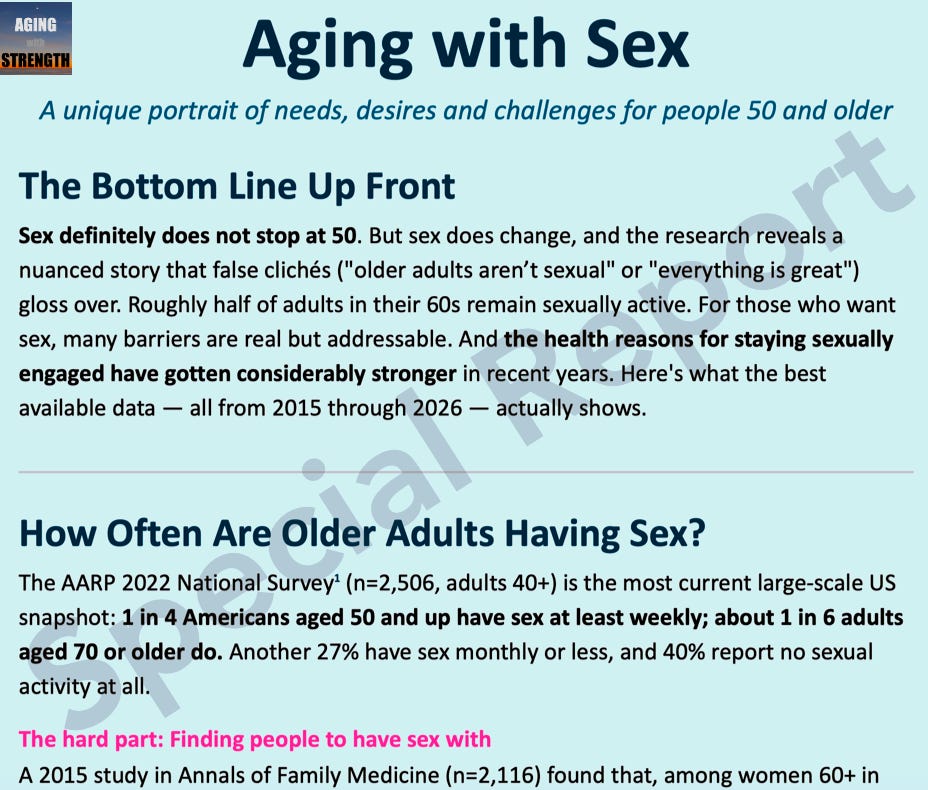
The Aging with Sex special report
I put dozens of hours of reporting and fact-checking into the 10-page report below, which paying subscribers can access. The report covers 10 topics and offers a list of summary takeaways:
How Often Are Older Adults Having Sex?
The Types of Sex Older Adults Are Having
Having Sex Is Good for Your Health
Masturbation: Important, Protective and Healthy
Polyamory and Consensual Non-Monogamy
A 30-year Sex Recession (Thanks, Internet)
Men: Erectile Dysfunction
Women: Genitourinary Syndrome & Sexual Dysfunction
Sex and Testosterone | Sex and Estrogen
Major Barriers to Sex in Europe, Australia & Asia
Takeaways: An Actionable Summary of the Data
How I reported it: I created this report by pulling together every credible study on sex after 50 I could find — 2015 through 2026, comprising a total of 39 footnoted sources. Then I ran it through more than a dozen rounds of fact-checking, with the help of two top-tier AI models I work with almost daily to analyze large data sets.
Sex does not stop at 50, and it’s good for your health
That’s the major headline of this report. Roughly half of adults in their 60s are still sexually active. But sex most definitely changes. Often the changes, whether from E.D., menopause, stress, or lack of a suitable partner, are navigable. For many many people of a certain age, sex becomes many things that are not intercourse.
The biggest barrier, according to the research, is partner availability and personal health. On a very bright note, the data now link regular sex to lower mortality, better cardiovascular markers, less depression, sharper memory.
The hitch in the story is that most older adults with a sexual problem never raise it and, apparently, most doctors rarely or never ask. That’s too bad, because many of the problems sex after 50 may present are treatable, by which I don’t mean just medically.
Over the coming weeks I’ll break down Aging with Sex into strategies, including:
the cardio and strength exercises that most benefit good sex
addressing E.D., estrogen and testosterone treatments
what happens when traditional intercourse isn’t an option
Until then, here’s the 10-page Aging with Sex special report, which provides a foundation for all the above: