


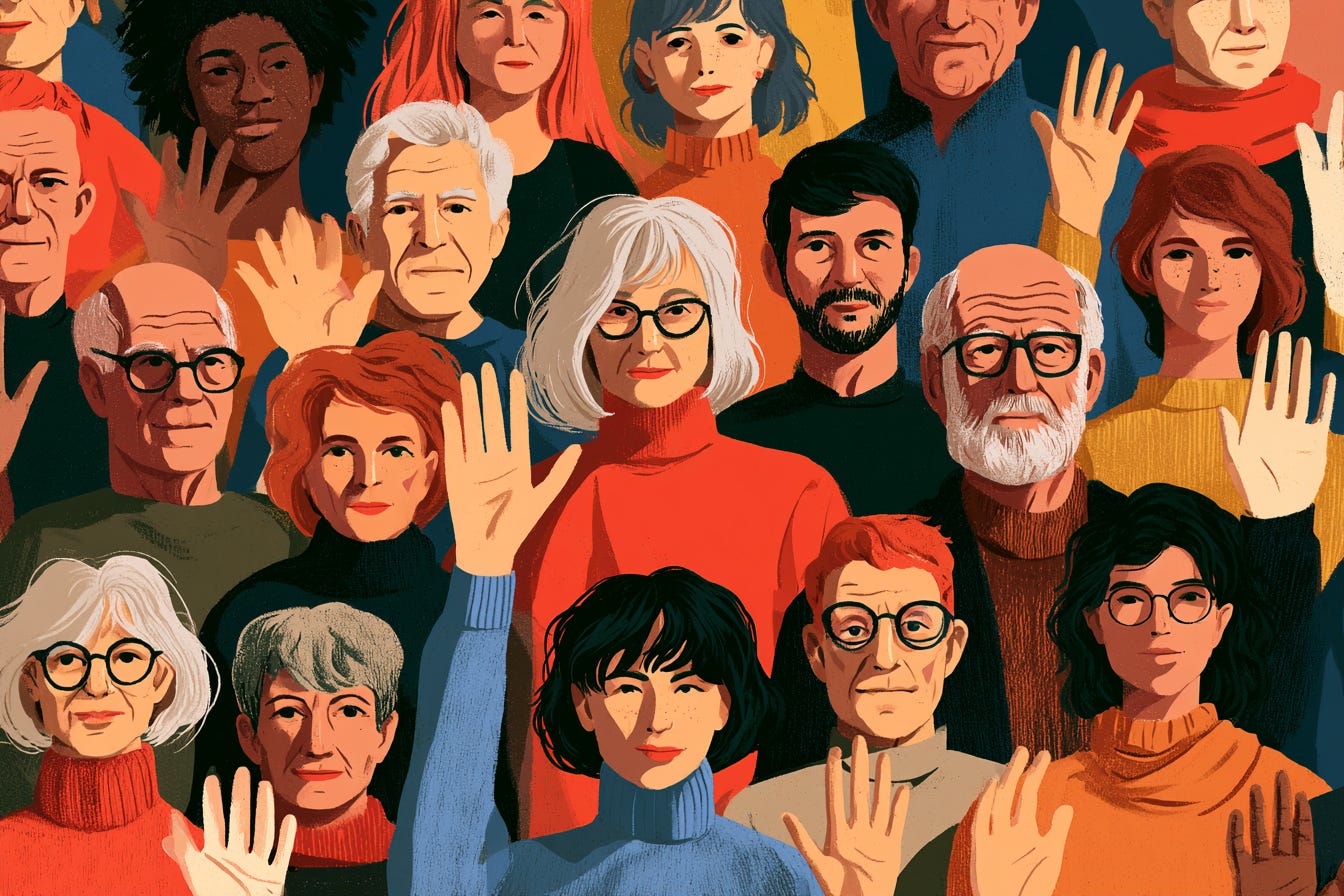
Travel has a way of exciting new ideas, new spirits, new ways of thinking. The farther from home you go, the bigger your thoughts and ideas become. During my recent two weeks in Sydney, my first experience of Australia, I caught myself contemplating the notion of becoming powerful.
I don’t mean just physically or professionally. But powerful as a human exercising full agency in life, and burning with a hard gem-like flame1.
Becoming powerful, or more powerful, after 45, after 50, after 60—a number I’m going to hit in about 4 weeks (a fact that continues to blow the mind of this surfing, sprinting, ego-lifting, occasionally sophomoric 42-year-old-at-heart2) is important and necessary, to age with maximum healthy years. I’m not arguing for the cartoon version of the word, mind you, but the more durable, effective, positive and gratifying kind of powerful, which forces us to figure out what we want from this one life.
Becoming powerful, or more powerful, is a potent form of longevity. When you approach mastery over the life areas you care about most, your relationship with the world begins to change. Negativity starts bouncing off you instead of sticking; optimism radiates from you, like a broadcast signal that beckons other like minds; and bullshit stops bothering to even ring your buzzer…or maybe you just stop noticing when it does.
I think of personal power as manifesting in six forms: physical, nutritional, emotional, cognitive, spiritual and social. (Not coincidentally, these are also the manifestations of strength this Substack is built on.) To bring those six forms to life requires building actions, habits, mindsets—choose the descriptor that works for you—that allow you to flex each of the physical form, the cognitive form, etc., as you would any developed muscle in your body.
These are my 16 moves to become powerful, or more powerful, in life’s second half. Each is strategic and effective, I’ve found—either because I’ve managed to make them habits or am finding out how difficult doing so is. I elaborate on each below.
16 power moves for your second half
Pay attention
Persist—90% of power is not quitting
Eat the Fritos, move on
Choose action over inertia
Know why you deserve it
Constantly ask “What if?”
Embrace beginner’s mind
Get wet and sandy
Schedule bullshit time
Carve and protect your morning 10
Feed your body, brain & soul
Be kind to your carcass
Look better each month
Spend your no’s
Practice mattering
Lift heavy things
How to put each power move into action
1. Pay attention
We live in a distraction economy that is lethal to a quiet mind. Your attention is a currency, and how you spend it says a lot about what you value or don’t value. I like this formula: attention = satisfaction. Each side of the equation grows or shrinks in parallel. When you talk with a friend, cook a steak, do a split squat, watch a film or debate a strategy, the level of your attention determines the quality of the outcome. Depth of focus makes people powerful.
Two Harvard guys built an iPhone app that pinged 2,250 people at random moments and collected about 250,000 reports on what they were doing and how they felt. People’s minds were somewhere other than the task at hand almost half the time. Where the mind was predicted happiness better than what the body was doing.
2. Persist—90% of power is not quitting
You may have noticed that many of my replies to comments on AGING with STRENGTH articles end with a short imperative: “Keep going.” What so often separates people who achieve big things from those who don’t is plain, boring persistence. Refusing to quit is among the most underrated personal powers.
Example: I’ve been strength training for 47 years, showing up quarter after quarter, working back from tears in tendons and holes in cartilage and grinding through the misery of working my way back from weakness and schlubbery after each of my seven orthopedic surgeries. I didn’t persist because I wanted muscles so badly but because I had trained my body and brain to want the feeling of working those muscles. I knew my why, and it kept me coming back, even after months-long surgery recoveries.
Persistence = expertise. Not to get Gladwellian, but I figure I needed about 10,000 hours to develop my expertise in writing, strength training, parenting, curling a soccer ball into the upper 90, and journalism. I’m still working on surfing, tennis and Substacking.
Becoming an expert through persistence makes you powerful.
3. Eat the Fritos, move on
If you’re like me, you will eat the entire, party-size bag in one sitting. This will happen on a random Tuesday evening, whereupon you decide that your incandescently poor food discipline means you’re just a flabby, undisciplined piece of crap who, late in his sixth decade, is not worthy of his lofty goals (more on that in #5, below). Self-condemnation is not powerful. Powerful is forgiving yourself for not being a machine, taking a moment to inquire what may have prompted the lapse, and resolving to only eat half the bag next time. Self-empathy = strength.
Two Berkeley psychologists ran four experiments on exactly this question: does going easy on yourself after a screwup make you soft? To the contrary. People told to respond to a personal failing with some self-directed kindness came back more motivated to fix it, and studied harder after a bad test, than people who got a pep talk about self-esteem.
4. Choose action over inertia
I’m convinced that most powerful people have watched “Santa Claus Is Comin’ To Town,” the 1970 stop-motion animation classic, because they all do what Kris Kringle preaches: Put one foot in front of the other. Powerful people keep moving forward, they choose creating over deliberating, and accept imperfections as a cost of labor. Progress = balance. My least productive weeks are the ones I spend going backwards: re-reading, re-tweaking what I’ve already published instead of churning out the next imperfect article, live interview or audiocast. Reviewing what’s already done may feel like work, but it’s yesterday’s. Becoming powerful means habitually pushing into new territory—just like young Kris Kringle.
Steven Levitt built a website where people stuck on a real decision—quit the job, end the relationship, move—flipped a virtual coin and reported back. More than 20,000 coin tosses later, people the coin told to make the change were more likely to make it, more satisfied with the decision, and measurably happier six months on than those told to stay put.