


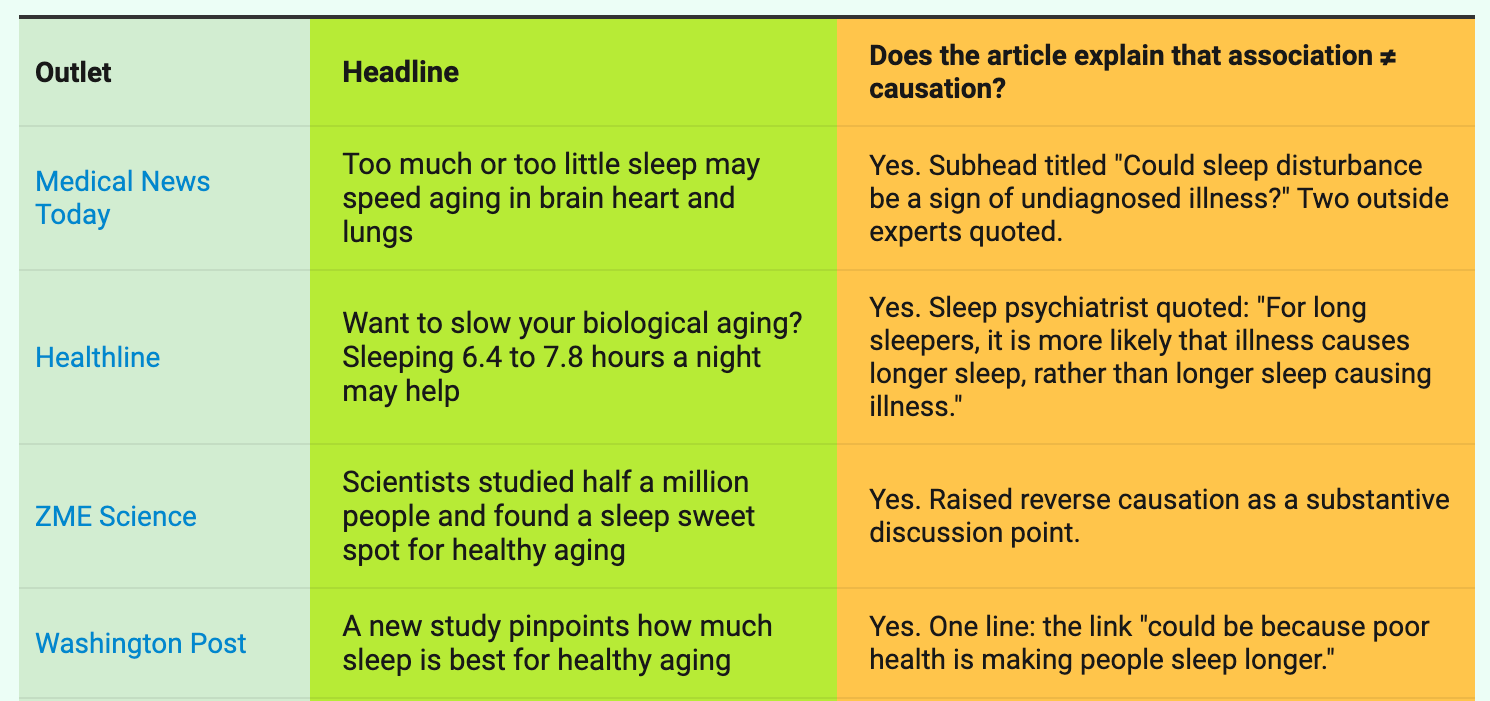
The Wellness Industrial Complex is now worth $7 trillion. New research examined the association between how much sleep people get and how fast their organs are aging. Most media sites that covered this research published recklessly misleading headlines about what the research actually showed. See the chart below, with links to each article.
Even the Washington Post—which is still capable of quality reporting, whatever one may think of it now—ran1 a blatantly deceptive headline above a relatively accurate article that highlighted the appropriate caveats on the limitations of this new sleep research (which shows that 6 to 8 hours is what most healthy people should aim for.)
Why this matters: We all need to become better informed consumers of information that, by design or just bad reporting, so often misstates facts and misinforms the public about effective aging science, routines and supplements.
In other words, longevity literacy is a critical skill. Here’s why.
New research linking sleep duration and organ aging
A new study of about half a million British adults found a sweet spot for sleep duration: people sleeping between 6.4 and 7.8 hours a night had the youngest-looking organs. Organs of people who slept outside that range showed signs of faster biological aging. People outside this range also had higher rates of 153 diseases and were likelier to die during the follow-up period.
The catch, which the researchers themselves flag: the study shows that long sleep and poor health travel together, but not which one is driving, so to speak. Put another way: correlation of faster aging to shorter or longer sleeping patterns doesn’t prove causation, it merely proves (or strongly suggests) a link between them.
Indeed, the likeliest story is that longer sleeping times are often a symptom of an illness already in progress rather than a cause of faster aging. So the illness or disease may be driving the sleep lengths, instead of the other way around.
With that in mind, look at how most media headlines2 on this study falsely made sleep the action that drives aging, even in cases where the article underneath the headline provide the appropriate caveats:
What would you like to AGING with STRENGTH investigate in upcoming posts?
After publishing, the Post updated its headline from the original to the more accurate, “A sleep-time ‘sweet spot’ is linked to healthy aging, study finds.” But the first paragraph of the article misconstrues the research findings by stating that it “suggests that too much sleep also may not be ideal.”
Some headlines may have been updated to reflect more nuance in the two days since I first canvassed all the media organizations in the chart.
interesting analysis. Headlines are merely catching eyeballs. The article, if anyone gets around to reading it, is where the meat is. One of the most overlooked predictors of positive aging isn't what we do when we're awake. It's what happens when we're asleep.
Most people are trying to out-exercise, out-supplement and out-optimize a sleep deficit. And biology doesn't negotiate.
Sleep is when your brain clears waste products linked to Alzheimer's disease. It's when memories are consolidated. It's when hormones regulate appetite, recovery and metabolism is reset. It's when the body repairs muscle tissue and regulates inflammation.
Yet somehow sleep has become the first thing we sacrifice and the last thing we prioritize.
The science is pretty clear. Poor sleep has been linked to increased risk of heart disease, stroke, obesity, diabetes, depression, cognitive decline, and dementia. It affects reaction time, emotional regulation, decision-making, and recovery.
Paul, I believe your statement--that the likeliest explanation for this study's findings is that illness disturbs sleep rather than too little or too much sleep causes illness--is itself an unsupported "headline." This is a highly sophisticated set of analyses in a very large population, using Mendelian randomization, propensity matching, and non-linear structural modelling to explore that very question, is sleep duration or disease the causal agent. These are not lightweight academics looking for a quick pub and a flashy headline. If you read the article carefully, including the supplements, you will come to appreciate their conclusion, that potentially modifiable sleep duration probably explains most, but not all, of the association(s) between insomnia/hypersomnia and a wide range of biologic markers of accelerated aging. This is an important study.