



Don’t pump up the volume (and, for the love of all that is good and decent, don’t pump up the jam, either—both are awful 1980s songs). Instead, if you want to maximize the benefits of the time you spend working out: Pump up the intensity.
Two recent studies each make this point rather clearly. So as you head into your weekend routines, consider the quick takeaways.
Actionable takeaways from this post:
💡 Intensity beats volume: adding short bursts of vigorous effort to your weekly routine cut the risk of eight major chronic diseases by 29% to 61%, even when total exercise time stayed the same. read the study
☛ If you can run, do it in short bursts a couple times a week. Even for 20 seconds
☛ Do 10 squats holding a weighted ball or dumbbell, during the commercials
☛ Take the stairs…as fast as you’re able (and if possible, two at a time)
☛ When all else fails: jumping jacks for the daily heart-raising win!
💡 Walking is America’s favorite workout, but only about a quarter of walkers hit federal activity guidelines — pair your walks with weightlifting or a conditioning routine to actually meet the mark. read the study
☛ keep walking, but start and end walks by spending 2 minutes lifting something heavy
☛ if you walk often, consider carrying light weights or wearing a weighted vest
☛ a bag of garden soil or fitness sandbag are excellent ways to add weight to daily movement
Training harder, even briefly, beats logging more easy/moderate minutes
A new study of nearly 100,000 adults wearing wrist accelerometers (so, no self-reporting problems that confound other studies) found that how hard you exercise matters more than how much.
People whose workouts included more than 4% vigorous activity had a 29% to 61% lower risk of contracting eight major chronic diseases—heart attacks, stroke, heart failure, atrial fibrillation, type 2 diabetes, autoimmune diseases, fatty liver, lung disease, kidney disease and dementia. They also were found to have a lower risk of death from any cause. The benefit held regardless of total exercise volume.
For some conditions, like autoimmune diseases and dementia, intensity mattered far more than volume. For others, like diabetes and kidney disease, both counted roughly equally.
In case you missed it:
Walking is good, but it isn’t nearly enough to maintain muscle
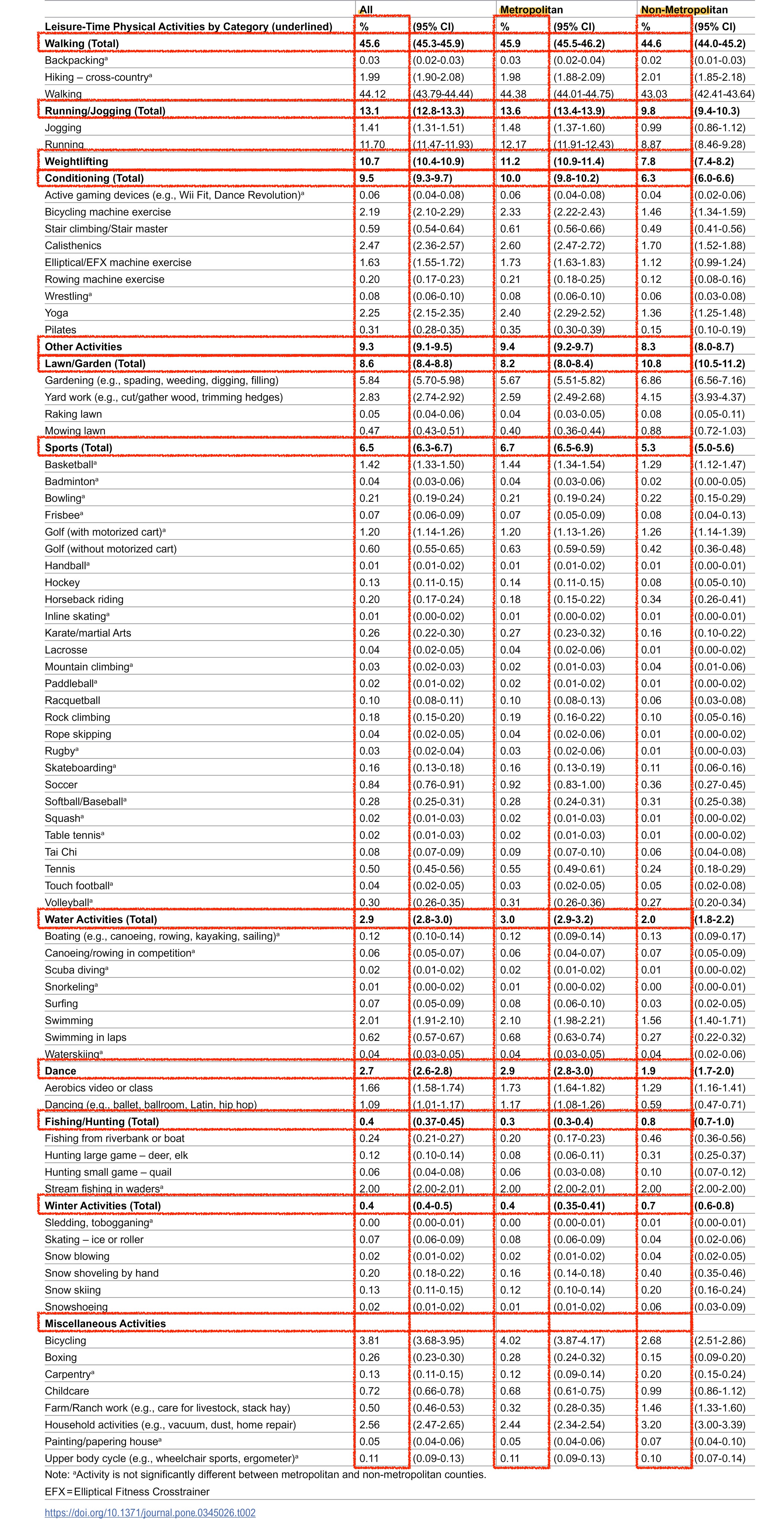
New research on nearly 400,000 American adults, drawn from a big annual CDC health survey, reveals that people who list walking as one of their top two exercise activities were among the least likely to hit the federal exercise guidelines (150 minutes of aerobic activity a week, plus two weekly strength training sessions), and about 23% of walkers met neither target. By contrast, people who ran, lifted weights, did conditioning work or danced cleared the combined guidelines at rates of 45% or higher. The authors call it discouraging that America's favorite exercise is also one of its least effective at the recommended dose, and they suggest pairing walking with something more demanding—like strength training—rather than treating it as a complete fitness program on its own.
I’ll leave you with this sobering chart from the above study, which tells several interrelated stories about the current state of American physical health:
The fractions of Americans who engage in physical activities
Enjoy the weekend and, by all means, keep going.
Regarding walking: I completely agree that "strolling" (because let's face it, that's what most people who walk do) isn't enough. Just wanted to chime in that there is one type of walking that is enormously beneficial: hiking. But even here, many people interpret "hiking" as "putting on some burly shoes or hiking boots and going for a relaxed, flat stroll in the woods."
That isn't hiking. True hiking is to walking what running is to walking. First and foremost, it involves walking uphill, quickly...and not just a gentle slope, but STEEP uphills. Many people who say they hike avoid going uphill like the plague. You should not only go uphill, but you should LIKE going uphill. And trust me, comparative heartrate studies show numbers for hiking up steep hills to be equal to numbers for running, even sprinting.
A good hike is actually more like high intensity interval training than steady state, because the ideal terrain changes: you go up, you go down, then you go up again, even more. Add to the uphill part gnarly trails (not baby-bottom-smooth wood-chip paths) filled with rocks, and it becomes even more challenging, because now it's become exercise for balance and ankle strength.
I realize not everyone can hike like this, nor does everyone have access to anything but perfectly flat, smooth paths. Obviously you should use what you have. But it's important to distinguish between what I call "true hiking" and just "strolling in the woods." They are two entirely different things.
If you hike with a GPS and record your track, then aim for a minimum of 1,000 feet of elevation gain (the total vertical distance you climb while hiking) in every hike. That's pretty much guaranteed to repeatedly get your heartrate up into the 150-180 range (depending on steepness).
Hi Paul, At 85, I'm teaching an exercise class to older women. The youngest is 75 and the oldest is 87. It's a small class (6-10) so I can watch them. We do 30 minutes of aerobic dance, 20 minutes of weight work with light weights (no more than 3 lbs) and standing beside a chair so that we can do leg strengthening as well. Then a 10 minute sitting stretch. It's a pretty balanced class and they love it!