


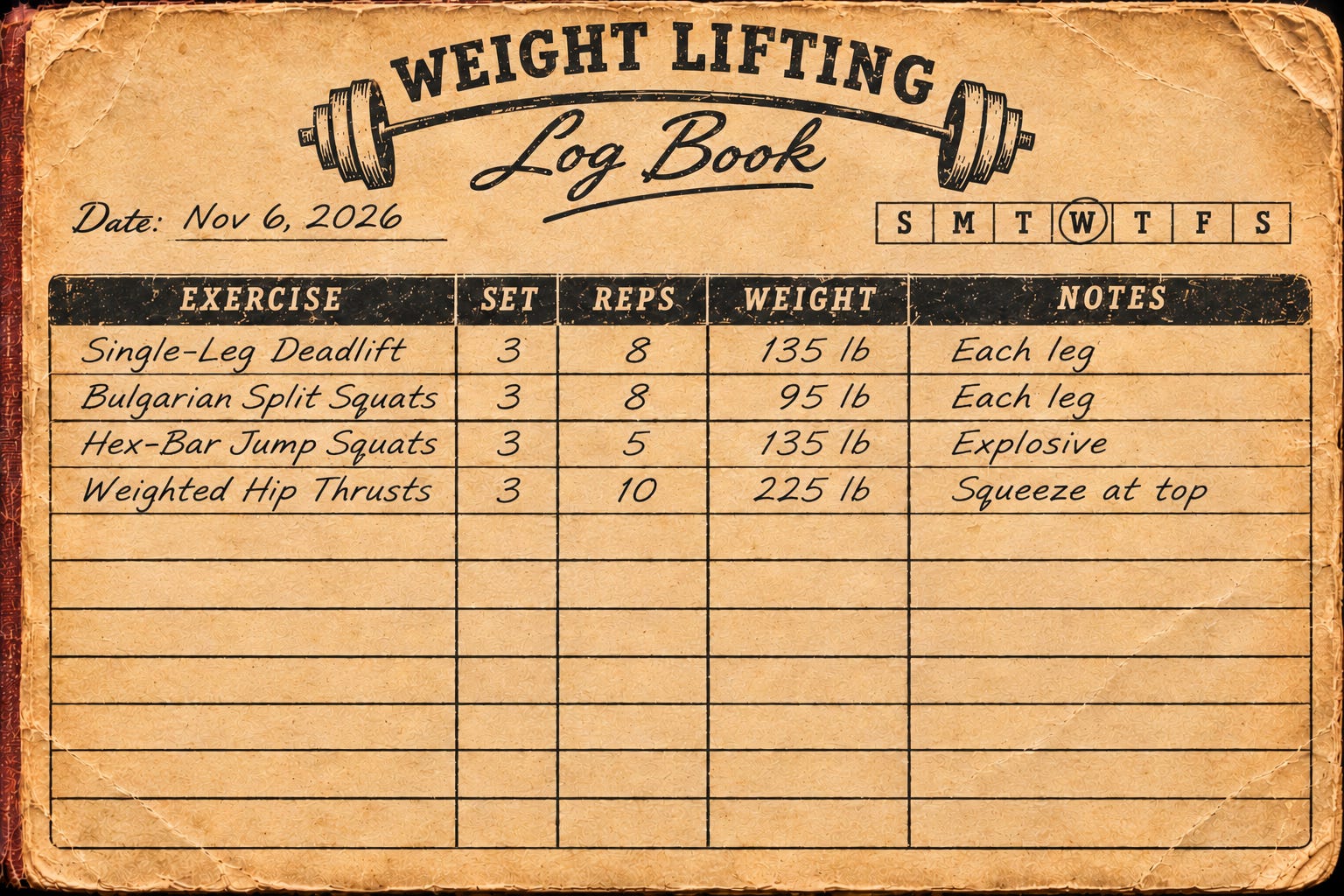

I’m often asked about how many sets and reps I recommend for my bodyweight-only #WorkoutWednesday videos and the weighted Move Like It’s 1899 routines. They’re good questions that, to be candid, almost always catch me off guard.
Not because “how many sets?” and “how many reps?” aren’t important questions (they are) or because the answers are obvious (they’re not). Rather, the questions smack me in the face, I realize now, because, after 48 years of strength training, sets and reps are no longer unknown factors in my basic strength-training equation.
That equation1 being:
(≥60% of 1-rep max weight × ≥50% max reps per set) +
(≥70% of 1-rep max weight × ≥75% max reps per set) +
(≥80% of 1-rep max weight × ≥85% max reps per set) =
noticeable strength & power gains
Here’s how that equation translates into words: I start with a relatively easy warm-up set in which I lock in good form (and test for any unannounced hitches, glitches or pains), followed by a second set where I move closer to my maximum weight and edge closer to my maximum number of reps, followed by a third set where I move pretty close to the maximum weight I could lift once, and do that set almost to failure.
Reducing all that to just one sentence: I do at least three sets of every weighted exercise and push the last two set until the reps in each become what I’d call too uncomfortably uncomfortable. (I rarely if ever lift to failure nowadays, unless I’m doing eccentric strength training. Mostly because muscle size isn’t as important to me now as building neuromuscular strength, power and muscle-group balance.)
Those three sets, usually done with minimal rest in between, act as a quasi-HIIT workout, especially when working those big muscle groups in your butt, legs, chest and back, and result in what I’d call “noticeable strength and power gains.”
In case you missed it…
Caveat: I don’t always do only three sets, following that same equation with those same ratios. Really, my routine depends on several X factors—mostly those I bullet list below. Though I almost always do at least three sets, I’ll often do four, sometimes even five sets of a given exercise, where the last two are usually at the upper range of my maximum weight and rep threshold.

Why “how many reps & sets?” is so hard to answer
What I’m describing, repeated over weeks with gradually heavier weights, is classic progressive overload: the gradual increase of weighted stress to create greater muscle strength and endurance. And mass, if you’re into that.
But not everyone needs to, or should, practice progressive overload with weighted exercise. On many gym days, I shouldn’t. Sometimes I’m not in the right frame of mind, or I don’t have time to do it with good form, or something in my body feels off. And that’s what makes questions about the right number of sets or reps tricky to answer: there are so many questions that inform a workout that you—each of you—would define as successful.
Including:
what’s your training goal—mass, strength, power or just “get off my ass for 10 minutes and do something”?
how trained are your muscles and nervous system, how deeply do you understand them and how smoothly do they work together already?
is your tank full today, or are you operating on a mental, physical or emotional deficit?
how far is your mind willing to push your body to squeeze out reps when your muscles are burning? There’s no way if there’s no will.
other than strength, power or size, what makes a workout feel good for you?
Each of these questions surely changes how many reps and sets each of us will do for any given strength routine on any given day.
I’d love to hear your thoughts, comments, reactions, counterarguments and criticisms.
You can adopt this equation for your workouts, if you know your one-rep maximum weight for a given exercise, ie, the most weight you can lift once with good form. If you’re new to lifting or over 50, you can estimate it. Pick a weight you can lift between three and 10 times, do as many clean reps as you can, then use this formula: weight × (1 + reps ÷ 30). For example, if you can lift 100 pounds 10 times, your estimated one-rep max is about 133 pounds. In my formula, that would put your 60% at about 80 pounds, 70% at about 93, and 80% at about 106. Treat the result as a rough guide, not a prescription.
Very interesting - thank you for the data.
I turned 50 this year and got back into the gym after a (basically) 20 year break. I knew I couldn't lift like I did in my 20s and 30s and I was also aware that the science of resistance training was far more advanced. So I turned to ChatGPT for advice.
My stated goal was overall health and hypertrophy. I'm not looking to get ripped, but I definitely wanted to look better than I did.
So Chat created a 3 set workout that goes 3 RIR, 2 RIR, 1 RIR. No failure. Ever.
I was skeptical but I went with it. The results are amazing. Noticeable muscle growth within a week and now three months down the road it continues. But better than that I feel stronger and healthier rather than just look stronger. I also have much less recovery pain because I'm not going to failure.
I'm guessing by not going to failure my power ceiling isn't climbing as fast as it could though?