


What’s News? is a critical look into the latest aging & longevity news and ideas.
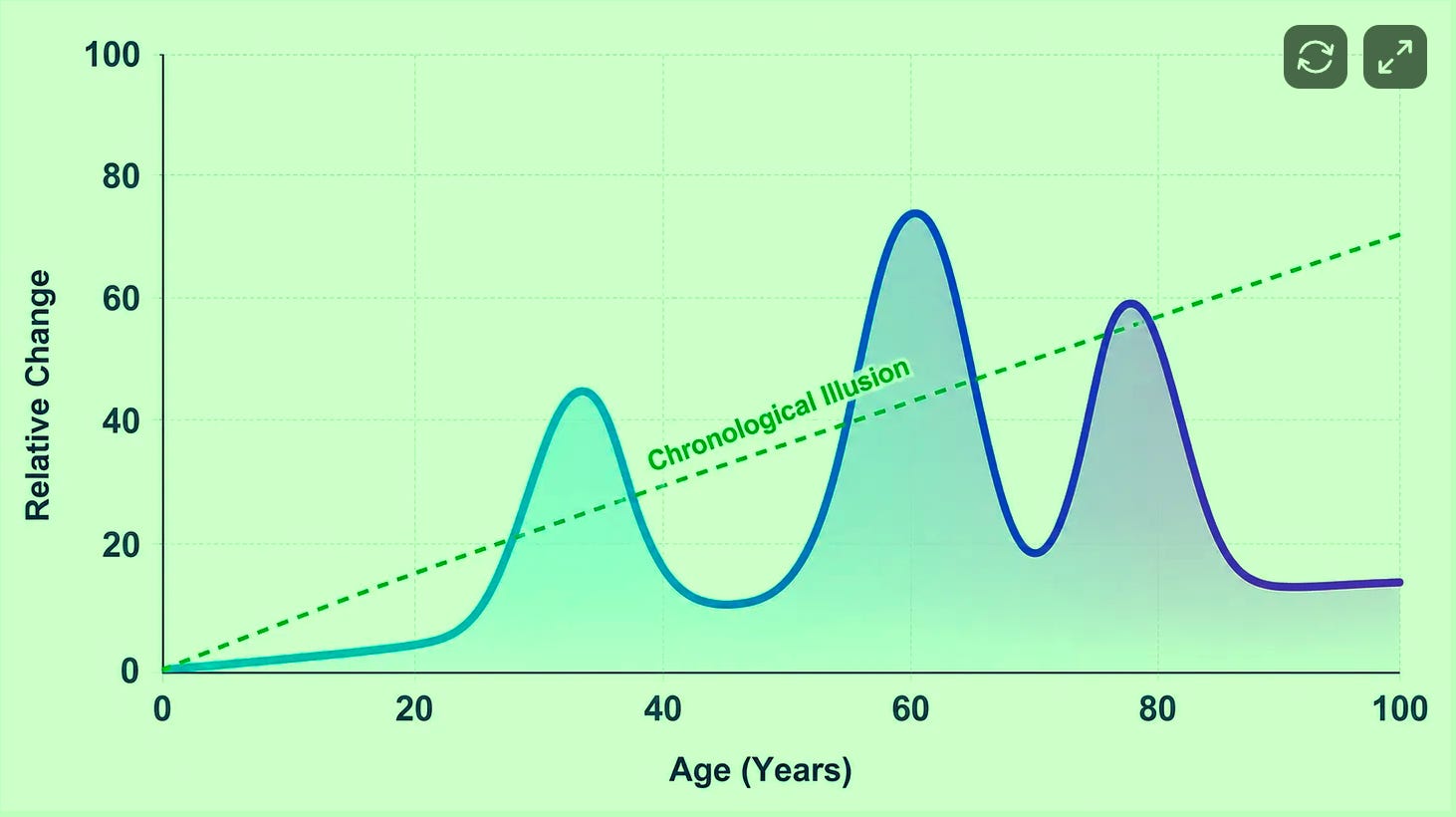
Summary: Dr. Eric Topol this week translated an invited review he and Stanford's Tony Wyss-Coray just published in Nature Medicine, “Biological Aging Clocks in Health and Disease.” The bottom line up front is that your birthday is a lousy measure of your age, and we can finally do better. Large-scale proteomics—reading thousands of proteins from a tube of blood, then letting AI sort out which ones track which organ—has debunked the idea that we age at a steady, linear clip. Multiple studies now point to three distinct waves of aging clustering around 34, 60 and 78. Worse (or better, depending on how much you really want to know), our organs don't age in lockstep. In Britain's National Survey of Health and Development, 1,800 people all born in the same week of 1946 were tested at age 63; their organs and immune systems spanned roughly a 10-year range in biological pace. But this “ground truth” goes deeper than organs. A study published two weeks before this review assessed more than 40 cell types across more than 60,000 people, and found about 1 in 4 had accelerated aging in at least one cell type. People whose brain astrocytes (cells that support neurons) aged fast developed Alzheimer's at 12.6x the rate of those whose astrocytes aged slowly. Among people carrying two copies of the APOE4 risk allele, the gap approached 40x. Two systems keep surfacing as gatekeepers: the brain and the immune system (Topol’s excellent book, “Super Agers: An Evidence-Based Approach to Longevity”—more on that below—also discussed these two organs as drivers of human aging). When brain and immune system age at a normal pace, survival over 15 to 17 years approaches 100% even when other organs are aging badly. His closing thought is classic don’t-buy-the-longevity-bullshit Topol advice: do not buy the direct-to-consumer aging tests currently on the market. The methylation-based clocks being sold now, Topol writes, lack standardization and reliability and (surprise! not surprised) cost a fortune. The organ and cell clocks with real promise are not commercially available yet.
Context: Topol—a cardiologist, the founder-director of the Scripps Research Translational Institute and a shrewd arbiter of health science and research—produces one of the best publications on Substack, regardless of category. (Last year, I sat down with him in person for nearly three hours to discuss the biggest insights from the “Super Agers” book. Read Part 1 of our lengthy Q&A here; Part 2 is here.)
Insight: This is the rare longevity post that tells you not to spend money. Topol argues that biological age is finally becoming measurable at a granular level and, critically, that it appears to be modifiable: the NSHD organ clocks were worsened by adolescent overweight, smoking, lack of education and life adversity; they were protected by sustained physical activity, among other factors. But the field's commercial edge is racing ahead of its evidence base, and the Longevity Industrial Complex will happily sell you an "epigenetic age" today. Topol is launching a randomized trial this month to test whether aggressive lifestyle change with 24/7 coaching lowers Alzheimer's biomarkers in high-risk people.
Takeaways:
Aging isn’t a smooth slope. It comes in waves—at roughly ages 34, 60 and 78.
Your organs age at different speeds. In a cohort of people born the same week, organ ages varied by about a decade.
The brain and immune system look like the master switches. When they age normally, survival stays remarkably high even if other organs are struggling.
Lifestyle shows up in the proteins. Sustained physical activity was one of the protective factors. Smoking, adolescent overweight and chronic adversity did the opposite.
Don’t waste money on an aging clock right now. The tests on the market lack standardization and reliability. The good ones aren’t for sale yet.
Read the big numbers carefully. The 12.6x and 40x Alzheimer's figures come from observational studies. They show a clock predicts disease. They don't yet show that changing the clock prevents it. That's what Topol's new trial is designed to find out.
# # #