


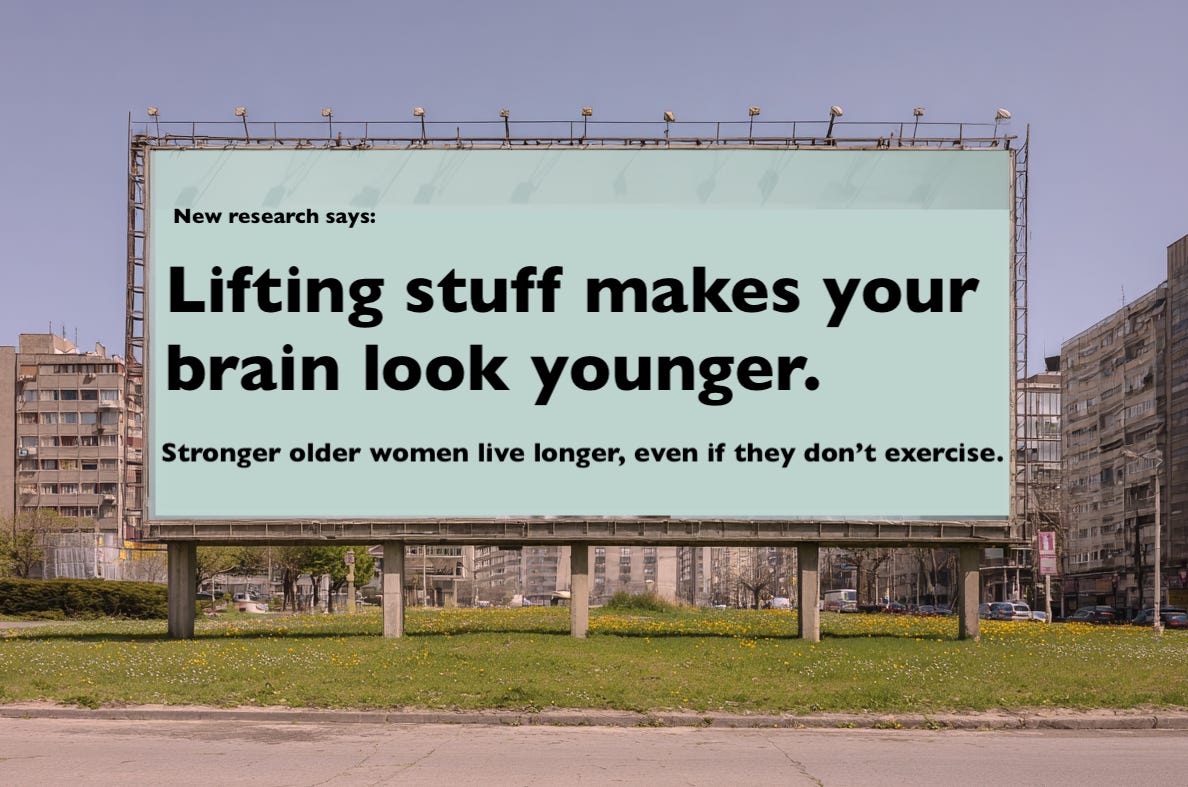
Five recently published studies, summarized below with links and takeaways, harmonize around a few important themes for aging with strength:
Move your body daily & lift some moderately heavy stuff a couple times a week
Build regular meals around plants, nuts & seeds, fiber and olive oil, with lean, unprocessed protein
Protect your sleep & be skeptical of supplements — most of the benefit other people claim from them depends on gut bacteria you may not have
The five studies below suggest strength and healthy meal plans are the two levers that keep you, your brain and the rest of your body as young as possible. Both are free, both are boring, and both—with a smidge of discipline—allow you to build muscle, slow brain aging, improve gut microbiomes and lower the inflammation that data suggest drives nearly every age-related disease.
In case you missed it:
DISCLOSURE: I used a paid, upper-tier AI model to distill these five research papers into the concise summaries. Links to each paper are provided.
Lifting weights makes your brain look younger
A two-year randomized trial published in GeroScience in February 2026 found that older adults who lifted weights had brains that looked measurably younger on MRI scans. Researchers in Copenhagen and Chile split 309 adults aged 62 to 70 into three groups: heavy lifters training three times a week, moderate lifters training once a week with home workouts, and a control group that did nothing strenuous. Both lifting groups came out two years “younger” on brain scans, the study found. The control group didn’t budge.
Takeaways:
The benefit held a full year after training stopped
Moderate lifters got results as good as the heavy lifters; you don’t need to train heavy
Consistency matters more than intensity; two sessions a week is enough
Different parts of your brain age on different genetic timers
USC researchers published the first study mapping how genes drive aging in specific regions of the brain, rather than the brain as a whole. The paper, out in GeroScience in December, used MRI scans from 41,708 people in the UK Biobank. They trained a computer to estimate how old each tiny piece of brain tissue looked, then checked which genes tracked with faster or slower aging in each region. They found 1,212 genetic variants that matter. Some genes accelerate aging in the areas that break down first in Alzheimer’s. Others protect the areas that go first in frontotemporal dementia.
Takeaways:
Your brain doesn’t age as one organ but in pieces, on different genetic schedules
Those schedules are partly set before you’re born
In the future, a cheek swab might tell you which parts of your brain are most vulnerable, years before symptoms show up
Eating less is still the best way to live longer, but it’s tough
A major review in Nature Aging in March confirmed what researchers have known for nearly a century: eating less extends life; nothing else comes close. The review, written by longevity scientists from Oslo, Johns Hopkins, Wisconsin, the National Institute on Aging and University College London, synthesized decades of animal research. Humans are harder. A two-year trial called CALERIE asked people to cut calories by 25%. They only managed 19.5% for six months, then dropped to 9.1%.
Takeaways:
Eating less extends life in animals, but it’s not feasible or fun for humans
Humans saw better cholesterol, lower blood pressure, and slower biological aging
Restricting calories isn’t healthy: mice on deep calorie cuts die faster from infections like the flu, and their wounds heal slower
The study authors also flag Ozempic and similar drugs as a new way to get the benefits of eating less without the hunger
Your gut bacteria shape how you age
A review in Nature Reviews Endocrinology earlier this year made a simple case: the bacteria in your gut help determine how you age, but they’re so different from person to person that generic advice rarely works.
Italian researchers pulled together the evidence showing that aging in Western populations shifts gut bacteria toward an unhealthy mix—less diversity, fewer good bugs, more inflammation-causing ones. This fuels the slow-burn inflammation that drives frailty.
The most interesting data come from people who live past 100: their gut bacteria get rearranged in a very particular way, with more of the anti-inflammatory strains.
Takeaways:
Probiotics help a little, but not much
The Mediterranean diet helps more, especially if you’re coming from a fast-food baseline
Whether you benefit from polyphenols in berries, nuts, or pomegranates depends on whether your gut carries the bacteria that activate them—most older people don’t
Movement and sleep feed the good gut bacteria
Don’t trust supplement claims—what works for your friend may not for you
Stronger older women live longer, even if they don’t exercise
Researchers at the University at Buffalo and six other institutions tracked 5,472 women aged 63 to 99 for more than eight years. Each woman did two simple tests at the start: squeezing a grip meter, and standing up from a chair five times. They also wore activity trackers for a week. Nearly 2,000 women died during follow-up. The weakest had three times the death rate of the strongest, according to the study, published in JAMA Network Open in February.
After the researchers controlled for everything they could, including age, weight, smoking, chronic illness, inflammation, how much the women actually moved and even how fast they could walk…
Takeaways:
…Strong women still had a 33% lower risk of dying (these were all women past menopause)
The effect held in women who barely exercised at all, and in women who used walkers
Was this post helpful, a colossal waste of time or something in between? Let me know what you’d like to see covered more, or less, in a comment.
This is so helpful! It reinforces what I’ve been hearing: 2x/week moderate but somewhat challenging strength training, especially if doing complex moves to target multiple, opposing muscle groups, pays big dividends. I’m 65 and only recently developed a consistent 2 x/week strength training habit. I’m seeing positive results. I’m glad to learn it’s helping my brain too!
Thanks for the disclosure of your use of AI—some Stacks are spitting out tons of data/essays/books—so much so it has to be largely AI generated—-it’s clogging my inbox. I unsubscribed due to info overload.
Not your post here—prudent use of AI but collated by a human!
This is just me observing how people age in more remote places, like the mountain town I live in, but those still involved in heavy physical work (chopping wood, gardening, plowing, planting, harvesting) are visibly aging better than those who are not. Men stay active until late years. My neighbor is 83 and fitter than I am. Women live longer on average but are less involved in load bearing activities, and the cognitive decline is more visible. I wonder if this has something to do with decades of different physical load?