




Last month was not a good one for “longevity journalism.” Two national magazines with storied histories published articles that treat a Harvard geneticist known for lying about his scientific achievements as a wunderkind who’s about to solve aging.
Here’s Time magazine on Aug. 20: “David Sinclair’s Research Is Now Testing Whether Blindness—and Aging—Can Be Reversed.” The headline presents what Sinclair hopes the research eventually leads to as what it’s currently testing. When a headline is demonstrably false, as this one is, you wonder whether the reporting under it is worth a damn. It’s not.
Two weeks earlier, National Geographic ran a 5,100-word feature under an even more preposterous headline, “Are We on the Brink of Ending Aging?” I’ll save you an hour: no, and we’re not even close. Even the article’s hero—David Sinclair, credulously quoted issuing one unproven assertion after another as if they’re facts—admitted that much.
‘He has a long track record of doing this’
The irony of featuring a known scientific prevaricator like Sinclair, who in 2024 was forced to step down from the Academy for Health and Lifespan Research for lying about having reversed aging in dogs, was not lost on his former colleagues.
“David is particularly effective at taking credit for and running with other people’s work,” Matt Kaeberlein, a respected longevity scientist who worked with Sinclair years ago, wrote in an email in response to my questions about the two media articles.
“He has a long track record of doing this: rDNA circles (Brad Johnson),1 sirtuins (Lenny Guarente, my PhD work with Mitch McVey),2 NAD-CR-aging axis (Su-Ju lin and Shin Imai),3 epigenetics in aging/information theory (a bunch of different people way before he ever brought it up),4 reprogramming for aging indications (Yamanaka —> Belmonte and others).”5
“Getting the media to buy into the narrative is part of the magic,” Kaeberlein said. “It’s a genuine talent.” (Note: I added the footnotes to Kaeberlein’s quote.)

A failure to report on the longevity industry with skepticism
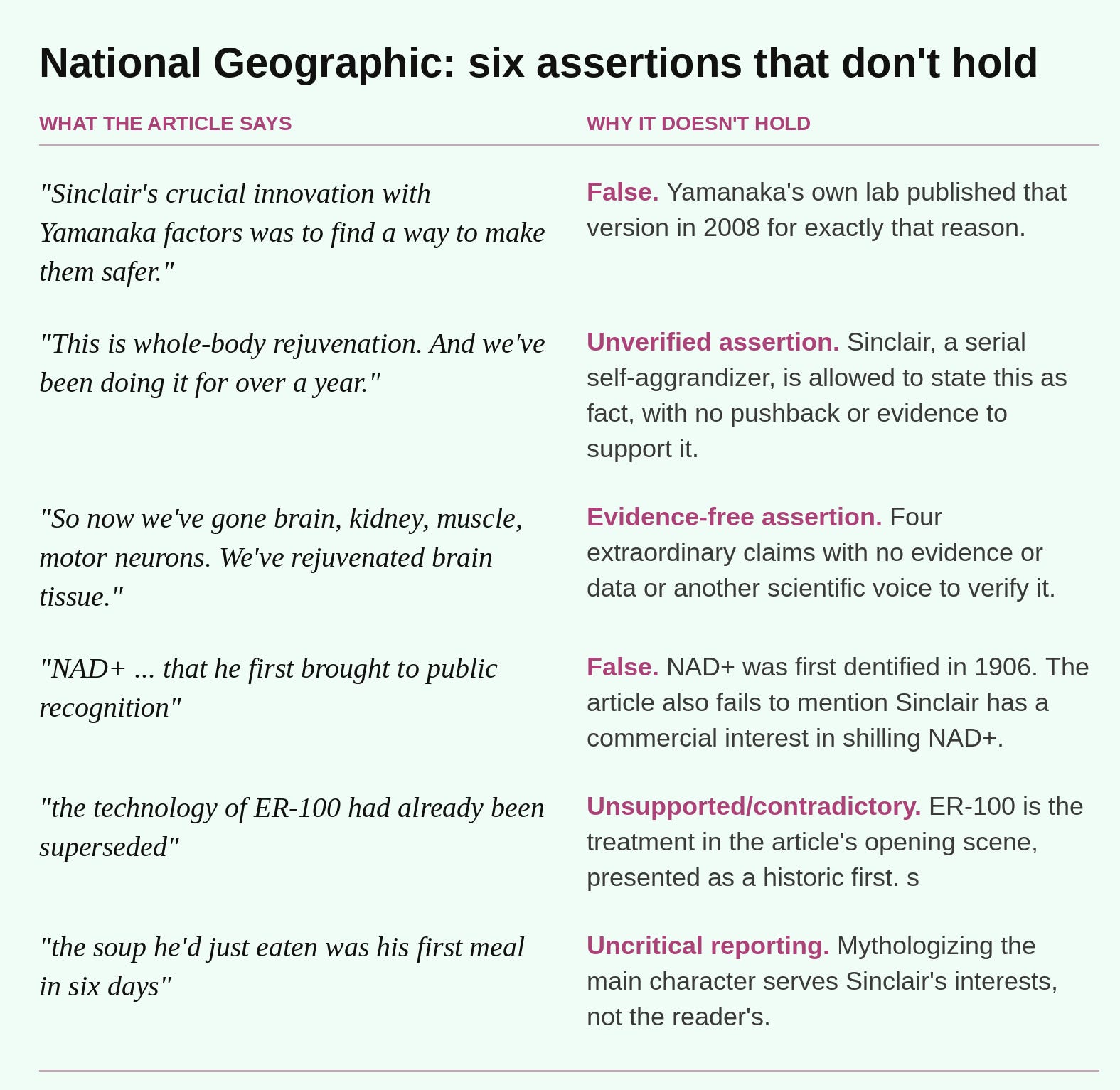
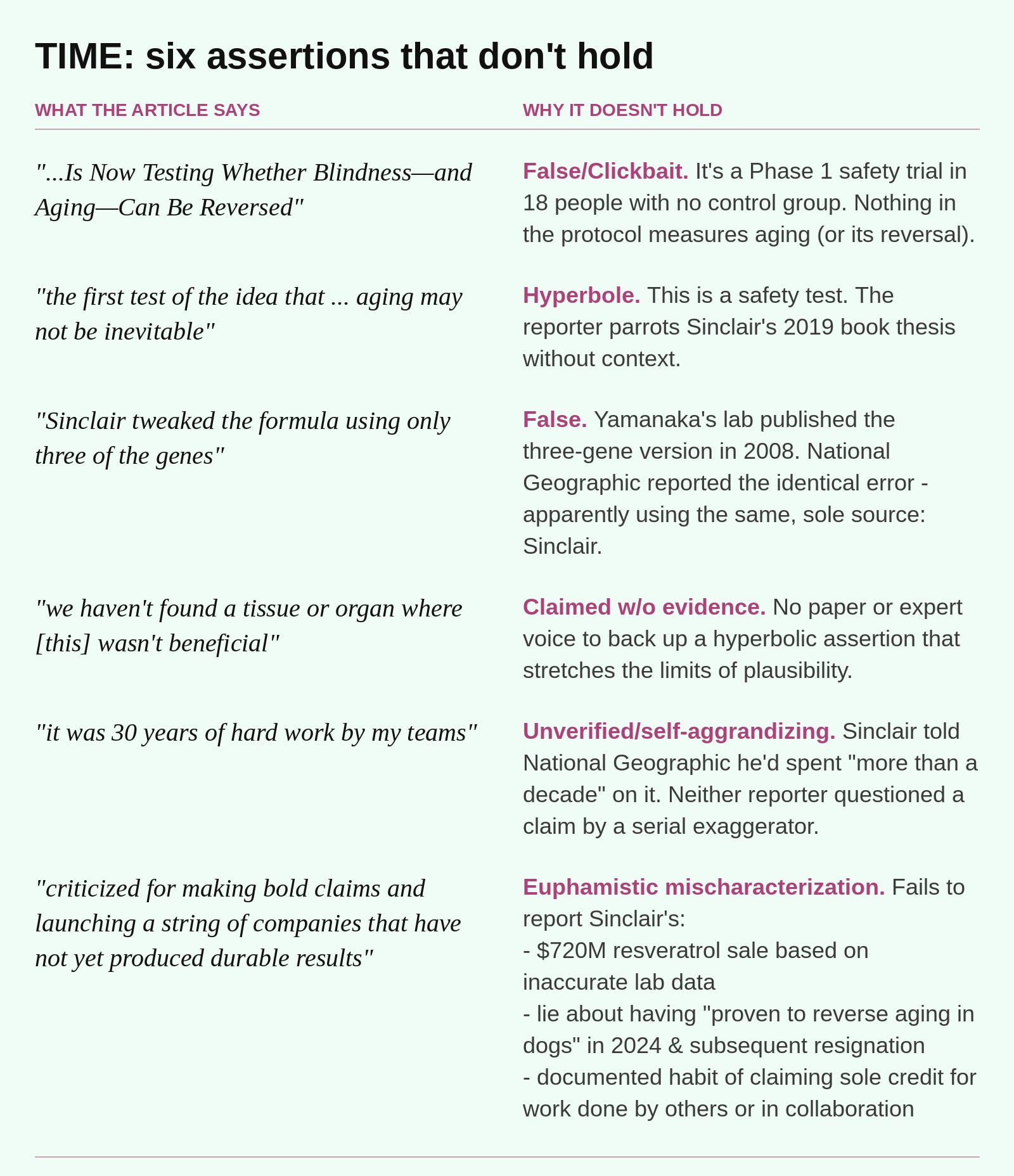
Below, I categorized the most impressive failures of the National Geographic feature, a 5,100-word exposition relying on weak reporting and on taking Sinclair at his word, and the much shorter Time article, a 626-word, one-source story that seems to believe anything Sinclair asserts as fact—despite contrary evidence.
Time’s article was part of a series it’s calling “Longevity Leaders 2026,” pairing Sinclair with scientists who have sterling reputations, including Shinya Yamanaka, Francesca Duncan and Robert Waldinger, and who aren’t known for stealing credit from their colleagues and lying about their work.
Journalism should champion its audience, not its sources
Both of these articles rely on levels of credulity that would make any journalism professor slap her forehead. The National Geographic story is notable for being biased in favor of a source that provides the reporter exclusive access.
In the latter third of the piece, reporter D.T. Max follows Sinclair through his Harvard lab. Over about a thousand words, Sinclair describes results that would be among the biggest findings in modern biology. Almost none of them have been published. The article doesn’t vet them with any independent source.
The article notes that Max was the only journalist allowed into Sinclair’s lab since the ER-100 trial was announced. That could be a trove of tough but fair reporting, knowing that everything the reporter saw or heard was curated for him by Sinclair.
It’s a tough spot to be in, as a journalist.
Of course, you want the access; you want to be nice to people or organizations who give you access. You also must remember whose interests you’re championing: your audience. You’re not your source’s champion. Otherwise, you become a mouthpiece.
I’ve been in such situations. It helps to remember whose interests you serve—the people paying for your work!—and why. That always helped me maintain a healthy skepticism, even when I know a source won’t be thrilled with the accurate and utterly fair article as published.
Lazy reporting serves not the audience or the public interest but a Longevity Industrial Complex that will say whatever it takes. And that ain’t right.
The landmark paper is David A. Sinclair and Leonard Guarente, "Extrachromosomal rDNA circles—a cause of aging in yeast," Cell 91, no. 7 (December 26, 1997): 1033–42. F. Brad Johnson worked on nucleolar aging in the same Guarente lab and co-authored "Molecular biology of aging" in Cell (1999).
Matt Kaeberlein, Mitch McVey, and Leonard Guarente, "The SIR2/3/4 complex and SIR2 alone promote longevity in Saccharomyces cerevisiae by two different mechanisms," Genes & Development 13, no. 19 (October 1, 1999): 2570–80.
Shin-ichiro Imai, Christopher M. Armstrong, Matt Kaeberlein, and Leonard Guarente, "Transcriptional silencing and longevity protein Sir2 is an NAD-dependent histone deacetylase," Nature 403 (February 17, 2000): 795–800. Su-Ju Lin, Pierre-Antoine Defossez, and Leonard Guarente, "Requirement of NAD and SIR2 for life-span extension by calorie restriction in Saccharomyces cerevisiae," Science 289 (September 22, 2000): 2126–28. See also Su-Ju Lin et al., "Calorie restriction extends Saccharomyces cerevisiae lifespan by increasing respiration," Nature 418 (July 18, 2002): 344–48
Leo Szilard, "On the nature of the aging process," Proceedings of the National Academy of Sciences 45, no. 1 (1959): 30–45, framed aging as a loss of information. Thomas A. Rando and Howard Y. Chang, "Aging, rejuvenation, and epigenetic reprogramming: resetting the aging clock," Cell 148, no. 1 (January 20, 2012): 46–57, laid out the epigenetic-reset framework eight years before Sinclair's 2020 paper. Steve Horvath, "DNA methylation age of human tissues and cell types," Genome Biology 14 (October 21, 2013): R115, produced the epigenetic clock.
Kazutoshi Takahashi and Shinya Yamanaka, "Induction of pluripotent stem cells from mouse embryonic and adult fibroblast cultures by defined factors," Cell 126, no. 4 (August 25, 2006): 663–76. Masato Nakagawa et al., "Generation of induced pluripotent stem cells without Myc from mouse and human fibroblasts," Nature Biotechnology 26 (2008): 101–6 — Yamanaka's own lab removing the cancer-linked factor, 12 years before Sinclair's paper. Alejandro Ocampo et al., "In vivo amelioration of age-associated hallmarks by partial reprogramming," Cell 167, no. 7 (December 15, 2016): 1719–33.