


Are you happy? I don’t know anyone who says they are, except for few venture capitalists. The rest of us are moving too fast, talking too fast, listening too fast, eating too fast, and just trying to keep up too fast. This is neither a healthy nor good way to age with strength. Something about the way we’re living now has to change.
1966: The 59th Street Bridge Song → 2026: The 59th Open Browser Tab Song
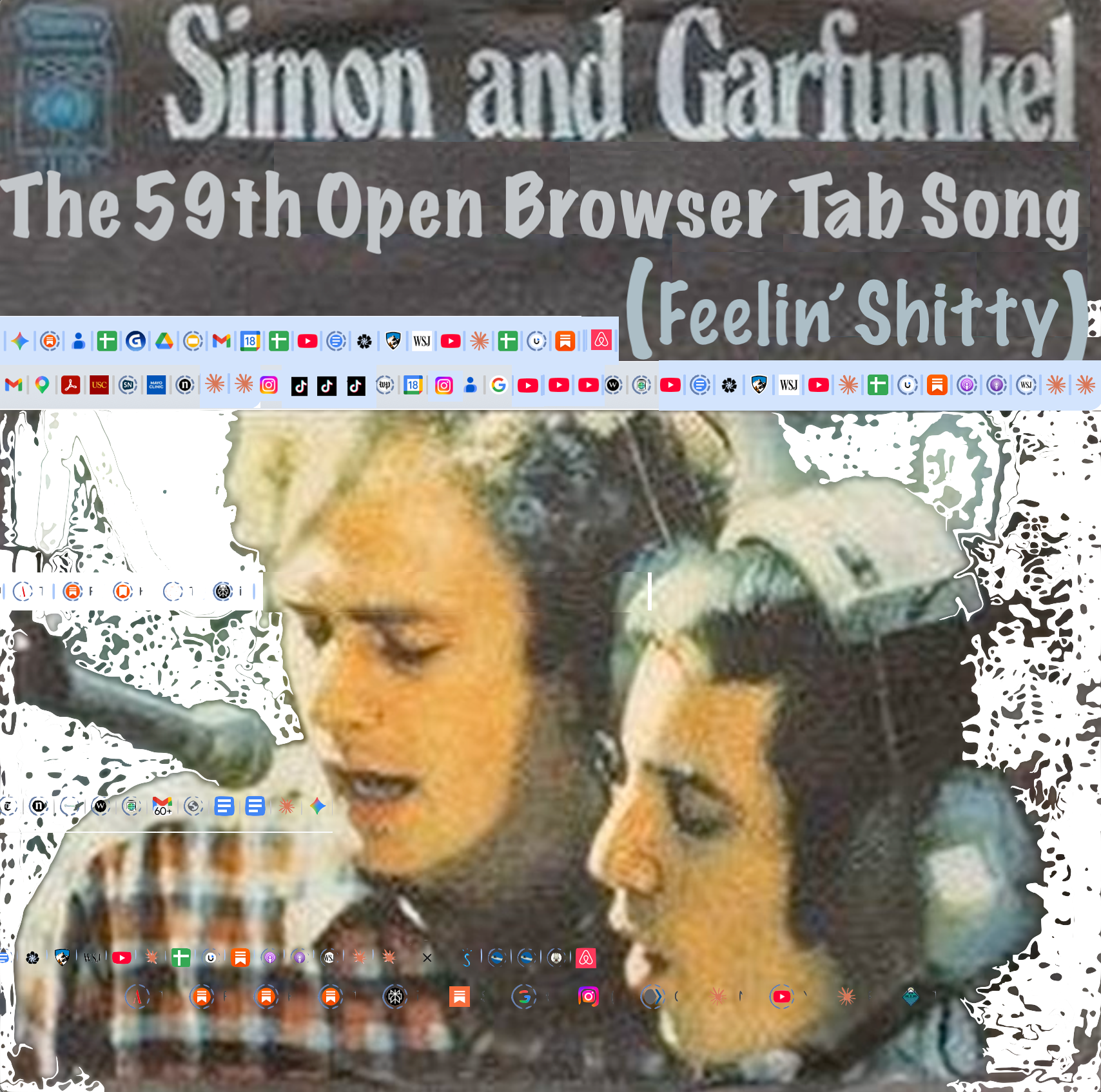
The most famous anthem for slowing down to savor life’s simple pleasures may be Simon and Garfunkel’s 1966 classic, The 59th Street Bridge Song. It documents what life was like about 300 years ago, kicking around cobblestone streets, talking to flowers and taking afternoon naps. Here’s what I believe that song would have turned into, had a young Paul Simon written it today:
The 59th Open Browser Tab Song
Slow down, you swipe too fast
You got to make the doomscroll last
Just puttin’ down my soulless phone
Looking numb and feeling shitty
Ba da-da da-da da-da, and self pityHello shitpost, you’ve got ‘em going
I’ve come to watch the anger growin’
Ain’t you got no memes for me?
Doo-ait-n-doo-doo, feeling shitty
Ba da-da da-da da-da, and self pityI got no job (do you?) no deepfakes to peep
I’m laid off and lousy and ready to weep
Let ChatGPT drop its algos on me
Life, it’s over, AI’s winning
(If that didn’t make any sense, here’s The 59th Street Bridge Song’s actual lyrics.)
Why life now feels too fast, and what to do about it
Relentlessly adopting ever more technology is perhaps the primary way that many of us become trapped in the cultural speed cycle that only seems to be accelerating with AI-everything-all-the-time. (There are other ways, too, such as over-exposure to present-day politics, but I’ll focus here on the tech and AI.) But it’s not only the speed of the changes but the opacity of what’s causing them, who’s influencing them and why that is creating a sense that we no longer have agency in how we get to live our lives.
The feeling that you don’t know what you don’t know can be incredibly destabilizing.
We’re at only the beginning of a massive—to use the technical term—enshittification phase of our professional and personal lives, in which trying to understand and keep up with the changes that we are continually told are good (really good!) for us can often lead, instead, to more stress, uncertainty, dysfunction and a lower quality of life.
For a clever take on this idea, watch this:
Disenshittifying AI to slow down your life
Ignoring AI isn’t the answer, and learning how to functionally use it will be, for anyone who needs to professionally function or understand how other people do, essential. Because it creates that critical sense of agency. For example, I’m not a tech person but I use AI every day to solve practical business problems, test arguments, understand complex subjects and be more creative.
In the past week or so, I’ve used paid versions of AI to:
identify false claims about longevity supplements, including those made by well-known longevity doctor who shall remain nameless (Mark Hyman)
plan two summer vacations (because the original plan fell through)
create a spreadsheet of my 2025 business income and expenses for my taxes
examine the condition of a 150-year-old gold coin
examine aging research claims made in published scientific papers
create images to top off AGING with STRENGTH articles
understand the circular financing problem at the heart of “AI bubble risk”
transcribe the audio of two hour-long interviews of Sari Botton, for a profile I wrote of her for the forthcoming issue of Geezer magazine
find the best credit card offer with the best benefits for the lowest annual fee
proofread my articles before I publish — though I still missed a typo (since fixed)
ruthlessly cuss out Claude.ai after I caught it condensing two of Sari’s remarks in the raw transcript of our interview, contrary to my explicit instructions.
What I have not used AI to do is write this or any other AGING with STRENGTH article. Because certainly you’ve noticed how many other Substacks, including many doctors, have begun feeding readers dense slabs of AI-generated Content that feels like it came from a vending machine running an Nvidia chip.

However, in the spirit of stress testing my ideas on practical steps we can take to slow down our lives and recapture a diminishing sense of agency, I did what any modern reporter would do: I asked the most robust AI model I can find. Here’s what my paid version of Claude (Sonnet 4.6) had to say about how to slow down your life in actionable ways—and its rather candid response to my interrogation of its answers.
Disclosure: I think some of Claude’s recommendations are effective. Including committing to mastering an analog skill—resistance training, sport shooting, restoring bicycles or cooking, for instance—and trying a weeklong “information fast.”
Keeping the phone pocketed more often, and keeping it quiet always
One habit I changed that had a cascading effect on slowing my life down is refusing to pull out my phone on the walk home from my daughter’s school in the morning. Like almost every other parent, once you see the kid walk past the gate, I’d pull out my phone and occupy my brain with…nothing really important. But one day a year or more ago, I forced myself to keep the phone pocketed and just walked home occupied by only my thoughts. About a week later, I no longer had the urge to “enphone” myself on the walk home, and since then, I’ve also been able to stop habitually looking at it while in grocery check out lanes, waiting rooms and the car, at stoplights.
I also don’t allow emails and text messages to ding, bleep, buzz or vibrate my phone. As a result, I can focus without interruption when necessary, and life feels a little slower and more on my terms. I check texts a few times a day, in batches. Your friends and family may complain at first, but they get used to it. I still regress to checking scores of teams playing sports I care nothing about, just because. But keeping the phone quiet has made me feel less like Harrison Bergeron (thanks, Kurt Vonnegut) and more like a pre-internet version of myself.
Going back to writing hand-written letters
One of the cultural truths that Geezer has proved, as a print-only, thrice yearly coffee-table magazine with original reporting and writing about the Gen X aging experience, is that people are hungry to read real words on real paper written by other real people. (That appeal crosses generational frontiers: Geezer has, to our surprise, a growing number of Gen Z and Millennial readers. I think they react to Geezer the same way I reacted to grainy, 1960s film footage of Sasquatch: “What the hell is this?”)
Which got me thinking about starting a new thing: writing a hand-written letter and mailing it, in an envelope addressed by hand and affixed with a stamp, every month to whomever wants to receive one. The letters will be four handwritten pages, give or take, and include notes and observations about the analog world that keeps life interesting, and will probably also have some drawings from my 10-year-old daughter, an artist at heart.
Whoever wants to receive these mailed letters will get one, for a flat rate of $8 a month. I’ll create a website dedicated to this idea shortly, but I thought I would first share it with you, dear readers. If you’re interested, you can message me here
…or use my ko-fi page to set up a monthly $8 payment (and cancel anytime).
If you hate that I’m even writing about this idea, please leave a comment. Any honest feedback is good to have. Be sure to explain why you hate it.
Until my next post, on more unconventional strength training movements, consider experimenting with AI, to build agency, and reading paper, to keep one foot in the analog world.
I do love this. Very very much. The world moving too fast is a problem that’s very much on my mind and one I’m trying to solve for myself. And enshitification is frustratingly real. Sadly we’re accepting it. The video is hysterical. I would add AutoCorrect. And airline seats.
Please spread the gospel of no phone notifications! If the phone (or website, streaming device, wearable, etc.) is pushing you to do it, it's not likely in your best interest.
As I desperately cling on to my ability to be bored (leading to thinking and creativity) the constant attraction of these empty dopamine hits kills me.
Time and place for everything, just not all
the time and everywhere.