


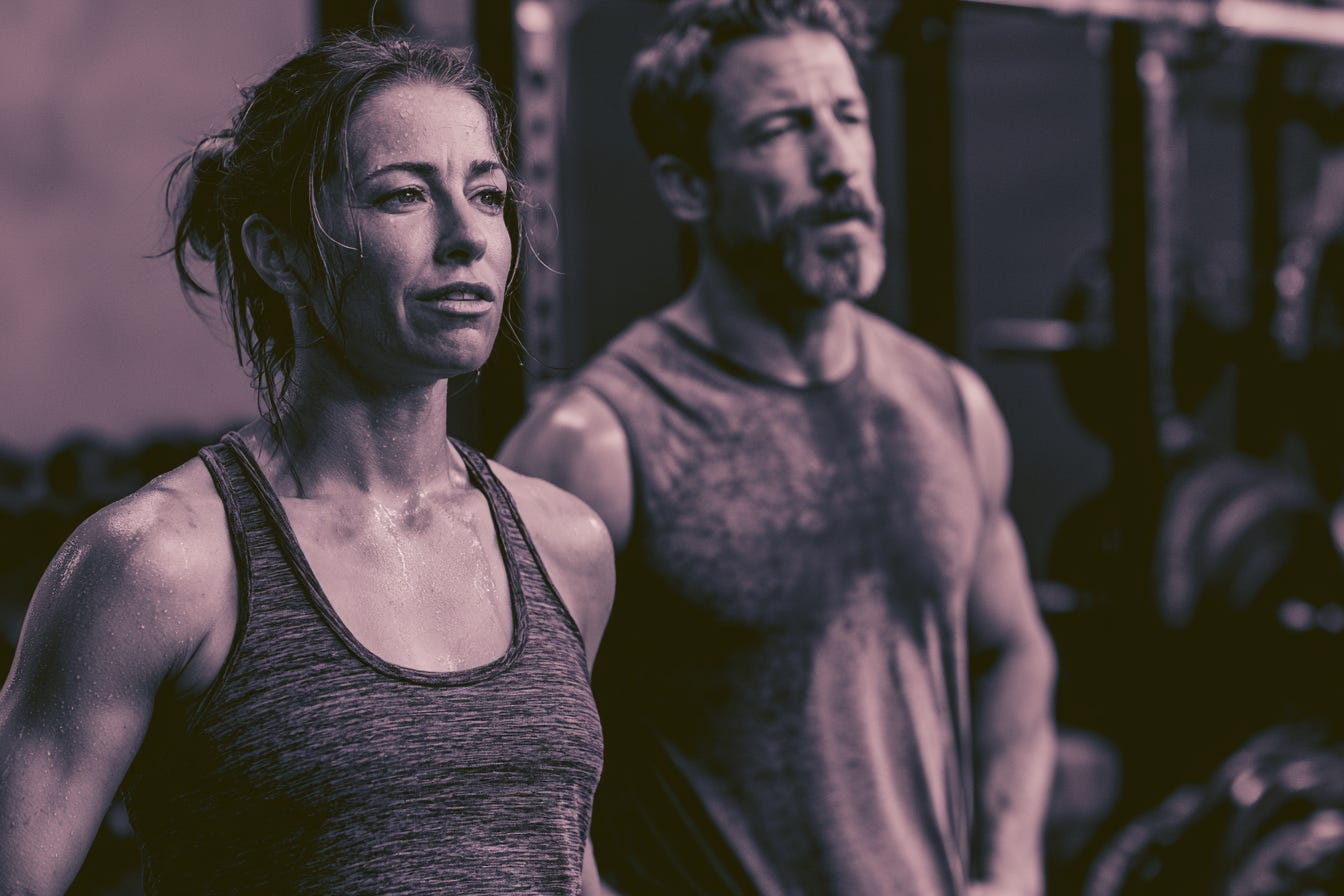
Where, how, how often and with whom you strength train is about as personal a fitness choice as there is. That choice, in my experience, tends to correlate not only to what you want your body to look like but also how you want to feel by the time you hit the showers.
Two different kinds of gym workouts
If the goal is to punch that timecard, execute your routine, lift the weight and book a gym win, your workouts tend to go in one direction. If the goal is more akin to rebooting your operating system by going long, hard and deep into your strengths, exhausting yourself into a palpable physical, mental and emotional restoration—well, then, your workout probably goes in a different direction.
I’ve spent years regularly going in that second direction, through supersets. Supersets combine strength training with aerobic and mental conditioning that, according to scientific research that bears out my experience, confer a unique set of physical benefits that regular gym workouts don’t.
Below, I explain the physiology of those gains and the cyclic compound effect they generate. I also describe my personal lower-body strength supersets routine that AGING with STRENGTH paying subscribers can use as a customizable blueprint to condition your all-important posterior chain, as well as your aerobic fitness and mental toughness.
What are supersets?
Supersets are more intense versions of regular workouts. The word superset refers to executing sets of two or three different exercises in rapid succession without much rest in between—and then repeating that cycle for an entire workout. Supersets may incorporate different muscle groups—legs and chest, for instance—or blend related exercises focused on just one muscle group.
With supersets you’re typically:
lifting only 50% to 75% of your maximum…
which enables doing more reps that build into a wall of fatigue…
because you’re resting only 30-90 seconds between sets…
A muscular flow state
That’s how mental toughness enters the superset equation: when each set leaves you breathless, you don’t cool down; you keep going. Your mind must convince your body to hit the next set in the rotation as soon as your heart rate begins to settle, without losing proper form or technique.
You sweat a lot more, burning more fat than you do in a regular workout.
And, in a major breach of gym protocol nowadays, you don’t have time or desire to look at your phone in between sets. You’re in a muscular flow state.
In case you missed it…
Posterior-chain workouts are the ones I enjoy supersetting the most, because they’re the biggest and arguably most important muscle groups, and engaging body and mind to work them to sweaty exhaustion produces as close to a calming physical reset as you’re likely to experience in a public space. As we age, lower-body strength is the engine of our mobility and supports a powerful core.
Supersets are also just plain fun because they demand all your attention; you’re captivated. I admire and respect those regular gym workouts I described above, but I often can’t carve out regular workout times that make them a habit. So whenever I do have a glorious 90 minutes or more to work out, I tend to train in supersets.
Turns out, there’s no shortage of science to support the feelings I’m describing.
The unique advantages of training with supersets
Supersets do two useful things at once: they shorten the session and keep your heart rate up. When researchers compare combining exercises this way against the conventional one-lift-at-a-time approach, the muscle and strength gains come out about the same, while the combined version finishes in roughly a third less time.12 The 50–75% load is heavy enough to build muscle and light enough to keep moving while you tire, and that pairing—moderate weight, short rest—produced the biggest changes in a 45-study review: a 4.3% drop in fat mass, a 1.9% gain in muscle mass, and a 6.3% rise in VO2max.3
If you target the same group of muscles with supersets, fatigue within those muscles accrues, and you move less total weight than you would resting fully between straight sets. Thus, the harder sessions can demand longer recovery before you train those muscles again.4
The muscle-mental resilience superset cycle
There’s one more major advantage supersets offer that the literature doesn’t mention.
Cutting the rest between sets trains local muscular endurance and, over weeks and months, builds a fitter system—one that recovers faster between efforts and tolerates more discomfort before the urge to quit takes over.
Growing more tolerant of discomfort is the definition of mental resilience.
Your ability to endure discomfort yields a physical payoff that builds mental toughness. The toughness makes the next hard session more tolerable, which produces more physical gain, which feeds the toughness again.
This cycle yields and compounds, yields and compounds. You may find that it starts to show up in other areas of your life, away from the gym or fitness. If that sounds a bit Nietzschean, there’s a reason superset workouts require more recovery time than regular gym routines.
My lower-body superset routine: a triple-strength workout
Here’s my typical 90 minute posterior-chain superset routine, which hits several related muscle groups to build muscle, modestly increase VO2 max and train mental resilience.
I’ll describe the specific movements, the number of sets and amount of weight I use for each, and estimated resting times. This is not prescriptive but rather a template anyone can adapt and edit to their liking. Tune it to your body type and fitness goals.