

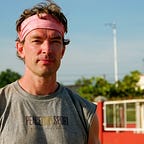

Dispatches are true short stories told in my own voice.

TRANSCRIPT
I’m going to tell you the story of that magical night in Vietnam in 1993 that I alluded to in my previous Dispatch, describing how intimidating it felt to wake up in this town in this province of northern Vietnam and know that there was 300 kilometers between me and the next town that had a place where a foreigner could legally sleep in Vietnam.
Foreigners were not allowed to sleep just anywhere. It was a government rule. And I knew that I wouldn’t be able to make that entire 300 kilometer journey in one day, given the quality of the roads and the weather. And so my guidebook was also blank.
It had nothing to say about anywhere between me and that 300 kilometer village or town on the other side. And so if I was only able to ride maybe 100, 110 kilometers, where would I end up? Where would I sleep? How would I communicate?
Because the two elements that made this so intimidating were one is just the language barrier. In northern Vietnam at that point, no one spoke any English. I mean, not any more than hello and goodbye and what’s your name. Maybe that’s it. I spoke a few words only of Vietnamese at the time.
It was mostly talky pointy and I’m quite good at talky pointy, but being able to humanize yourself enough through this, what I’ll call a xenophobic fascination that the Vietnamese at that point had with me was would be tough. I knew even after the six weeks that I’d been on the road, a relatively short time, but every day it was whole villages, dozens of people that would come out to watch me eat breakfast, watch me stop for coffee or tea, watch me eat lunch, watch me have dinner.
There was just no sense of that it could be reality that someone like me, a Caucasian six-foot-three sweaty dude with spandex bike shorts with this mountain bike and backpacks would show up. It was like I was dropped from a moon of Jupiter. And so cutting through that level of xenophobia, and again, it wasn’t hostile or negative. It was just, it was like being a caged animal at the zoo.
People were warm and friendly and gracious, but, you know, there was just no sense that we had anything to share other than the fact that we were both breathing. And so the intimidating part of that challenge for me was knowing that I would have to try to find a way to Ingratiate myself, humanize myself, so to speak, enough to allow someone to say yes to the request I would have to stay with them at their home illegally in Vietnam, you know, back in this time when the government authority was still overwhelming.
And so what happened was, this is gonna take a couple minutes, but I hope you’ll stay with me because it’s an incredible story, I think. What happened was I rode hard and long that day. I thought I would be able to get 120, 130 kilometers down the road, given the quality of the roads and the weather. I managed, I think, to get 140 kilometers before dusk, and you don’t want to ride your bike at night. So I knew I had to stop, and I had a strategy that I devised While peddling for hours that day on how I would humanize myself enough to get someone to give me a place to stay.
And here’s the strategy and I’ll explain why because it’s going to sound a little goofy. The strategy was that I was going to stop for dinner and find a place along the roadside in these villages, which were numerous. I decided I would find a family where the mom was about the same age as my mom.
I was 27 at the time, so my mom was 50. And the reason is because I’d noticed up until that point, it’s going to sound a little odd perhaps, but the only kind of people in Vietnam that gave me a sense that they understood me beyond a foreigner or an alien creature we’re the moms of families where I would stop to eat. It was as if they saw me a little bit as, I’m not like a son or anything like that, but just sort of like a young guy on a journey by himself. Like there was a slight bit of empathy that I felt.
And it may have been illusory. I may have been making it up. I don’t know, but that was my only strategy and I was going to stick with it. So at dusk, in the middle of nowhere in this village, I found this one place and I thought, okay, you know, there’s the lady, there’s the husband, there’s the kids. This is my gambit. So I went in and I knew what was about to happen. I sat down and the whole village, or at least so it seemed, came out to watch me have my dinner, like my rice and chicken dinner. And I remember just being really sweaty, took my bandana off, but I kept my bike gloves on, oddly enough. I was full of upbeat energy because my whole goal was to ingratiate myself with the people and especially this family because I was about to ask them if I could stay there for the night.
So what I did was I pulled out this photo of my family that I kept in my bag and I showed it to them and I remember showing it first to the preteen girl who was serving me the food. You know, she took it and she was fascinated with it.

It was this color photo of me and my family, like a portrait. And then all the other people who were already about three feet away from my table from the village who had come out to watch me just sort of leaned in and started passing the photo around.
And then the second part of my strategy was to empty out my Vietnamese vocabulary and just say as many Vietnamese words as possible in the best accent that I could, which at that point was probably still pretty crappy. But I had a list of vocabulary words that I studied every night on the road each night after my bike journey was over because I wanted to learn Vietnamese. I was able to say things like, my name is, and I am from, and I am blank years old. I am not married, because that’s what the operative question always was in Vietnam.
And so, as much as I could say, people responded warmly. And I thought, okay, this is going well. And then the photo of my family came back around to me, and then something utterly unplanned happened. And I realized that I was about to cry and not just a little tear down the side of my cheek, but I was about to have a full on cry. It was because I missed my family. I was just, you know, after weeks of just being isolated and ogled at and sometimes mocked, but mostly just utterly made to feel as if I am the biggest foreigner that ever lived.
It was adding up to a big cry. And so what happened was I just put my bike gloved hands over my face and put my chopsticks down and I just sobbed into my bike gloves. In front of, you know, 30, 40, 50 people who were now just stunned into another kind of silence watching me have my food.
And I felt so embarrassed, not because I was crying, but because I was crying in front of them. This was a part of Vietnam that was incredibly poor. These were rice farmers, you know, just trying to make ends meet. No advantages, no technology, no support from the government, and no support from really anybody.
And here I was, this relatively wealthy foreigner, although I had only about $500 to my name, and it was all in my pocket to last me however many more months that was. But here I was with all this privilege, just crying in front of these people, and it just felt absurd.
And so eventually when I was able to pull myself together. I removed my gloved hands from my face and my, of course, my eyes were red. And I thought everyone would have backed off a little bit, sort of just out of kind of respect, but people had actually moved in closer.
So they were about two feet away from me now. And I thought, okay, this is just the way it’s going to be. So I pulled myself together. And at that point, the dad of the family that had this little open area restaurant sat down beside me and he pointed up at the wall and there was a photo of Jesus, a portrait of Jesus, not a photo, obviously a portrait of Jesus. And this was unusual because there weren’t that many Catholic, openly Catholic Vietnamese families where they would be willing to put up the icon of, you know, Christian culture on the wall, especially in a communist country.
And so he started talking to me rapidly. I didn’t understand a damn word he said, but he kept pointing to Jesus and gesturing to me. And I kept saying in Vietnamese, thank you. Cảm ơn, cảm ơn, cảm ơn....
Because I felt I was making progress. Maybe, in fact, he would let me stay there for the night. So when he got done with his speech, I asked him in talky pointy,1 —using as many words in Vietnamese as I could—me, sleep, here, today. I worked out a request to please stay with him.
And he said, sure, no problem. No problem at all. And I felt such huge relief.
Of course, I’m sitting still in front of an amphitheater of villagers who would come out to watch me have this dinner and then this impromptu cry. And so the dad said, sure, you can stay here. And he pulled out a pack of Vietnamese cigarettes from his shirt pocket and he gave me one.
And as you can imagine, on a bike journey of months where you’re riding 130, 140 kilometers a day, smoking wasn’t really my thing. But you know what? I lit that cigarette, or he lit it for me, and I had a few ceremonial puffs and just tried to not choke and I was thankful.
The end of the story is that after dinner people eventually filtered back into the village because everyone goes to bed Not long after dark. And I went upstairs in this very basic cement home that this family had.
And for the next hour, I used my flashlight with the young boy who was about 9 and the girl who was about, I’d say, 12 or 13. I think she said she was 13. Because we used my Vietnamese English two-way dictionary and the flashlight under a mosquito net, sitting on the boy’s defeated mattress in their room, and just went through word by word trying to have a conversation one word at a time with this dictionary.
It was such an utterly sweet moment that I’ll never forget. And I ended up sleeping on the boy’s buckled, defeated mattress while he and his sister slept in her bed at the other end of the room.
The roosters started crowing at 4:30 in the morning. Everyone was up by 5, and I had breakfast. I paid for my meals. I paid them for the bed. It was probably $3 or $4. And I thanked them and I was on my way.
And that’s the story of the magical night in Vietnam.
the lingua franca of foreign travelers the world over


