


What’s News? is a critical look into the latest aging & longevity news and ideas.
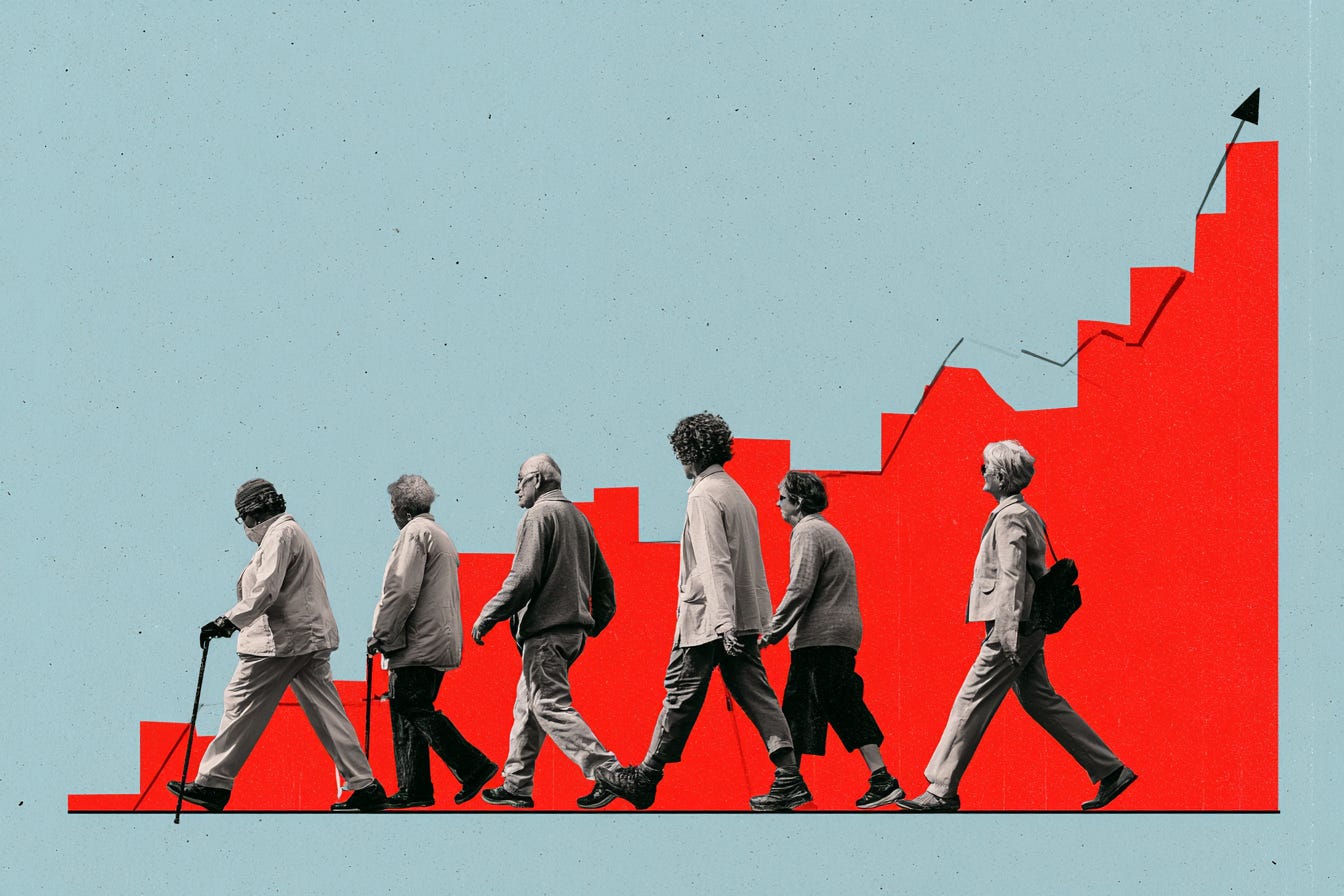
Summary—Global life expectancy rose over the past three decades, from 65 years in 1990 to 74 in 2023. But healthy life expectancy rose slower, from 56 to 63. The difference between these two measures is what demographers call the morbidity gap, and it widened in 203 of 204 countries over that period, according to a new analysis published in The Lancet Public Health. Palestine was the only exception, the paper said. The United States has the largest morbidity gap on Earth: 14.0 years, although Australia and Canada, at 13.9 and 13.7 years, respectively, aren’t far behind. Worldwide, people now spend almost 15% of life in poor health. In 1990, that figure was 13.6%.
Five general causes account for most of those unhealthy years. Musculoskeletal disorders lead at 1.8 years, driven mostly by low back pain. Mental disorders follow at 1.6 years, sense organ diseases at 1.1, unintentional injuries at 0.9, and other non-communicable diseases at 0.8. Women live longer than men but also spend more of that time sick: a 12.1-year morbidity gap for women vs 9.3 years for men.
Insight—Some of the increase in the morbidity gap is due to better and more available medical treatment, which the authors acknowledge. Stop people from dying of heart attacks, and they live long enough to acquire back pain, hearing loss or depression.
Musculoskeletal disorders are the single largest contributor to the global morbidity gap. In high-income countries, they and mental disorders together account for more than a third of that gap. Falls rank fourth worldwide. Low bone-mineral density sits in the top ten global risk factors, alongside high fasting plasma glucose and high BMI.
Context—The study comes from the Institute for Health Metrics and Evaluation at the University of Washington, the shop that runs the Global Burden of Disease project and supplies the population health numbers most governments and the WHO rely on. The Gates Foundation paid for it and had no role in the design or the findings. The underlying data is public.
These are modeled estimates built from surveys and registries, not a clinical trial, and the authors say the trend holds because 203 countries point the same way, not because any single country’s number is airtight.
Takeaways (and what each one means for you)
The biggest single contributor to years lived badly is musculoskeletal problems, and the biggest piece of that is low-back pain.
what it means for you: train your posterior chain—butt, legs, back—like the longevity intervention that it appears to be.
Falls are the fourth-largest contributor globally.
what it means for you: balance and lower-body strength, once again, are important in older adulthood.
Low bone mineral density ranks in the top ten risk factors worldwide.
what it means for you: resistance training + proper nutrition is a proven formula for strengthening bones.
In high-income countries, the leading risk factors are high fasting glucose and obesity.
what it means for you: tending to your metabolic health may add healthy years to your life and/or avoid unhealthy years.
Morbidity is spreading across a larger segment of adult life, not remaining concentrated at the end. The paper found the gap widening across the whole adult course.
what it means for you: start visualizing now the habits that will help keep you healthy later in life, or, if you’re already later in life, next week and next year.
# # #
What did you think of this post? Leave a comment.