


What’s News? is a critical daily look into the latest aging & longevity news & ideas.
Summary
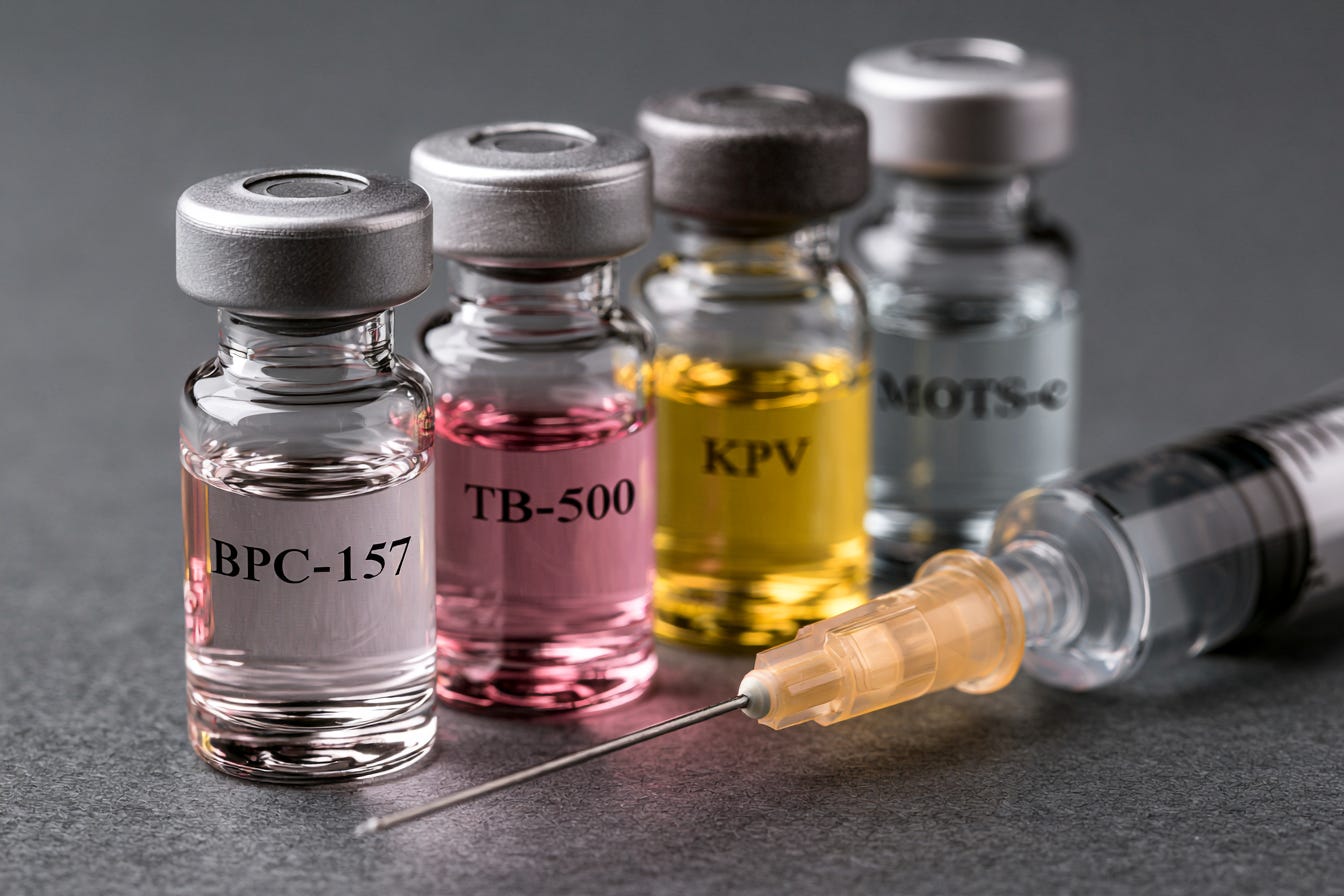
On Thursday an FDA advisory committee voted to loosen the 2023 ban on four of the seven peptides under review—BPC-157, TB-500, KPV and MOTS-c—opening a path for compounding pharmacies (the specialty shops that mix drugs to order) to make and sell them. The BPC-157 vote was 8 to 6. The remaining three—DSIP, Semax and Epitalon—are up for a vote today, Friday, July 24. The votes are nonbinding, and the committee broke with the agency's own scientists, who said the drugs have not been adequately studied in people. Weeks earlier, Health Secretary Robert F. Kennedy Jr., who calls himself a "big fan" of peptides and says he has used them, added eight new members to the panel; six of them sell peptides. You can read the who-and-how in this New York Times article. What follows is the part the coverage skips: what the research on these four drugs actually shows.
Insight—what the peptide studies show
Let’s start with the one that got the most attention.
BPC-157 (the higher-profile half of the so-called “Wolverine stack”) has a large animal record and almost no human one. The most recent systematic review, published last year in an orthopaedic journal, screened 544 papers and found one human study that qualified: a retrospective look at 12 people who had the peptide injected into an arthritic knee, seven of whom reported relief lasting more than six months. Everything else the review included, 35 of 36 studies, was done in animals, much of it by a single Croatian research group going back to the 1990s1. The authors graded the human evidence at the two lowest tiers science recognizes, and noted that no clinical safety data exist at all. The first formal human safety test appeared in early 2025: two healthy adults given intravenous infusions, no control group, measuring only whether their organ markers moved. They didn’t. As of this spring there is still no randomized trial of BPC-157 in humans for any condition.
TB-500 (the other half of the “Wolverine stack”) is a lab-made fragment of a natural protein, thymosin beta-4, and it reached the wellness market by way of the racetrack, where it’s given to horses and greyhounds. The human trials people cite tested the full protein rather than the fragment being sold, and most of those were never published or failed to show it worked. TB-500 itself has essentially no completed human trials. The one cancer signal in the literature is not reassuring: in a study of gastrointestinal stromal tumors, higher levels of thymosin beta-4 tracked with more aggressive disease and worse outcomes. That tracks: the peptide's job is to grow blood vessels and move cells around, which are the same two things a spreading tumor needs.
MOTS-c is the least tested, and therefore least credible, of the four peptides the FDA panel approved Thursday. The single human trial anyone can point to did not test MOTS-c. It tested a modified analog, run by a company called CohBar, in 88 volunteers over 28 days. The drug cleared its safety check and showed no clear benefit…and then the company dissolved and the program stopped. What’s sold today as MOTS-c rests on claims derived from mouse and cell studies, and the FDA had already flagged it for immune-reaction risk.
KPV is a cream (the 3 other peptides are injected) and carries the most modest claim of the group: an anti-inflammatory fragment tested mostly in mice with inflamed colons. Human data is close to nonexistent.
The FDA’s peptide voters
Kennedy added eight new members before the vote, six of them peptide sellers. Add the standing members whose businesses also stand to gain, and the panel was loaded with financial interest in its own decision. Here is who they are, and what each has at stake.
The peptide sellers:
Gabriel Alizaidy, MD—scientific director, Maximus Health (Iowa). Sells growth-hormone peptides and GLP-1 “microdosing”; fun fact: the company drew an FDA warning letter in June for false claims about its compounded weight-loss drugs.
Asare Christian, MD—founder, Aether Medicine (Philadelphia). Sells BPC-157 and other peptides for pain, muscle and what it dubiously refers to as “longevity.”
Melissa Loseke, DO—chief medical officer, Re-new Institute (Omaha). A concierge clinic selling hormone and regenerative therapies.
Haleem Mohammed, MD—global chief medical officer, Gameday Men’s Health, which runs a retail chain. Sells sermorelin peptide injections.
Joshua Starbuck, MD—chief medical officer, Makena Health (Maui), a concierge “longevity clinic” (I’m using quotes because the phrase itself is hyperbole) that markets peptides.
Kris Wusterhausen, DO—founder, The Resurge Clinic (Texas). Regenerative “clinic” marketing peptide and hormone therapies.
The rest of the industry bloc includes:
Bobby Harshbarger, PharmD—Tennessee state senator and pharmacist at his family’s Premier Pharmacy. His mother, Rep. Diana Harshbarger, lobbied Kennedy to loosen peptide rules.
Timothy Fensky, RPh—compounding pharmacist and consultant. Compounding pharmacies would gain the right to make these drugs.
David Pope, PharmD—chief pharmacy officer, Xifin Pharmacy Solutions, a pharmacy-industry firm.
Context
Kennedy frames the move as harm reduction. The ban, he argues, only pushed users toward gray-market vials, and regulated compounding would be safer. The problem surfaced at the hearing. When supporters asked for guardrails, purity testing and mandatory harm reporting among them, the FDA said it has no power to require them, because compounding pharmacies answer to state boards rather than the agency. “I don’t have those regulatory authorities,” one official said. The safety upgrade on offer depends on rules the FDA can’t write. Peter Lurie of the Center for Science in the Public Interest, who testified against the change, said the people who manufactured demand for these drugs were seated to certify it.
Takeaways
Thursday’s vote lets pharmacies make these drugs, nothing more. Whether they work, or are safe, remains to be seen.
The human evidence is minimal in all 4 peptides. BPC-157 has one retrospective study of 12 knees and a two-person safety pilot; TB-500 has essentially none; the lone MOTS-c “human” trial tested a different molecule; KPV is mostly mouse work.
“No reported side effects” in the context of these peptides usually means no one has looked long enough, or in enough people.
Thin data can’t confirm benefit, and it can’t rule out harm, including whether the blood-vessel growth that BPC-157 and TB-500 trigger could feed an undetected tumor.
When the people vouching for a drug also sell it, don’t take their word for it.
# # #
BPC-157 went into human trials in Europe years ago under a code name, PL 14736, run by the Croatian drug maker Pliva. The company took it through an early safety study in healthy volunteers and then a mid-stage trial in patients with ulcerative colitis, a serious bowel disease. The trial reportedly showed some benefit with no obvious harm. But Pliva never published the full results, so no outside researcher could check the work. Then the program was shelved.
Pliva was later absorbed by Teva Pharmaceutical (the world’s largest maker of generic drugs. It had bought Barr Pharmaceuticals in 2008, and Barr then bought Pliva in 2006. So through those deals, BPC-157 ended up inside a giant generics company that had little interest in pushing an unproven peptide through the rest of clinical testing, and it got shelved). BPC-157 never won approval anywhere, and it resurfaced as the gray-market injectable people buy today.
Another safety trial registered in 2015 but cancelled the next year, again with nothing published.
Let me get this straight….for years Kennedy has railed against the FDA for being in the pockets of big pharma. So when he gets the levers of power he sets up a committee of peptide investors to vote on peptides and ignore the scientific community ?! It’s ludicrous! You know what never happened? Big pharma voting on the approval of their own products.
I’ve known several people experimenting with peptides for injury recovery, weight loss, vitality, and other goals. What concerns me is the level of confidence many place in them despite how little human evidence exists. The answers are also hard to interpret because peptides are often combined with testosterone or other compounds, so it becomes difficult to know what is actually producing the result. This piece helped clarify concerns I was already beginning to have, and I’ll keep watching the evidence closely.