


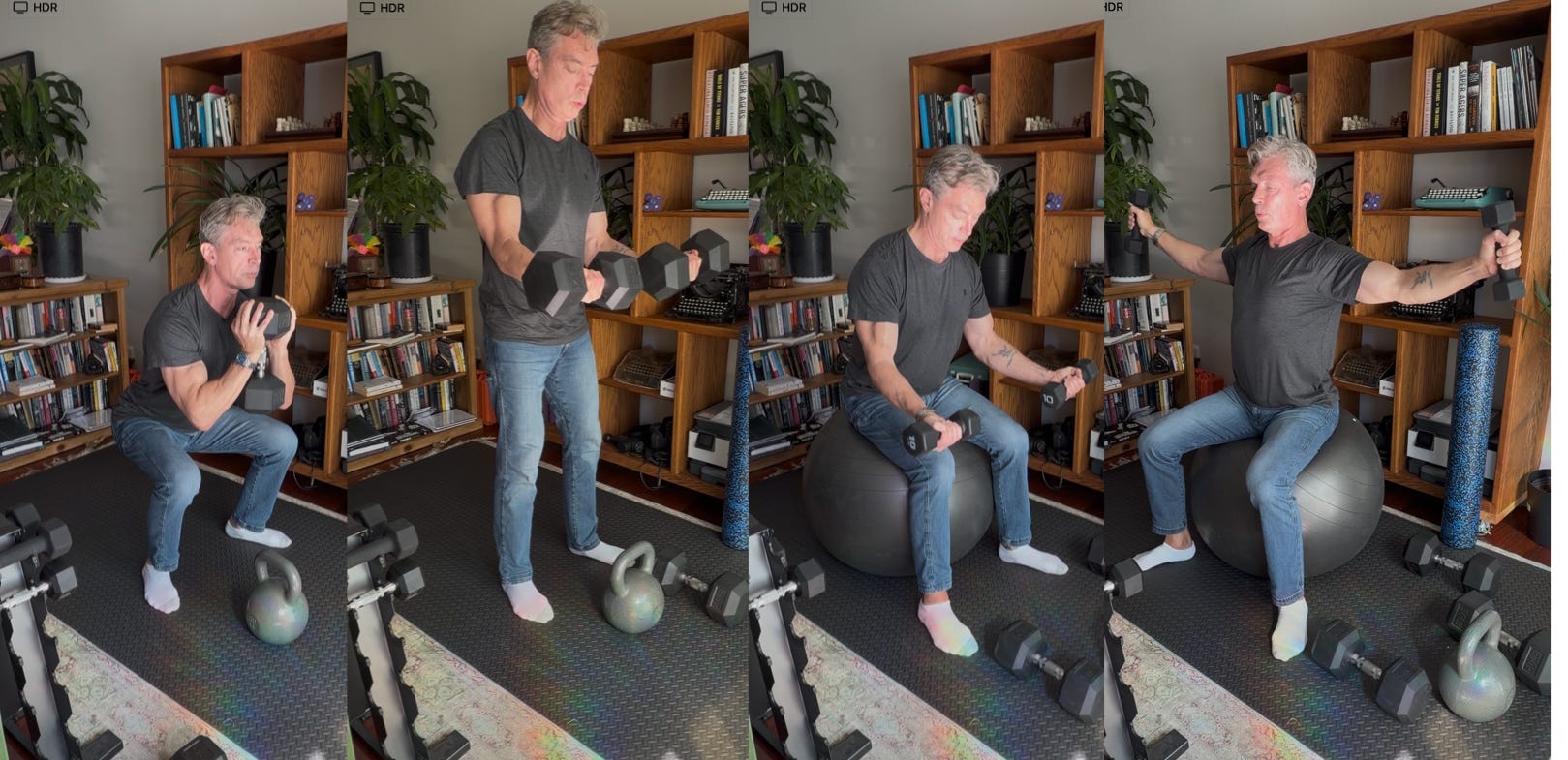

Bottom line up front: Every strength exercise has two halves. You lift the weight; you lower it. Most of us focus on the lifting half and let gravity handle the second. But that typical strength-training habit throws away some of the most useful, powerful work your aging muscles can do. Here’s a better way.
If you’re like me, you’ve been strength training slightly backwards—maybe for a long time. Partly that’s because we’ve all been repeatedly told to lift the backwards way (my phrase), and partly because lifting a weight just feels more satisfying than resisting its descent.
Yet, that’s the “backwards” part. Science and human experience show that the act of resisting weight against gravity can make you stronger, with less effort, than lifting weight against gravity. That’s not a misprint, and I’ve highlighted it for emphasis: You can make your muscles stronger, with less effort, by flipping how you lift weights, to focus on resisting the weight’s fall more than lifting it against gravity.
That technique is called eccentric strength training, and, somewhat oddly, you’ll hear it pronounced “e-centric” at the gym and by fitness trainers and sports doctors everywhere. Regardless of how you say it, eccentric training doesn’t feel as fun as lifting weight, a process in which your muscles contract to raise the weight, known as concentric training. But eccentric training is slightly more effective than concentric training for getting stronger, faster.
Below, paying subscribers have access to a video demonstration of several eccentric exercises you can easily do at the gym or at home, whether you’re a dedicated gym rat or just getting started at home.

What is eccentric strength training?
Let’s use a biceps curl, a classic gym exercise, as an example. In a biceps curl, raising the dumbbell toward your shoulder shortens the muscle. Exercise scientists call that the concentric phase. Lowering the weight under control is the eccentric phase: the muscle keeps working while it lengthens, acting as a brake. In a squat—whether weighted or bodyweight only—rising to standing is concentric and lowering into a squat is eccentric.
Eccentric training means deliberately slowing the lowering of weight, or loading the lowering half more heavily than the lifting half. Outside the gym, life is filled with small, eccentric movements: Walking downstairs is almost entirely eccentric work for your thighs.
Origins of two words: The word “eccentric” comes from Greek through Latin and means “out of the center.” Concentric, by contrast, means “sharing a center.” Eccentric started in geometry, describing circles that don’t share a center. Exercise science adopted both words: concentric when the muscle pulls toward its middle, eccentric when it lengthens away from it.
Why this kind of training matters in midlife and later life
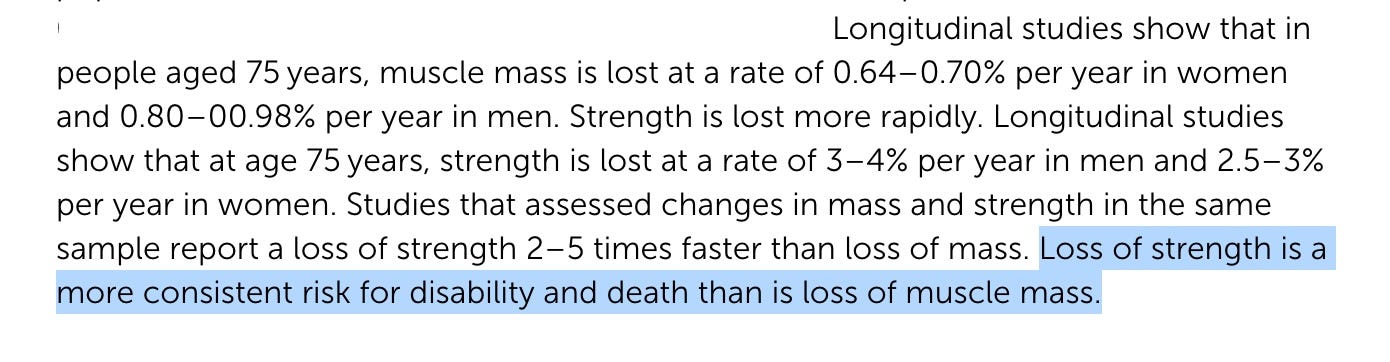
As you age, you lose strength faster than you lose muscle mass. Put another way, your muscles get weaker in older adulthood faster than they get smaller.
A 2012 review of the research found that in large studies tracking people over years, around age 75 or so, muscle mass shrank by 0.6% to 0.7% per year in women and by 0.8% to almost 1% in men.1 Strength loss in older adults is the bigger problem because it declines 2x-5x faster than muscle size. Low strength predicted disability and death more consistently than low muscle mass did, that 2012 review also found.
That’s why resistance training is so important to build as a habit, starting now if you haven’t already. Smaller muscles may not be optimal, but weaker muscles can be dangerous to your health and longevity.
Eccentric training requires fewer muscle fibers, less energy
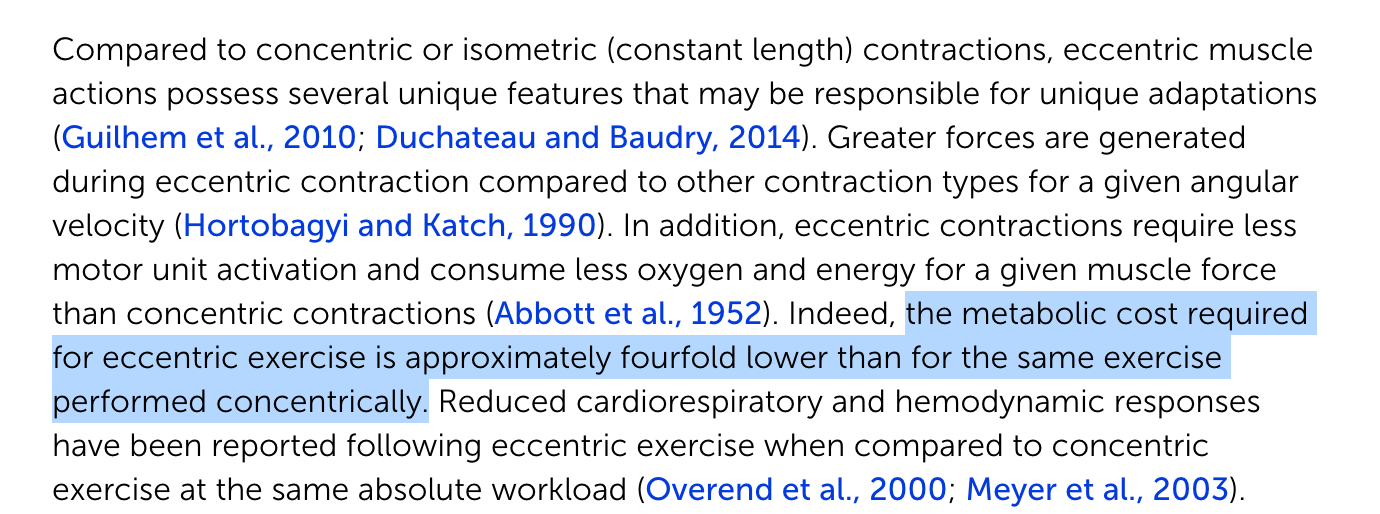
When you slowly lower a weight, as in an eccentric biceps curl, your muscle needs fewer fibers to do the job, and parts of the muscle act like springs that resist being stretched. That gives it extra braking force without needing to use more fibers. The result is that eccentric work uses about one quarter of the energy of lifting the same weight, according to a 2019 review in Frontiers in Physiology.2
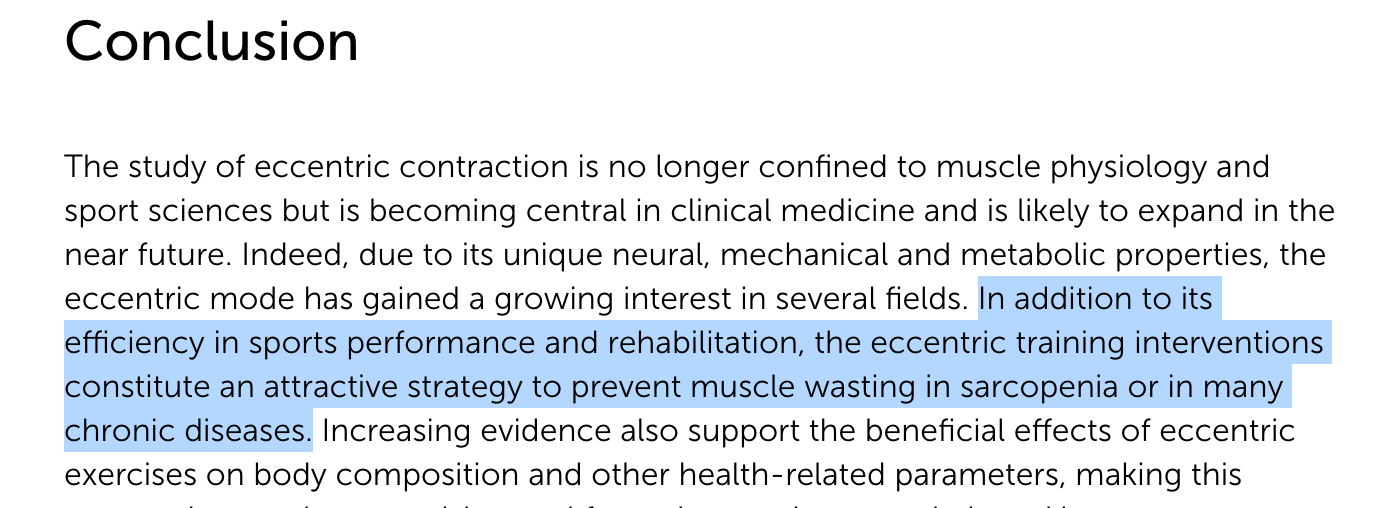
Two screenshots from that paper showing the operative conclusions:
Taxing fewer muscle fibers, however, doesn’t mean creating less added strength.
How eccentric training builds (slightly) greater strength
Because fewer fibers share the work during the lowering phase, each one that fires is under more stress. That stress signals the muscle to rebuild stronger. It can also cause tiny disruptions inside the fibers, which is why eccentric work makes you sore, but those disruptions aren’t required for the muscle to get stronger or bigger.
A 2025 analysis of 11 randomized trials in healthy older adults found eccentric training produced slightly larger strength gains than conventional lifting, with no difference in muscle size or everyday physical function.3 A 2017 meta-analysis of 15 studies found muscle growth averaged 10% with eccentric training and 6.8% with concentric, but the difference wasn’t statistically significant; ie, it could be chance.4
An earlier review of 20 randomized trials found that eccentric training’s advantage showed up mainly when it used heavier loads than the concentric training it was compared with.5
With eccentric strength training, you build about the same muscle and slightly more strength for far less exertion. If your heart, lungs or joints make conventional lifting hard, that’s a very good deal.
Why you don’t see everyone doing these exercises
It’s just not as fun, sexy or satisfying. Speaking from personal experience, the act of lowering a heavy weight slowly seems to take more mental energy, and patience, than lifting it.
Also, as you lower the weight your muscle lengthens, so you don’t see it bunch up the way it does when you lift. Gym culture counts what goes up, and there are no known competitions for how much weight someone can lower.
Third, you’re often not able to max out your eccentric weight, because getting that weight into position would require a helper. Eccentric training at more manageable weights can leave people feeling, ironically, as if they’re leaving strength gains on the table.
You don’t need to go heavy to get eccentric strength gains
To be clear, eccentric training doesn’t mean you must lower only weight that’s heavier than what you can safely lift into position. As you can see in the video below, I’m eccentric curling 40-pound dumbbells, which are heavy for me, and getting a decent biceps workout by slowly lowering them. I could use 50-pound dumbbells for the lowering phase…but honestly, my goal isn’t to get huge, just stay strong.
If you’d like to experiment with heavy eccentric strength training, ie, lowering more weight than you can lift into place, you’ll need a training partner, a workaround (below), or equipment most gyms don’t own. (Much of the research on eccentric training has been done in labs and physical therapy clinics on motorized machines that are expensive and require expertise to use.)
Expect to be sore afterward
Unaccustomed eccentric work is the main cause of the muscle soreness that shows up a day later, peaks 24 to 72 hours after the workout and fades within five to seven days. Plenty of people try it once, can’t walk downstairs comfortably on Wednesday and quit. The soreness drops sharply after the first few sessions, as the muscle adapts.
How to add eccentric strength training at home or the gym
Here’s how I think of why this is worth experimenting and incorporating into your long-term strength training plans:
Eccentric training makes gravity your training partner and makes you marginally stronger than conventional concentric weight training. As with all my other advice in this arena: you don’t need to go heavy. You just need to go heavy enough.
8 eccentric strength training exercises, and 6 video demonstrations
Here are 8 specific exercises to start, at home or at the gym, and a video of me demonstrating 6 eccentric strength training exercises, including 3 seated exercises with lighter weights that most people can start out doing right away: