


I have fond memories of my heavy squat sessions. They were often on Friday nights, when the gym was empty but for the true believers. The core of my routine was 8 sets of 10 reps of 225 pounds. The endorphins, the sweaty heart-rate spike and the iron-denominated gains in strength were addicting; the return to existential baseline real.
“The king of all exercises”
Weighted back squats are one of the most demanding compound movements there is, because they recruit multiple muscle groups and joints simultaneously. NFL players, powerlifters and generations of coaches and dedicated gym rats the world over swear by them. They’ve long been considered one of the most complete lower-body exercises. They’re good at making your butt and legs look great. And they show the world—quite literally—how much of it you can shoulder.
And you should probably quit doing them.
For most people over 50 (and, very arguably, anyone) bar squats are not the best way to achieve well-balanced, injury-free lower-body strength for the long haul. Back squats tend to exploit pre-existing structural problems in your hips, glutes and core and create the potential for insidious, slow-developing back, pelvic and knee injuries that, in midlife, become harder to heal.
Also, squats aren’t even the best way to make your butt look great.
To build lower-body strength, balance and stability, several other workouts beat squats, and I’ll get into those below. But first, the case against bar squats—and some context:
I know people love their bar squats. After 40-odd years, however, I reluctantly stopped doing them, once it became painfully clear how they were setting up my body for pain and injury. I know I’m not alone and, conversely, also that my experience isn’t universal and that lots of people love squats. Which is why I’m hoping you’ll….
The case against weighted back squats
My argument is simple: Though legendary, bar squats—especially at or above body weight—are an outdated way to build lower-body strength. Depending on how hard and heavy you go, I’ve come to think of them as the workout equivalent of petting the bison in Yellowstone National Park: kinda not worth the risk.
Bar squats create lumbar spine compression
When you descend into a loaded barbell squat, you put your lumbar spine under significant compression. One study, albeit from 41 years ago, demonstrated that at loads between 80% and 160% of body weight, the compressive force on the lumbar spine can reach 6 to 10 times body weight.1
Heavy bar squats combined with deep knee flexion, in particular, carry increased risks as discs L4-L5 (the primary load-bearing segments of the lower spine) and L5-S1 (the lowest movable segment) are being compressed and sheared simultaneously while in a mechanically disadvantaged position.2
Back squats exacerbate your accumulated asymmetries
Back squats tend to magnify the asymmetrical muscle development that almost all of us have to some degree—a slight lean to one side, one hip dropping slightly lower than the other, a tilted sacroiliac joint, one foot turned out more than the other. Over time, these asymmetries tend to concentrate stress on one SI joint more than the other, which is a common source of the chronic, hard-to-diagnose low back and hip pain that long-term heavy squatters—me included—often develop in their 40s and 50s.
Beware the asymmetric, tilted SI joint. When SI joints are continually stressed by asymmetrical loading under heavy compression, the surrounding ligaments and joint surfaces can become chronically irritated in a way that is genuinely difficult to treat and often misdiagnosed as a lumbar or hip problem.
This is where the insidious negative impact of bar squats can become a problem, because SI joint dysfunction tends to accumulate quietly and become a nagging problem—the low-grade but persistent pain that seems to live in the middle of your lower back that you can’t stretch or massage away. (Once again, I’m speaking from personal experience.)
Okay, but what about people who haven’t been damaged by four decades of heavy squats?
Other reasons to ditch loaded back squats
At 50 or older, mobility deficits tend to become baked in from decades of sitting, asymmetrical muscle imbalances and accumulated tightness. All these factors, I believe, argue against starting a new habit of squatting with a heavy bar on the back of your neck.
Hormonal changes that reduce the protective buffer. Particularly in women post-menopause, high-compressive loading of knees and hips under a barbell becomes a different proposition after 50 when hormonal support for ligaments, tendons and cartilage diminishes.
The human tendency to ego load. Who among us isn’t susceptible to throwing more weight on the bar in an attempt to impress everyone else in the gym, none of whom actually notice?
Joint pathology accumulates silently. Plenty of people in their 50s have cartilage degradation, meniscus degeneration or disc issues that don’t produce symptoms during most movements but can flare up under barbell squat mechanics.3 That footnote refers to a 2024 paper in the Journal of Functional Morphology and Kinesiology that identifies excessive arching of the spine and knee valgus (inward movement under load) as the two most common problems in older adults who do bar squats, creating the potential for injury, on top of all the other factors mentioned above.
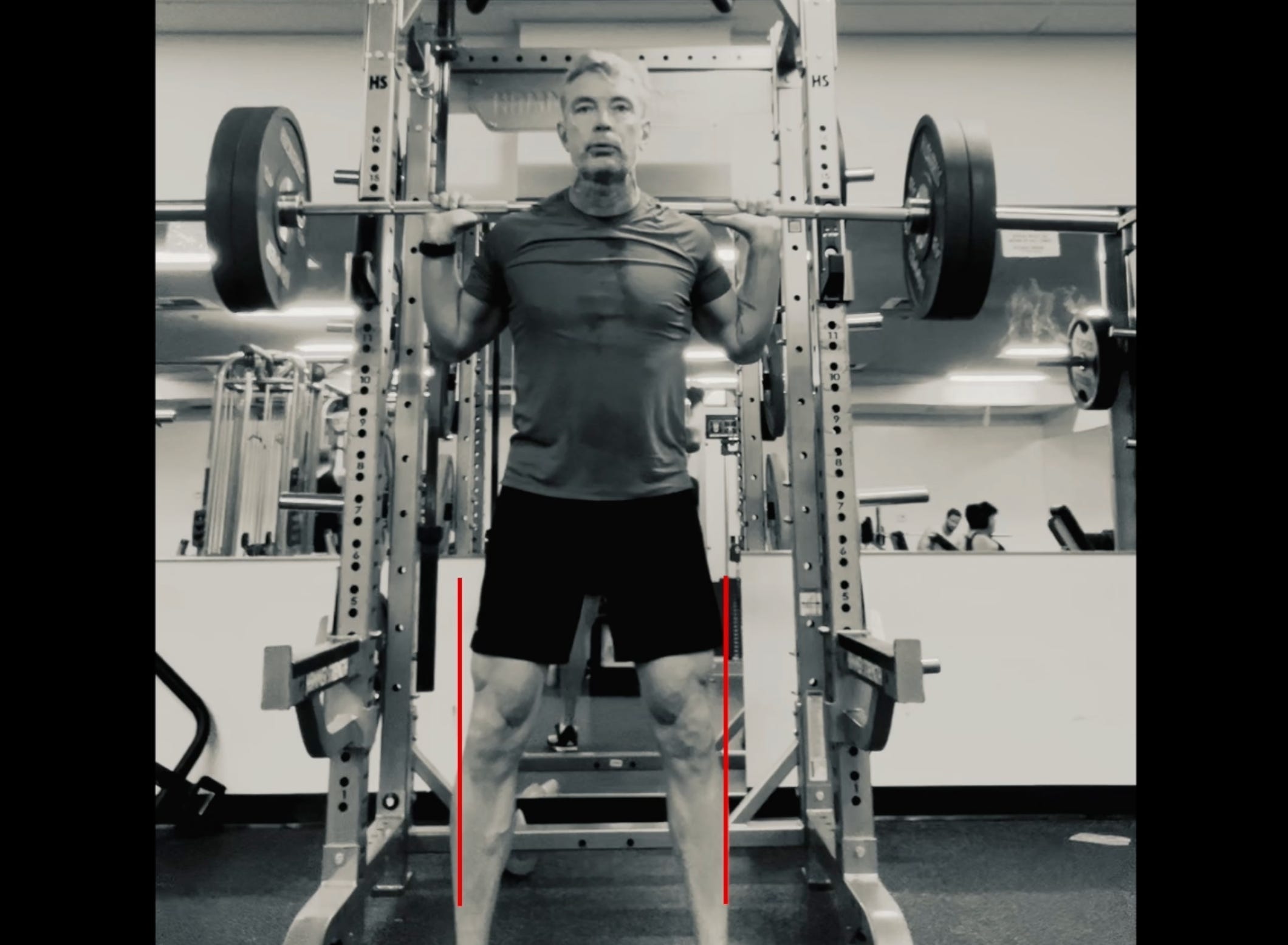
In that regard, I’m pretty much Exhibit A for my argument to ditch bar squats. I can squat heavy, and my form may look fine at first glance. But as you watch the above video, notice how much my left knee wanders with each rep, relative to the red vertical line (my right knee also does but not as much). That’s knee valgus, likely a function of weak hip stabilizer muscles, including medial glutes.
I hadn’t noticed that movement until I recorded myself, and for anyone who continues back squats, I recommend they do the same, from the front, side and rear, to understand exactly how their bodies may be compensating to manage the weight.
Further below, I offer a video of me doing a different weighted leg exercise that works the same muscles but without the lateral knee movement.
Don’t take just my word for it
As it turns out, some heavy hitters in the professional strength and conditioning world have come out in favor of ditching bilateral back squats. Here’s Mike Boyle, a renowned former strength & conditioning coach for the NHL’s Boston Bruins, the U.S. Women’s Olympic Ice Hockey Team and the Boston Red Sox, speaking in September on Peter Attia’s podcast (before Attia’s troubles) about why he moved away from training athletes on bilateral back squats:
Boyle argues against bilateral training in favor of unilateral strength work, which I was heartened to hear because it validated one of my favorite lower-body strength routines—it’s No. 3 in my list below.
“Let’s look at how the fastest people in the world, the people that jump the highest in the world—what are they doing for training. And again, you start to see more unilateral work, unilateral plyo work, unilateral strength work….”
— Mike Boyle, Olympic, NHL & MLB strength coach
6 better alternatives to squats for lower-body strength
If back squats work for you, and you love them and you’re convinced your form is excellent and you don’t want to give up the exercise, don’t. Just don’t go heavy.
But if you’re willing to consider better strength workouts for your legs and core, here are my top 6 strength workouts with explanations why I think each is superior to back squats.