


The takeaway: Aging research that isn’t fully transparent allows the media to misinform readers, misrepresenting what the science actually shows.
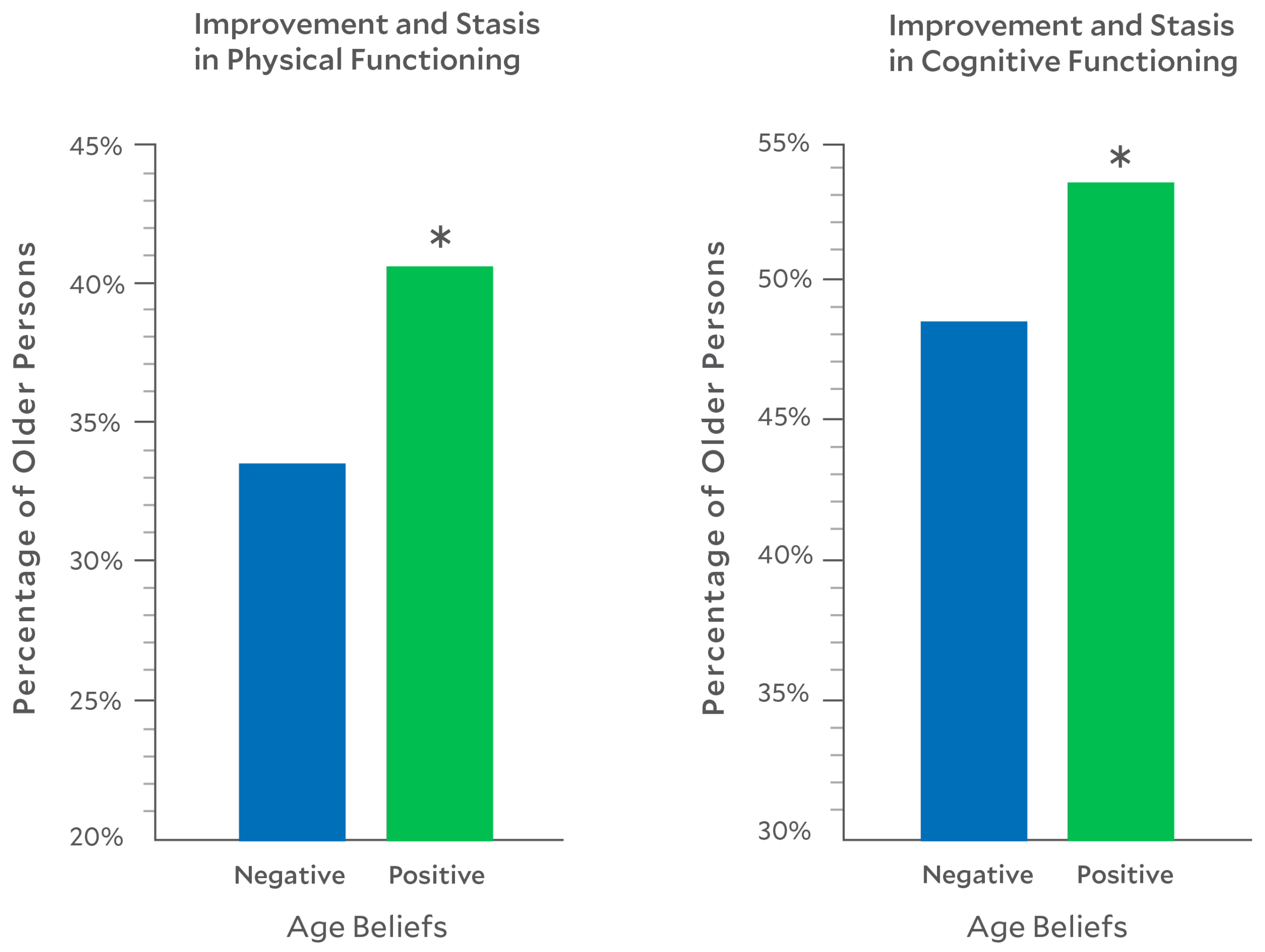
The journal Geriatrics published a Yale study with an unusually hopeful message about growing old: a lot of folks 65 or older appear to get measurably fitter, physically and intellectually, as they age. Drawing on federal data from more than 11,000 older Americans followed for up to 12 years, the researchers found that 45% of those measured in both domains improved in cognition or physical ability.1 The study presented positive age beliefs as a key predictor of who improved.
Unsurprisingly, national media ran with the story—the Washington Post; Scientific American; AARP—with the dominant headline being: aging is not a headlong descent into the grave, and positive beliefs about it lead to better outcomes.
I believe that’s true; it’s no small reason why I launched AGING with STRENGTH 22 months ago (and why I plan to build out its value proposition in the near future—more on that in an upcoming post). But one of the reasons many of you read this column is because it challenges convenient headlines on aging research and flips over stones everyone else, including researchers, leave unturned.
What I found, after interviewing the Yale’s lead researcher and reading the study’s full text and citations, is that this paper gets too many things wrong or not exactly right. It suggests causality its data don’t support and appears to mischaracterizes evidence.
I spent nearly three weeks researching and then working out how to present these findings. I continually asked myself, “Who cares?” to keep this report relevant to AGING with STRENGTH readers, and not venture too far into the scientific weeds.
Specific failures in Yale’s research into positive aging beliefs
Author’s note: The critiques below lean on principles like causation, correlation and odds ratios. I added footnotes to provide clear, plain-English explanations.
Yale’s aging beliefs paper did a few things that I wished it wouldn’t have, given the public hunger for greater transparency and accuracy in longevity-related communications nowadays:
It strongly suggests a one-way causal story—positive age beliefs leading to better health—even though the data it reports cannot establish causality2
It didn’t mention evidence consistent with a two-way relationship: healthier behavior and better function may also foster more positive beliefs about aging, not just the reverse
Though it lists factors it controlled for (depression, sleep, isolation, marital status, cardiovascular disease and diabetes, education, race, APOE43), it didn’t mention the possibility of other confounding influences like income, healthcare access, exercise or personality traits4—all plausible drivers of both age beliefs and health outcomes
The study didn't explain, in plain English, how statistically modest the data showed positive age beliefs to be as a predictor of improving health (odds ratios = 1.04 to 1.22), or how weak the correlation was (r = 0.09) between physical and cognitive health improvements occurring in tandem5
It misapplied a French philosopher's analysis of how biologists define aging and mischaracterized a WHO handbook on eldercare to support its assertion that most people believe older age is, respectively, largely “a process of loss,” and “a time of inevitable and universal cognitive and physical decline”
Before examining that last critique in greater depth, it’s worth stating clearly that the Yale study’s main argument is well established and feels intuitively right: how optimistically we view our remaining years must influence how we age. The argument rests on decades of research, much of it conducted by the paper’s main author, Becca Levy, a highly regarded Yale professor of public health and psychology. In 2022, Dr. Levy published a book, “Breaking the Age Code: How Your Beliefs About Aging Determine How Long and Well You Live.”
That depth is why these specific critiques of Yale’s research are worth raising. Also, the most rigorous science shows its work and highlights what it doesn’t know, as I point out below. So, I did what the media coverage of this study6 apparently did not: I read the PDF of the full paper and of several of its citations. And I wrote to Dr. Levy with questions, three times, and she responded three times.
The Yale study’s lead author’s response to questions, Pt. 1
Dr. Levy's replies were gracious and detailed and leaned heavily on the paper's own language and framing, which she said is based on stereotype embodiment theory. She created the theory in 2009 to explain how age stereotypes influence older adults’ health. On the science, she engaged directly, conceding that the study never tested the reverse direction and that the relationship is likely reciprocal. But none of that reasoning appears in the paper itself. My questions about the two outside sources were not addressed in substance.
“I do think that health behaviors are likely involved in the improvements we observe,” Dr. Levy wrote in responding to my initial questions, “and it is also likely that there is some back and forth dynamics with age beliefs contributing to better health behaviors and then these behaviors reinforcing positive age beliefs.” Her own stereotype embodiment theory, she noted, proposes that “health behaviors are a central pathway for age beliefs to impact health in later life.”
Dr. Levy also pointed to studies that test the reverse direction—health and functioning predicting later age beliefs—while emphasizing that in those analyses, effects are stronger from age beliefs to health than the opposite direction. That is broadly consistent with some longitudinal work she cited.7
But then I asked about those two curious citations the Yale study used to support its argument that “the predominant narrative of aging” is one of “inevitable and universal decline.” And this is where, in the absence of relevant data to support that claim, I believe the Yale paper got it wrong.
People don’t believe aging sucks as much as Yale says they do
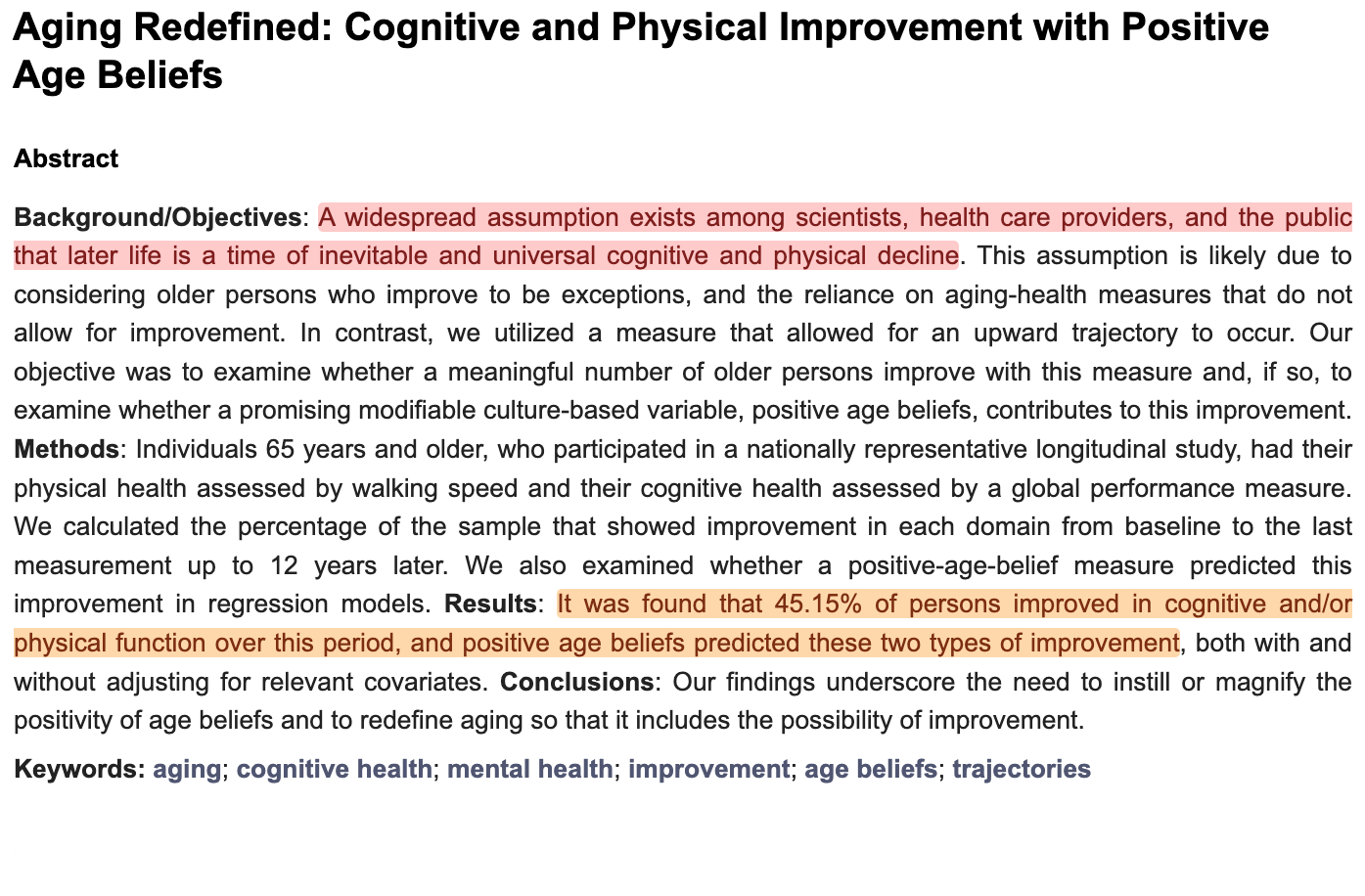
“A dominant belief about aging held by scientists, health care professionals, and the lay public,” the authors write in the paper’s introduction, is “that it is a time of inevitable and universal decline in functioning.” The next sentence adds: “A review of scientific definitions concluded that ‘Aging is consensually described as a process of loss’” (italics mine). (The study later refers to “the focus” on aging as a time of decline as a “predominant trend.”)
Curious about why any scientific description of aging would focus only on loss, I looked up the citation, which points to a 2020 paper by Maël Lemoine, a full professor of philosophy of medical sciences at the University of Bordeaux, whose definition of aging seems to be unduly grim:

An examination of the full paper8 from which the above abstract is pulled makes clear it’s a conceptual review of the evolutionary theory of aging rather than a definition of modern human aging or aging beliefs. Using it that way invites more questions than answers.
Misstating the World Health Organization’s views on late adulthood
Where the Yale paper appears to misstate fact is its characterization of the WHO’s 168-page handbook, Integrated Care for Older People, or ICOPE, published in 2024 to provide guidance for person-centered assessment and care. The authors cited the handbook to bear out their claim that even the world’s most prominent public health organization defines aging strictly as decline.
But the WHO handbook doesn’t say what Yale says it says.
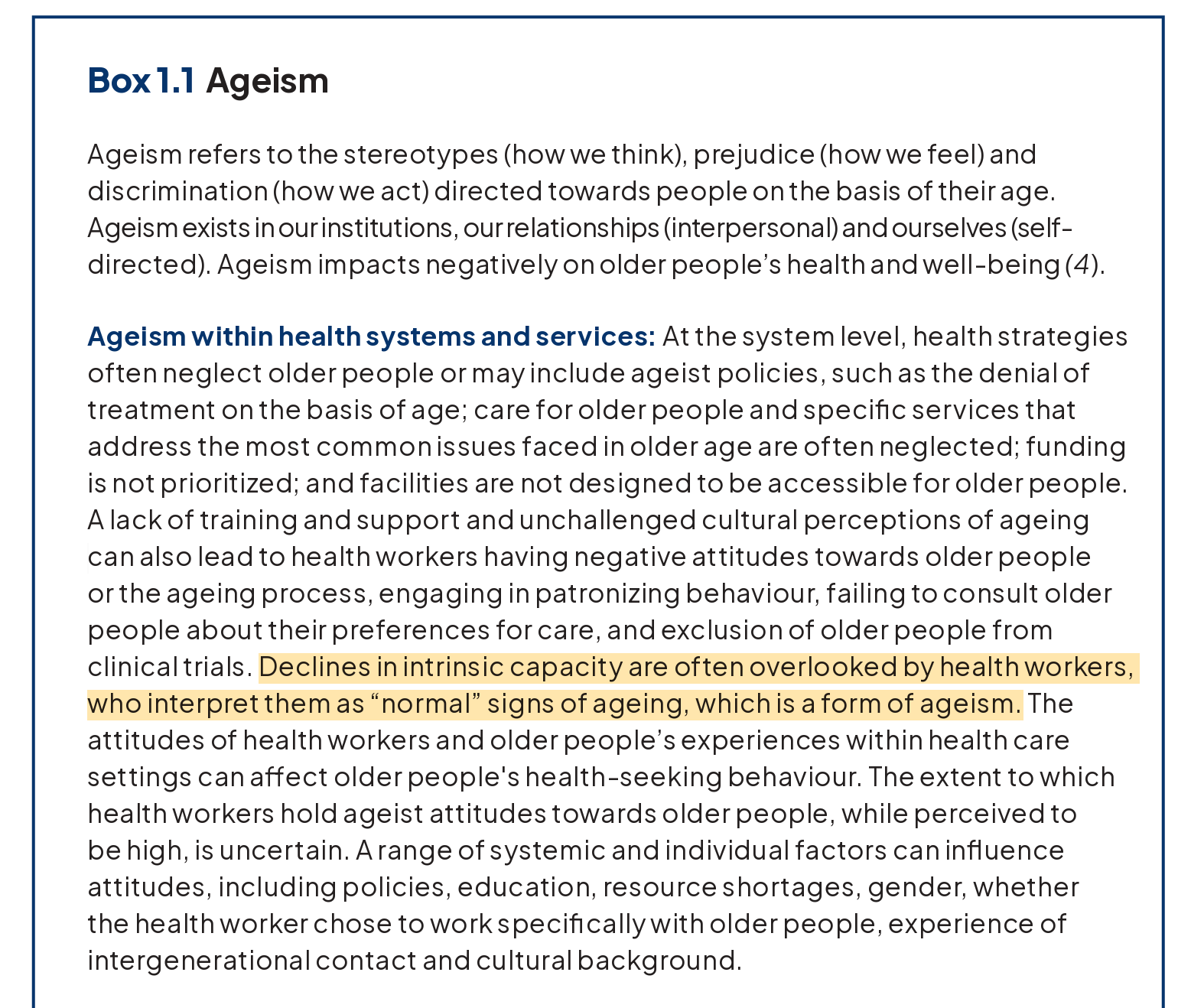
According to the Yale authors, the WHO handbook indicates that (quoting the Yale study here) “the best way to measure cognitive and physical capacities in later life is to classify these domains as either showing or not showing decline. Therefore, the corresponding WHO assessment tool does not allow for the possibility of improvement in these domains.” (italics mine)
However, the WHO manual doesn’t mention a “best way” to measure health capacities. The manual includes a screening tool, built to flag patients for fuller assessment, but that hardly justifies characterizing the WHO publication as not allowing “for the possibility of improvement” among older people.
To the contrary, page 3 of the handbook features a panel, titled “Ageism,” that condemns the aging views that the Yale study’s authors claim it holds.
The Yale study’s lead author’s response to questions, Pt. 2
About the use of a biological theorist’s definition of aging
In response to my question about why the study ran with a definition of human aging taken from a philosopher’s view of biological aging, Dr. Levy did not offer a direct reply. The paper’s aim, she wrote, was to challenge the “widespread myth” that aging is characterized by only decline. “There is evidence from a number of places that this myth is widely held.”
Quoting directly from the study (which cites her book as a source), Dr. Levy cited two surveys:
“A global survey of nearly 40,000 people found that 65% of health care professionals and 80% of lay persons falsely believed that all older persons develop dementia. A nationally representative survey found that 77% of Americans aged 40 and older think that their cognition will decline.”
The surveys are damning evidence of widespread bias. But expecting some cognitive decline is not the same belief as decline being inevitable and universal. Believing all older people get dementia, moreover, is a specific factual error about disease, not a philosophy of aging.
About the study’s claim that WHO believes the “best way” to classify aging is only in terms of decline
My final question to Dr. Levy was whether her paper’s assertion about the WHO’s ICOPE handbook was incorrect, given that A) the handbook’s clinical purpose is to identify older adults in need of intervention, B) its screening tool, like most others, is built to detect deficits, and C) the decline/no-decline rubric that the Yale paper says shows the WHO’s negative view of aging appears only in Step 1, the basic screening assessment, and its stated purpose is to flag older people for fuller assessment and trigger interventions to "slow or reverse" those declines.
In response, Dr. Levy, a scientific advisor to the WHO's Campaign to Combat Ageism, said the WHO is “doing great work addressing ageism” and noted how its screening tool flags declines for further assessment. Her email did not address the question of whether the study misinterpreted the WHO’s view of aging.
Why scientific transparency matters, and an example of what it looks like
When I first went deep into the weeds of this Yale aging beliefs study, it was out of curiosity: wasn’t reverse causation (healthy living → positive aging beliefs) also possible and, if so, why didn’t this peer-reviewed paper even mention the idea?
As I read further into the citations, the language seemed dispositive about causation being one way, but not the other. And the paper’s juxtaposing its support for positive aging beliefs against what it claimed is a near-global consensus that aging is a downward-facing dog—it didn’t feel appropriately cautious in the way most research is presented.
That matters because all of us, as consumers of aging research, deserve clarity. Clarity about whether a behavior causes a health outcome or is only associated with it. Clarity about why we should accept a baroque definition of aging from a philosopher in Bordeaux. Clarity about why a WHO screening tool should be taken as evidence that the organization can’t fathom aging as anything but a subtraction.
A dataset’s limitations matter. Causality (or its absence) matters. Being scientifically clear to the public about what data reveals and what it leaves open to question (eg, directionality) is what creates a literate, informed aging public.
And then, by chance, I came across another aging science paper that examined walking speeds in older adults, which makes clear the limitations of its findings.
The paper, published in Neurology9 this month, found a link between “super movers”—people 80 and older who maintained walking speeds far faster than their peers—and slower cognitive decline and lower risk of cognitive impairment. However, the Neurology paper explicitly flags the observational limit, cites competing directional explanations and addresses causality directly, stating:
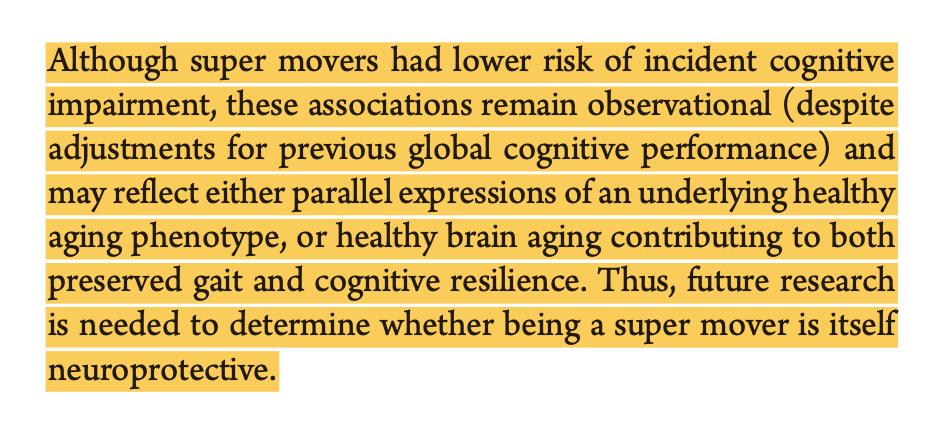
That’s what scientific transparency looks like.
What did you think of this article? Please let me know in a comment.
The Yale study’s findings, summarized: The study used phone-based cognitive testing and walking speed as its two outcome measures. About 32% improved cognitively (in a sample that included participants as young as 50), 28% improved in walking speed, and 45.15% of those measured in both domains improved in at least one.
The paper's statistical language is careful: age beliefs "predicted" improvement, the correct term for a correlation. But the framing around it isn't. The abstract's stated objective was to examine whether positive age beliefs "contribute to this improvement," and its conclusion urges instilling or magnifying positive age beliefs—a recommendation that only makes sense if beliefs cause the improvement, which this study's design cannot establish.
APOE4 is the strongest known genetic risk factor for late-onset Alzheimer’s disease
It's unclear whether the omission reflects a deliberate scope decision or a data limitation, since the federal data that this research is based on, known as the Health and Retirement Study—a nationally representative longitudinal survey of Americans aged 50 and older—does collect some of this information (eg, income, physical activity).
Plain-English explanation: The study scored each person's age beliefs on a 5‑to‑30 scale. Depending on the outcome and model, each single point higher came with roughly 4% to 22% better odds of improvement — a small step per point. The weakest result, for cognitive improvement, was statistically borderline, with an effect close to no change. Separately, physical and cognitive improvement turned out to be nearly independent of each other (r = 0.09): knowing that someone got sharper told you almost nothing about whether they also got faster. By contrast, the correlation between physical and cognitive improvement was very weak (r = 0.09), indicating that those two kinds of improvement rarely occurred together in this study.
Several media accounts framed the study as showing that positive beliefs about aging improve health, a stronger claim than the study’s observational design can establish.
a) Sargent-Cox KA, Anstey KJ, Luszcz MA. The relationship between change in self-perceptions of aging and physical functioning in older adults. Psychol Aging. 2012 Sep;27(3):750-60. doi: 10.1037/a0027578. https://pubmed.ncbi.nlm.nih.gov/22390161/
b) Luo, M.S., Li, L.W., & Chui, E.W.T. (2020). Self-perceptions of aging and control of life in late adulthood: Between-person and within-person associations. Journal of Aging and Health, 32(9), 1275–1281. https://doi.org/10.1177/0898264320917303
c) Joshanloo, M. (2025). Longitudinal relationship between self-perceptions of aging and depressive symptoms: Exploring reciprocal within-person links. International Journal of Mental Health and Addiction, 23, 1162–1178. https://doi.org/10.1007/s11469-023-01162-3
https://link.springer.com/article/10.1007/s10539-020-09765-z#Abs1
Jayakody O, Milman S, Barzilai N, Weiss EF, Wang C, Jin Y, Blumen H, Verghese J. Cognitive Aging and Brain Health: A Comparison of Super Movers vs Nonsuper Movers. Neurology. 2026 Jul 14;107(1):e214776. doi: 10.1212/WNL.0000000000214776. Epub 2026 Jun 16. PMID: 42302219.
The rigour you bring to this critique matters beyond the specific study, because the broader conversation about ageing — including the case against ageism in recruitment and organisational life — is only as strong as the quality of the evidence it rests on, and a field that overstates causality or misrepresents sources hands ammunition to those who prefer comfortable dismissal over genuine engagement. The distinction between correlation and causation is not a technicality here; it is the difference between a call to action grounded in science and one that can be picked apart. What do you think would need to change in how ageing research is communicated to the public for this kind of critical scrutiny to become the norm rather than the exception?
Paul, studies like this remind me very much of what happened to the field of economics when it was decided almost universally that only things that can be proved mathematically are to be taken seriously. It essentially took what I will casually call common sense out of the equation. It took the otherwise brilliant philosophies of the Austrian Economist’s out of the main stream for a considerable time because the math was and is hard to come by.
If I understand what this study is trying to say (and I’m not sure I do), I think it makes the modest suggestion that someone’s general beliefs about aging impact the measurables of their aging, with aging simply being defined as a process of loss of prior physical or cognitive capabilities. The quality of the study aside (and it seems like pretty weak self-reported data), hasn’t the undeniable placebo response to water pills already settled this?
In general, Winnie the pooh, maybe Kanga and Roo, Tigger, and perhaps Piglet will have generally better health outcomes than the fatalist Eeyore, or cortisol anxious Rabbit because they can see silver linings.
Belief that something is possible, real belief not just “that would be nice if it were so” belief, will impact someone to their core and change their behaviors in immeasurable ways.
My modest thought on this is that Sooner or later, you will get what you really expect you are going to get because on a very deep level, that expectation affects everything about how you behave, consciously and unconsciously.
Sidebar: of course, the ever irresponsible media will cherry pick items and declare causality when the research may only suggest that it bears further scrutiny. Sadly, the modern mainstream media appears to have an agenda that has very little to do with pursuing the truth. It is tragic, and has been going on so very much longer than most people, myself included, realized. Thank you for trying to tease out some useful information from this study Paul.