


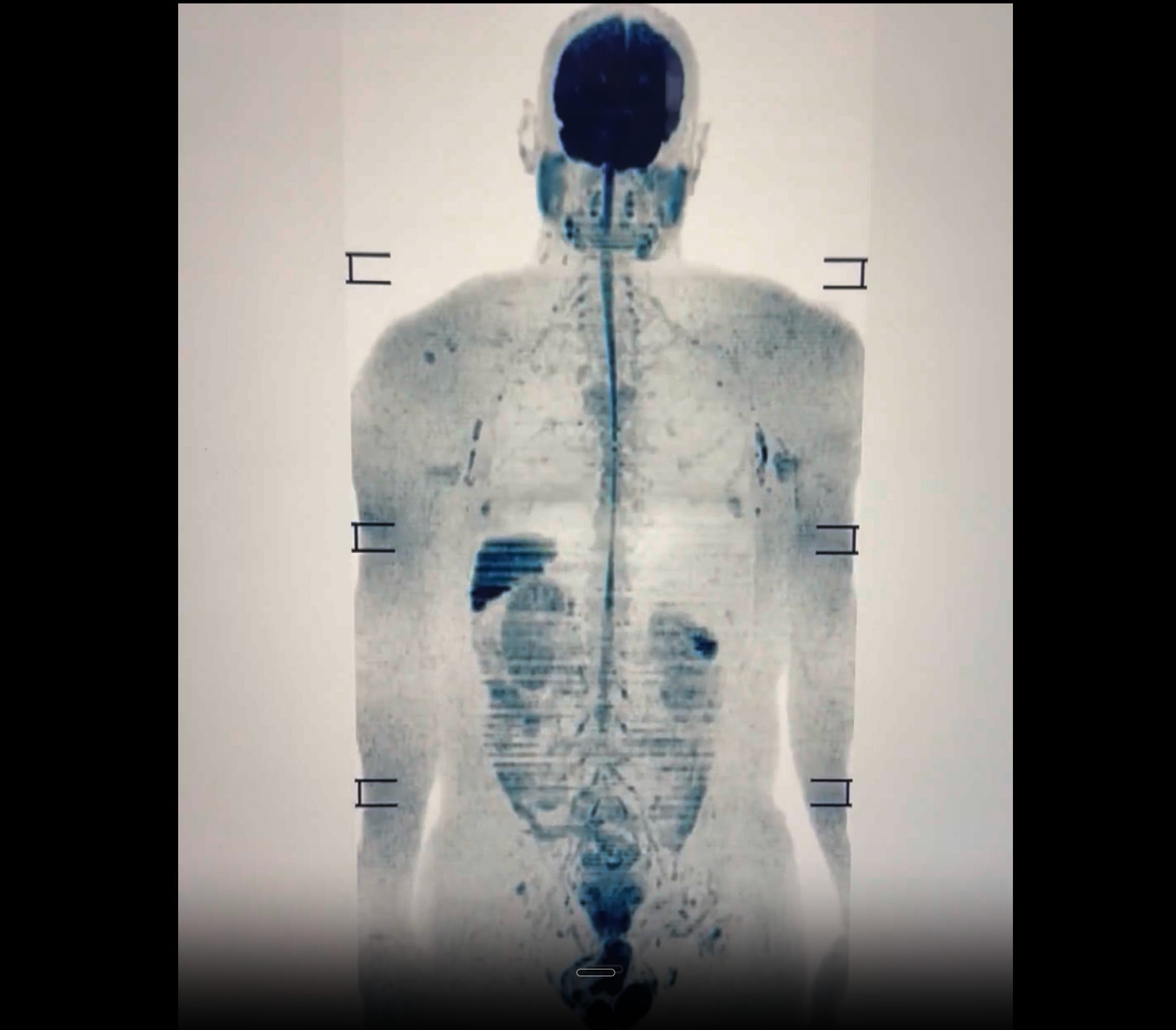
A couple months ago, I underwent two “full-body” MRIs offered by two different private companies to compare the experiences and results of each. One scan was by Prenuvo, the other by Ezra. How an asymptomatic, healthy and frequent skeptic of the Longevity Industrial Complex came to submit to two medically unnecessary MRIs is a story in itself, which I tell below.
Also, yes, the video above is of me, resonating magnetically “naked.” I assure you it’s the first and last time you’ll see my organs on the internet (or on video). But first:
Takeaways from my two “full-body” MRI scans:
Don’t expect a full-body scan. Neither MRI actually scanned my full body. Neither was necessary, as I had no medical need for them. Each offered some useful information but raised more non-urgent questions than they answered.
Prenuvo > Ezra. Prenuvo is almost $1,000 more expensive than Ezra for similar MRI scans. Prenuvo offers a superior experience and product that includes post-scan consultation with a clinician. Ezra seems intent on shaving every possible cost, and its MRI scans are done by a third-party vendor.
VC-based health tech. Both companies are venture backed, receive celebrity endorsements and, unsurprisingly, call themselves tech companies, not healthcare providers. Ezra, owned by Function Health, especially made me feel not like a patient but a consumer to be upsold. (More on that, below.)
You agree to give away your personal health information. Collecting it is central to each company’s business model. Surprised?
Limited accuracy. Each scan missed things that the other highlighted and vice-versa, illustrating why health professionals and medical organizations criticize their use in asymptomatic people. These scans can be medical rabbit holes that can prompt needless anxiety and medical follow-ups.
Clumsy user experiences. Neither Ezra nor Prenuvo makes viewing your downloaded MRI images easy. Ezra’s report felt half-assed at times, and its AI-agent, “Fin,” seems set up mostly to discourage Ezra customers from seeking a post-scan consultation with a human clinician.
Bottom line: If you’re healthy and don’t have significant reason to suspect you won’t be in the future, you probably don’t need a partial-body MRI.
About this article
Earlier this year, I was approached with an offer from a private individual: undergo two “full-body” MRIs from two of the most popular health-tech companies offering them and report my findings on AGING with STRENGTH. There were two conditions. One was that my expenses, including the cost of the scans and the time to report and write this story, would be covered by the individual, an entrepreneur in an unrelated business, who made the offer through an employee. Another condition was that this person not be publicly identified in my report.
After some thought about the ethical implications of the offer, I agreed. I could write whatever I found, as I always do, with no conditions, limitations or influence (I’ve never spoken or communicated with the person who underwrote the research below). I would receive access to a controversial longevity-industry service that would otherwise be out of my price range (or interest, frankly). I’d be compensated for my work. And I would share my reporting with you and acknowledge the terms up front.
Here’s what I found.
Ezra and Prenuvo “full-body” MRIs, compared
Price points: Ezra’s scan cost $1,649 and didn’t go below my pelvis. Prenuvo’s cost me $2,099 (which included a $400 holiday discount) and stopped at my knees because I was too tall—something Prenuvo didn’t make clear before I paid them. Neither MRI scanned my arms. So much for “full-body.”
Facilities: Prenuvo's operation was located in the lobby of an office building 15 minutes from my home. Its operations are entirely in-house, from reception to MRI scan. Prenuvo also has an in-house group of clinicians, including several nurse practitioners (I spoke with one this week, at length). By contrast, Ezra contracts MRI services with a third-party vendor, RadNet, a nationwide chain of outpatient imaging centers. Ezra didn’t make that clear until after I sent payment, and the RadNet facility it assigned me, a 35-minute drive away, wasn’t the one closest to my home.
Ambience & services: Prenuvo’s receptionist and waiting area had the look, feel and aura of a higher end longevity clinic. Warm greetings, offers of coffee, tea or bottled water and a personal escort to a private changing room, to change into branded Prenuvo scrubs. Ezra, by contrast, felt like a typical imaging appointment. RadNet’s front desk employees were perfectly cordial but busy. After identifying me as an Ezra private client, a lab technician walked me into a mini-locker-room changing area, handed me an XL-sized pair of 100% Egyptian-cotton pajamas emblazoned with the FUNCTION HEALTH logos, and told me I could keep them after my scan.
Prenuvo also offered me a free, optional metabolic blood panel, outsourced to Quest Diagnostics, which I did. Ezra offered no bloodwork review.
Insurance plans accepted: None. This isn’t healthcare, remember? It’s health tech.
Results & follow-up: This is where the two companies differentiated themselves—in different directions. Prenuvo and Ezra each created a digital report of my MRI results, segmented by body area. Prenuvo’s scan covered head/neck; spine (cervical, thoracic, lumbar); chest, abdomen, pelvis and knees. Ezra’s MRI didn’t scan chest or knees. Prenuvo’s digital dashboard of my report was delivered within three weeks of my scan.
Ezra’s rollout of my results was more choppy: The company first sent the faxed RadNet radiology report, written in medical shorthand. Then it sent an update. Then it sent the final, digital report, correcting a dictation error in the original report.
Above: A video of the Prenuvo MRI of my chest, abdomen & pelvis, from top to bottom
Prenuvo let me speak to a human. Ezra bot-blocked me.
The area in which I was most impressed with Prenuvo and least impressed by Ezra was in the post-scan follow up.
Prenuvo reached out to offer a consultation with a nurse practitioner, with whom I had an unrushed, very personable and enjoyable 45-minute conversation about my results and what they reveal and do not reveal about my health and any need for concern or follow up.
Ezra parried every attempt I made to speak to someone about my results. Instead of a human, Ezra bot-blocked me, using its AI agent, “Fin.” When I called the phone number, the auto-voice said, “We primarily answer inquiries online” and “Press 1 to switch to a live chat via SMS.” When I did, I found myself again in a cage-fight with Fin, which told me in its anodyne, HAL-like tone that it couldn’t help me.
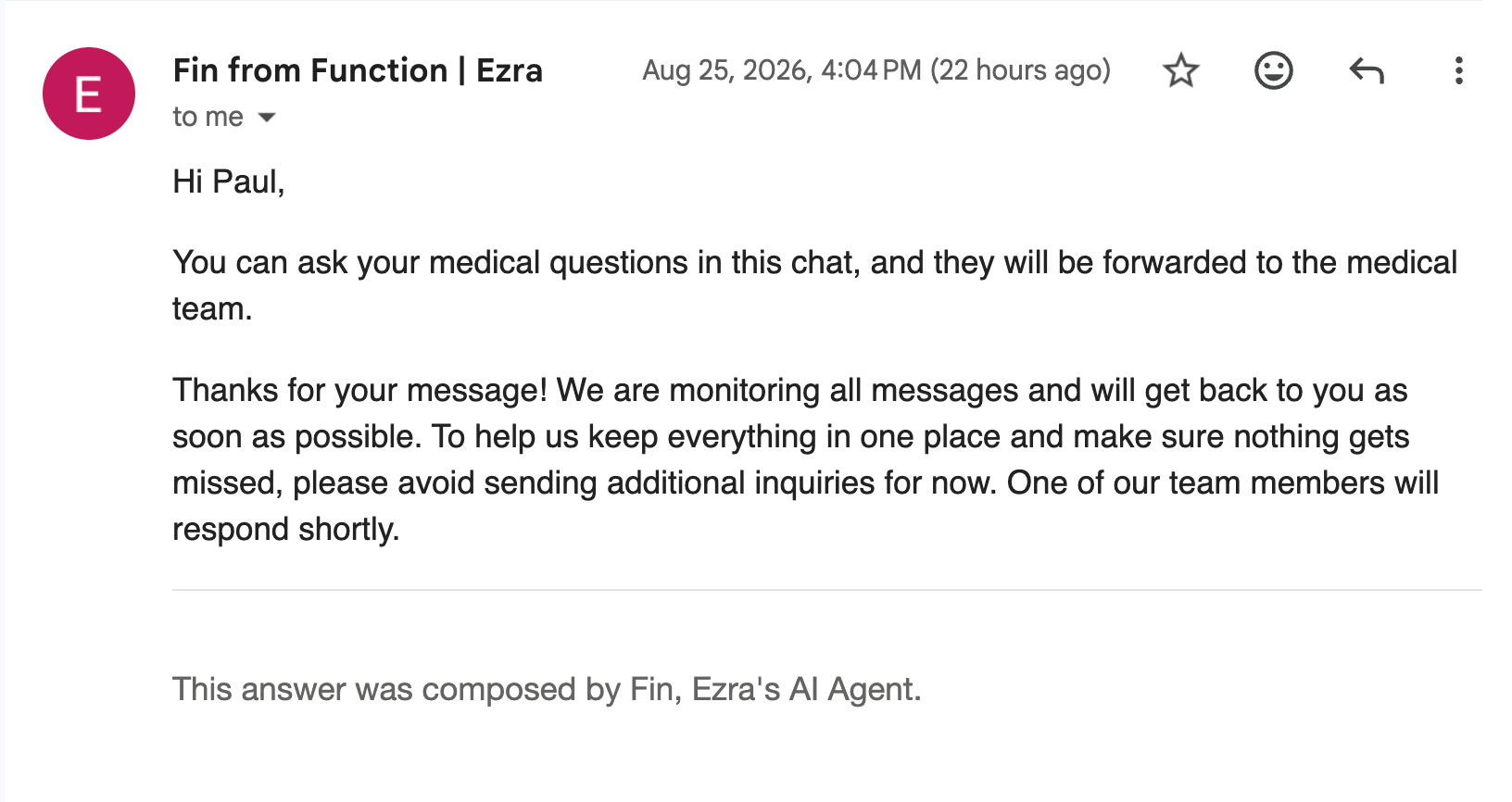
Data accuracy: Both companies were not as accurate as I had hoped, given the prices they charge for their services. Prenuvo identified my wrong knee as fluid-filled, which it labeled as one of the few things I should keep an eye on. It also failed to even reach my ankles, where I had hoped to gain some insight into any damage to ligaments from an old soccer injury. The MRI machine can’t reach the ankles of anyone over six feet tall.
Ezra rescheduled my MRI less than two hours before the appointment, because of what it described as a malfunction with its machine (which I later learned was actually RadNet’s). When I got my Ezra results, they included a notation that some part of my scan wasn’t readable because of movement during the scan. I had remained cadaver still the entire time in the tube.
What “full-body” MRI scans can’t do
“Whole body” is a marketing term, not a clinical one
The limitations sections in Prenuvo’s and Ezra’s downloadable reports are an inventory of what a $2,000-and-up, whole-body scan doesn’t do (or promise to do). They don’t scan the arms past the shoulders. They didn’t reach my ankles. They don’t evaluate the coronary arteries or quantify cardiac risk—so the thing most statistically likely to kill a 59-year-old American man remains outside the scan’s competence.
They also don’t see lung micronodules. They can’t detect GI polyps and don’t come close to replacing a colonoscopy. They can’t detect skin cancer. They’re not designed for the testicles. They don’t fully evaluate the rotator cuff, ligaments or menisci. They may miss thyroid nodules under 1 cm and, according to Prenuvo’s limitations section, “occasionally” ones larger. (How occasionally, I wonder.)
What remains, then, is a solid-organ survey of the torso, head and spine.
“For wellness purposes only”
Of the two MRIs, Ezra’s protocol is narrowest: head, neck, spine, abdomen and pelvis. No chest at all. No lungs, no heart, nothing between the neck and the diaphragm. On page 4 of my report, Ezra clarifies that the service is “for wellness purposes only,” is “not diagnostic,” and doesn’t replace accepted cancer screenings.
If you’re healthy, how much do you want to pay for wellness purposes only?
Above: Prenuvo’s fatty liver detector scan of my liver, from top to bottom.
Same body, different results & reasons for skepticism
Think of these two reports as a controlled experiment: my same body, scanned 8 days apart in late May, scanned by different MRI machines and read by different radiologists. Would they find the same things?
My spine. Ezra found “no significant disc herniation, central spinal canal stenosis or foraminal narrowing.” Prenuvo found multitudes of disc herniations: at C2-C3, C3-C4, C5-C6, L3-L4, L4-L5, and L5-S1—six of them, up to 4.5mm—plus mild central canal stenosis at two levels and foraminal narrowing at roughly eight.
Both readings are defensible; everything Prenuvo found is mild, and mild degenerative change is near-universal at 59. But a customer holding both reports has no way to know that. One says my spine has no significant problems. The other lists 30-plus line items of pathology-sounding findings. Neither changes what I should do, which is nothing.
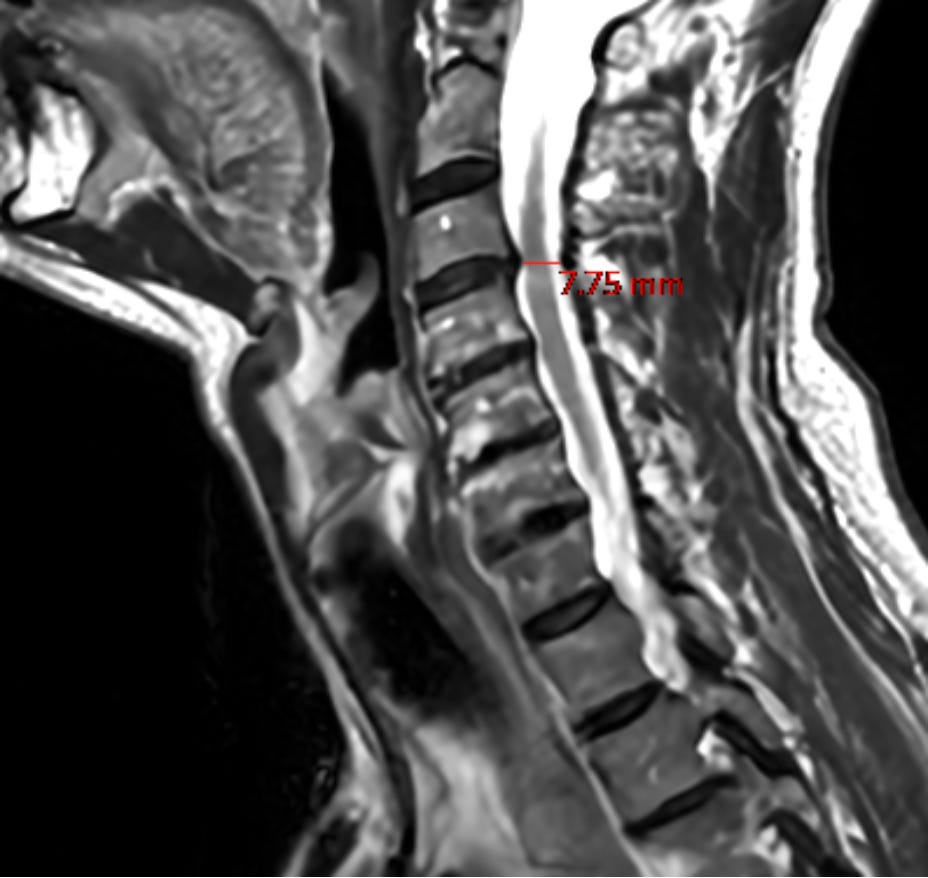
Above: A Prenuvo image of herniation in my cervical spine. (Ezra’s scan found none.)
My brain. Ezra’s single follow-up item—the reason my report says “non-urgent findings that require follow-up” with my doctor within 1-2 months—is its finding that I have a flattened pituitary gland with optic nerve sheath distention, possibly reflecting increased intracranial pressure. Prenuvo imaged the same brain eight days earlier and reported nothing.
Either Ezra flagged a common anatomic variant in an asymptomatic man as a doctor-visit-worthy finding, or Prenuvo failed to report the most clinically important thing in either scan. Both can’t be right, and I can’t tell which is wrong without more medicine, which is precisely the “worried well” rabbit hole that critics of these scans describe.
My kidneys. Ezra found simple cysts up to 2.3 cm plus a subcentimeter cyst on the right. Prenuvo found one 1.9 cm cyst on the left. All benign, but the counts don’t match.
My prostate. (Two words I did not envision typing on Substack, ever.) Ezra flagged heterogeneous signal and recommended a blood test to check it out. Prenuvo, running diffusion imaging Ezra apparently didn’t, found no suspicious lesion. So one company’s report sends you toward a medical test the other company’s imaging suggests you don’t need.
My knee. Prenuvo’s single “Moderate” finding—the top of its key-findings list—is a fluid pocket in my left knee that “cannot be characterized,” for which “a surveillance/investigation plan may be considered.” Except my left knee wasn’t the swollen one. My right knee was.
Post-scan quality control
Ezra’s radiologist electronically signed an impression reading “Mild heart is a sinus mucosal disease”—a dictation garble of “mild paranasal sinus mucosal disease”—which stood for 12 days until an addendum fixed it. Prenuvo’s signed report contains its own artifacts: “Small left foraminal disc herniation.’s no central canal stenosis,” and a thoracic-spine observation filed under the cervical findings.
These are mere dictation errors, not medical ones. But they made it through sign-off on documents people pay thousands of dollars for and potentially read as gospel.
Prenuvo, Ezra and the art of quasi-medical health-tech judgment calls
Pages 19-20 of the Prenuvo report explain that reporting every minor variation “could lead to unnecessary follow-up testing, increased patient anxiety, and possible harm from additional procedures,” and that a normal result doesn’t exclude disease. That’s the standard critique of consumer whole-body screening in the company’s own fine print.
It’s also a tacit admission of the underlying problem: these scans present findings whose meaning depends entirely on judgment calls the customer can’t evaluate, in a population where most findings are non-urgent noise.
Why doctors are not fans of these MRI scans
The American College of Radiology’s position is that there is insufficient evidence to justify recommending “full-body” MRI screening for people with no symptoms, risk factors or relevant family history, and that there is no documented evidence the practice improves outcomes.
A review of 12 studies found 95% of asymptomatic patients had at least one abnormal finding on whole-body cancer-screening MRI. More than 90% of those findings were not relevant. A 2026 academic review notes that adoption is being driven largely by consumer demand and direct-to-consumer platforms, while use in asymptomatic people remains controversial due to low diagnostic yield, false positives, overdiagnosis and the lack of survival outcome data.
My two reports—containing several abnormal findings that are nearly all irrelevant, plus a genuine contradiction on the brain—are a case study of exactly those numbers.
What the scans actually delivered
Here’s a short list of what I got for the money:
confirmation that I don’t have a visible tumor in the scanned organs (with sensitivity caveats)
a spine inventory that reads alarmingly only if you don’t consider my age, athletic background and lack of symptoms
one ambiguous brain finding that one radiologist thinks warrants a doctor visit and another didn’t report at all
a knee effusion (on the wrong knee)
instructions—in both reports—to keep doing the evidence-based screening (colonoscopy, blood pressure, lipids) that Prenuvo and Ezra (aka Function Health) implicitly market these scans as transcending.
Scammy elements of Prenuvo and Ezra MRI scans
Prenuvo and Ezra aren’t that different in their grasping methods or dollar-focused business goals, considering the gold rush mentality that infects the Longevity Industrial Complex writ large. Both companies seem eager to separate wealthier worried well folks from their money, use their data for their own AI and marketing purposes and urge as many follow-up exams as possible.
Example 1: Prenuvo’s full-body scan requires you, after entering your credit card details, to agree that what you’re paying for includes an annual membership that auto-renews unless you later remember to cancel it. That’s scammy.

The Prenuvo report’s parting recommendation is a follow-up scan in 12 months, which, like it’s automatic auto-renew, is part of its profit-first, patientcustomer-second business model.
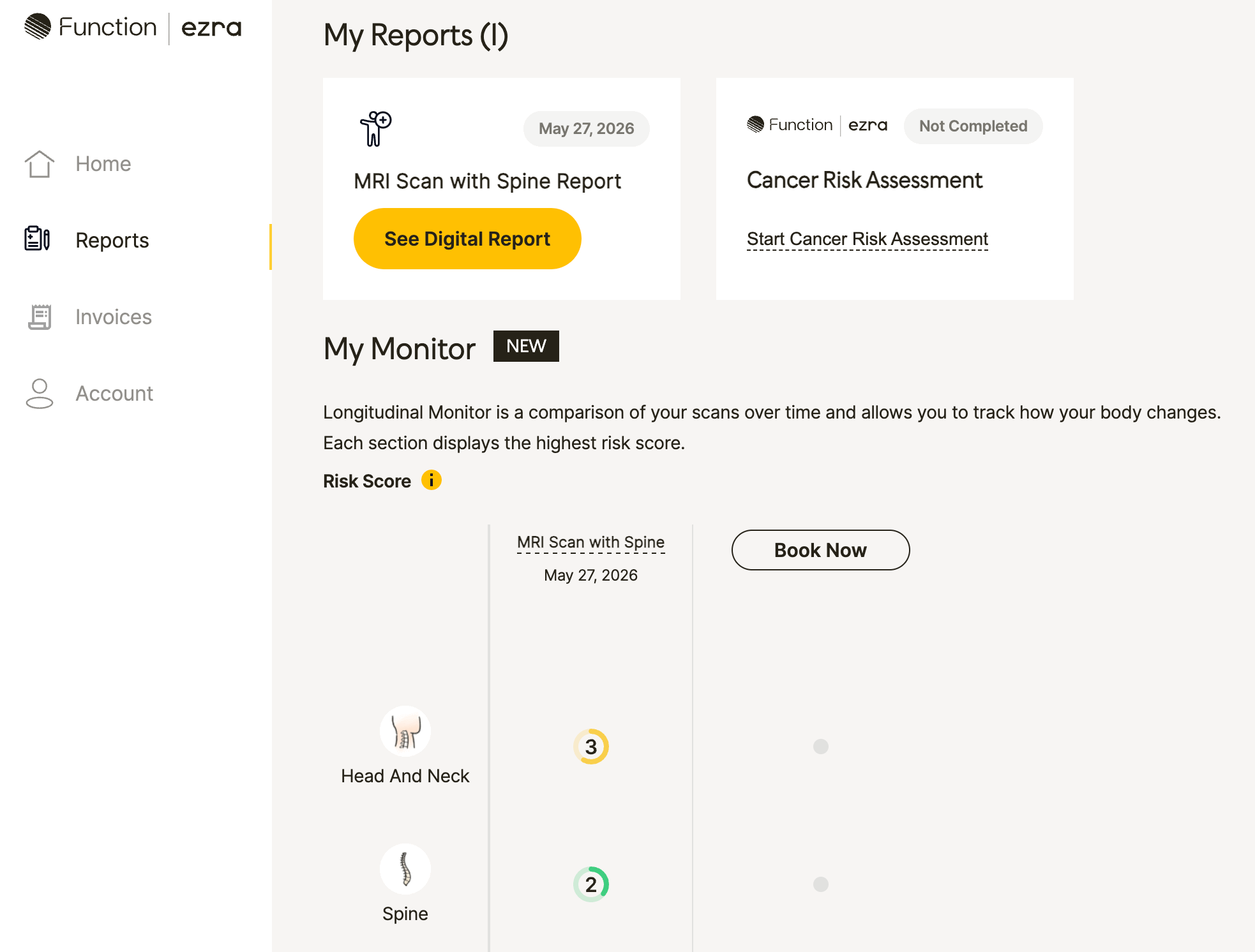
Example 2: The Ezra report includes a “Cancer Risk Assessment” that is utterly unnecessary for any customer not at risk. Ezra’s user interface also includes an ever-present “Book Now” button urging services you may not need.
Example 3: Ezra’s parent, Function Health, was co-founded by Jonathan Swerdlin, a venture capitalist, and Dr. Mark Hyman, the company’s chief medical officer who has shown himself to be less than above-board, if not intentionally misleading, about the supplements he hawks for a profit.
Also, that Function Health added Andrew Huberman, a celebrity neuroscientist known for his great appreciation of Andrew Huberman, to its advisory board is a statement. Whether that statement is that the company cares about solving customer’s healthcare problems or about acquiring their credit-card numbers is the question.
To me, at least, it’s a fairly simple one.
What did you think of this article? Let me know in a comment.
I have to admit it - I really admire your spleen. I don’t say that very often, but my personal and professional opinion is that you have a very nice spleen.
Superb report, as always. Very helpful.