


The billion-dollar longevity industry has become the Las Vegas of clinical science: a faux oasis that cares about only one thing—taking your money. To do that, Vegas built casinos; longevity marketers just lie.
Longevity literacy is therefore a skill—the ability to understand how a growing society of wellness chiselers and charlatans present half-truths as settled science and unproven supplements as the best $149 purchase you’ll ever make—but only if you act now.
lon·gev·i·ty chis·el·er, n. someone who intentionally promotes unproven anti-aging claims or misrepresents science for unacknowledged financial gain.
Below are three recent examples of how agents in the Longevity-Industrial Complex take advantage of their own readers—their most dedicated customers—to enrich themselves or burnish their reputations. I know some AGING with STRENGTH readers don’t enjoy articles like this one and, candidly, I don’t enjoy writing them. But I believe pushing back against wellness hype is important, to set a standard for the future.
Let’s get into each longevity literacy example in detail.
1 | Dr. Mark Hyman misrepresents research to sell a supplement
Hyman is a well-known and relentless figure in Big Longevity. He runs his own branded website and co-founded an online wellness site, Function Health. He’s published best-selling books and prominently advertises his proximity to famous influencers.
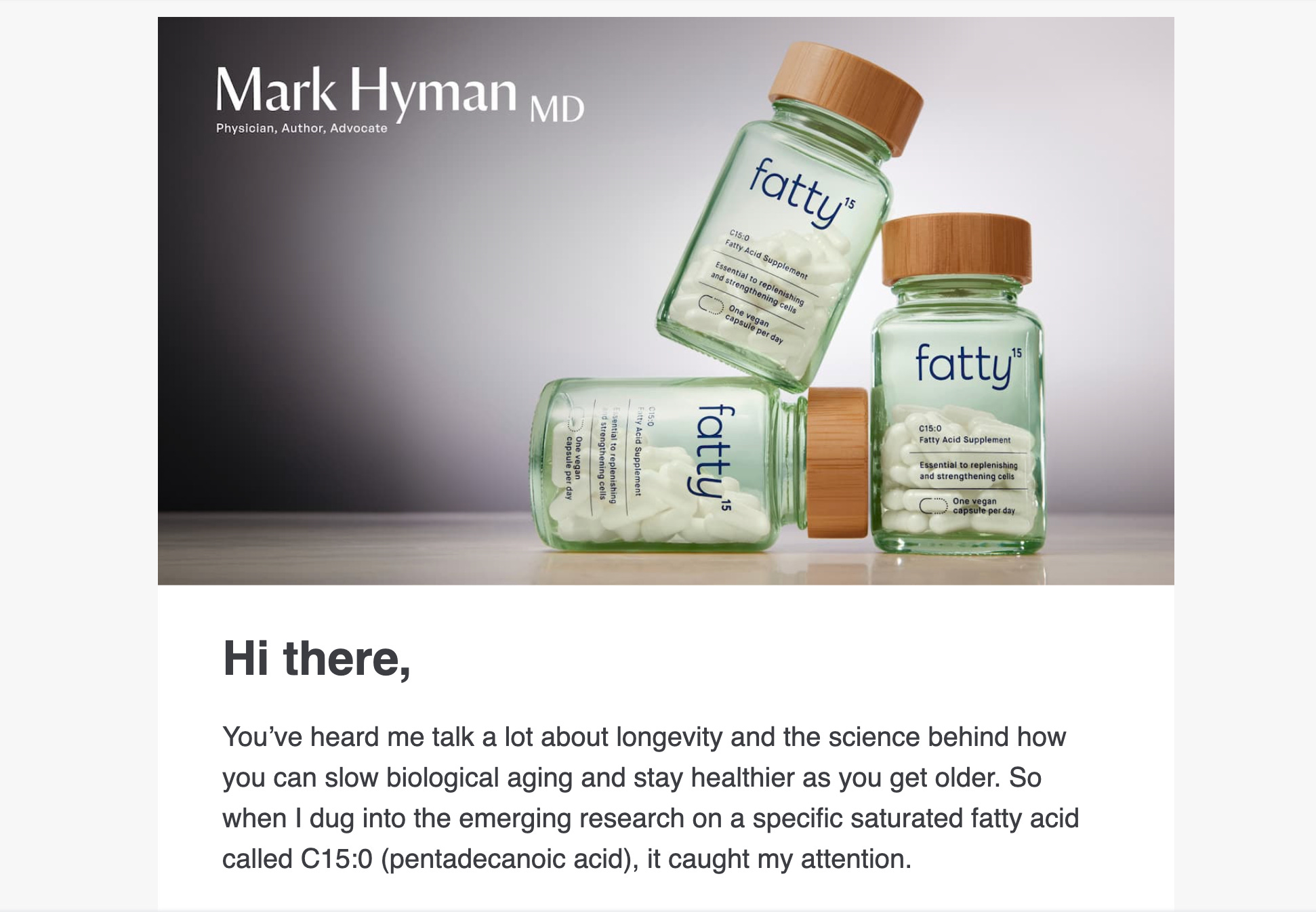
On Sunday, subscribers to Hyman’s newsletter woke up to an email, titled, “A Non-Negotiable in My Healthy Aging Routine.” In the first paragraph, Hyman presents his hook, which is “the science behind how you can slow biological aging,” and then baits that hook with a saturated fatty acid called C15:0, which, Hyman says, has “caught my attention.”
Turns out there’s a C15:0 “standout supplement” called fatty15. Hyman enthusiastically recommends it, citing 15 research papers to support his assertion that fatty15 can “improve our everyday lives.” And, as luck would have it, fatty15’s manufacturer is offering Hyman’s “community” a 20% discount.
But what he presents as a personal anecdote of research and discovery is, in fact, an unacknowledged sales pitch.
EDITOR’S NOTE: I reached out to Dr. Hyman and his website’s support staff by email several time, asking for his response to my questions about his financial relationship to fatty15 and his interpretation of the clinical studies about its active ingredient. He did not respond. A representative from the DrHyman.com support staff replied, suggesting I review Hyman’s website writings.
The undisclosed commercial relationship
Though he doesn’t acknowledge it in his email, Hyman financially benefits from fatty15 sales (the supplement’s website identifies Hyman as a paid promoter of the product). Hyman also sells fatty15 directly through his own website, with his own branded product page and has a promotional code relationship with the company.
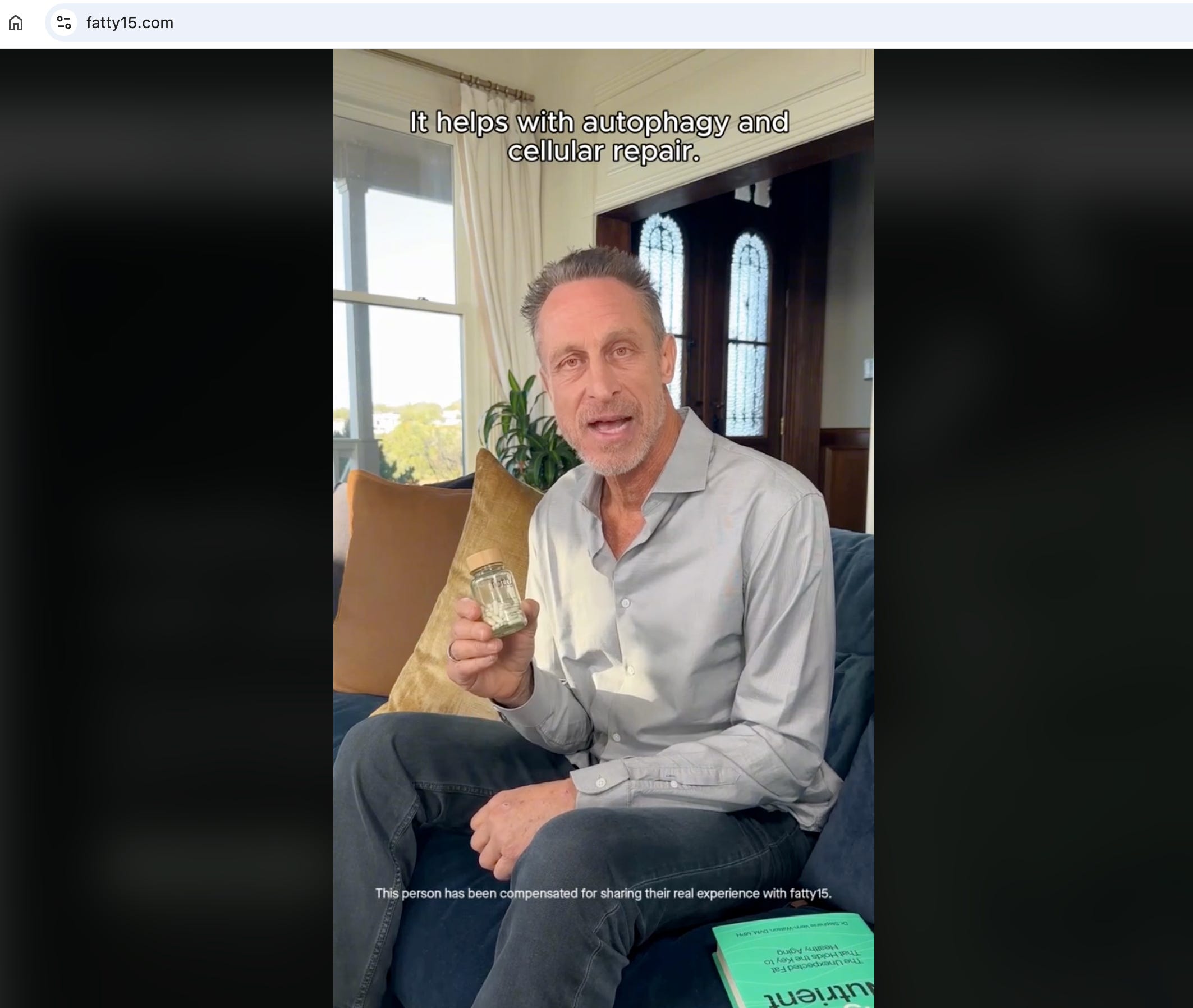
Hyman’s email structured as a personal letter from a doctor (“as I dug into the emerging research…”) is actually cloaked marketing of a product pipeline.
The intentional misrepresentation of research to sell supplements
Hyman’s email dives into what seems like convincing evidence that fatty15 is a supplement with a proven clinical track record. Hyman cites no fewer than 15 research studies. But in fact:
Almost none of the research Hyman cites was conducted in humans, and the two studies that were found effects too small, too narrow, and too preliminary to support anything he's claiming
Several of the 15 cited studies are authored by the co-founder and CEO of fatty15’s manufacturer, Seraphina Therapeutics.
Several other papers Hyman cites studied only mice, rabbits, or dolphins, or involved petri-dish experiments on isolated human cells — the kind of early-stage science that routinely fails to translate into human benefits.
The only human clinical trial of C15:0 supplementation in Hyman's entire reference list involved 30 obese 20-year-olds, and across most key measures—cholesterol, blood pressure, glucose, and inflammation—found no significant improvements.
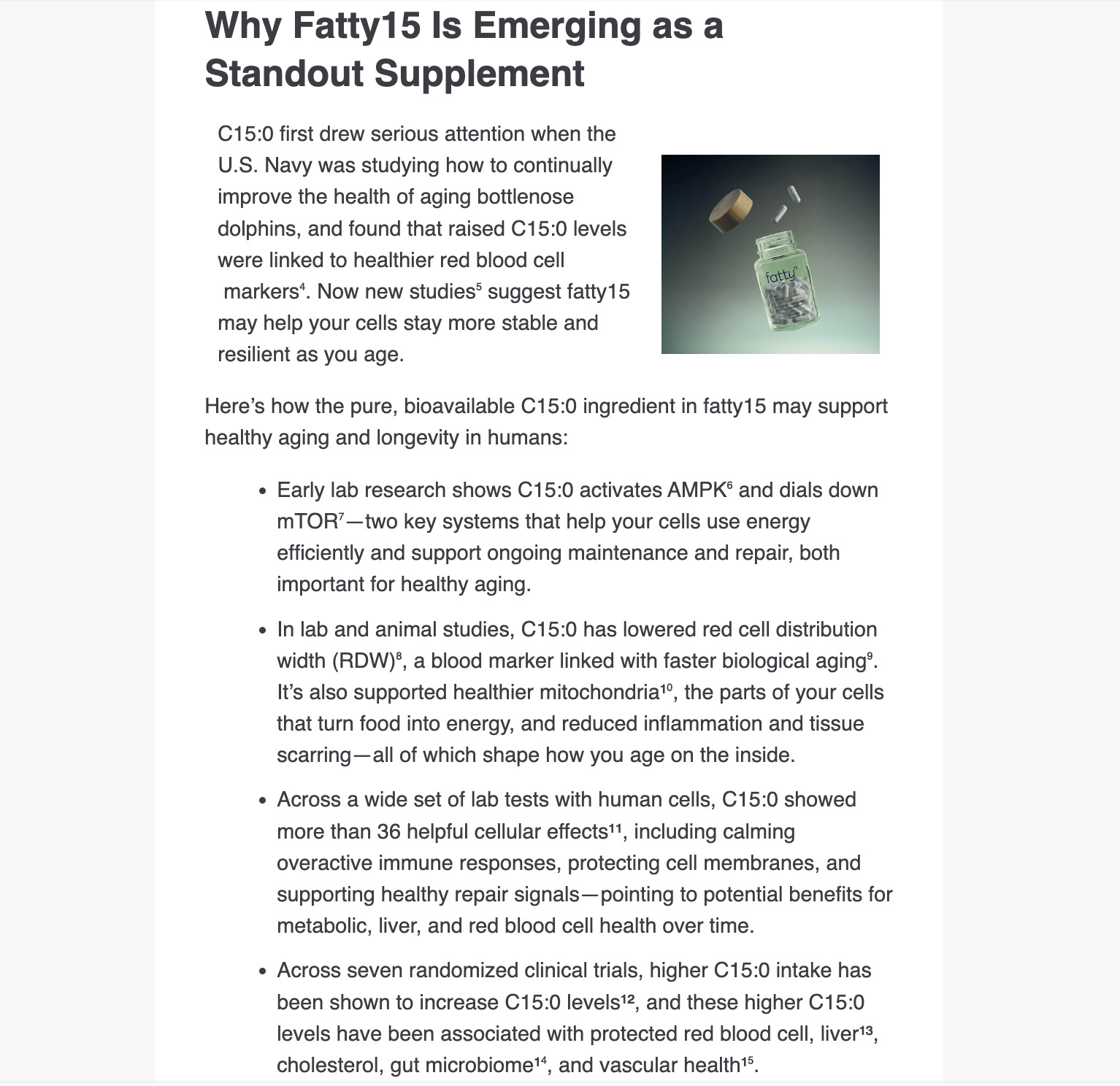
None of the 15 papers Hyman cites is a randomized, controlled trial testing C15:0 in healthy middle-aged or older adults — which is precisely the population to which he’s surreptitiously marketing.1
I asked two longevity scientists about Hyman’s representation of the research behind fatty15. One of the scientists said the supplement may have potential but has “extremely weak evidence for human benefit at this point.” The other scientist called Hyman’s email “100% advertisement.”
“I looked up this product…a while back and read through a lot of those papers,” this scientist told me. “There is no data worth citing, all conjecture and animal data designed to sell a ‘new’ type of fatty acid.”
The sad part is that C15:0 might turn out to have real benefits for people. Hyman’s fatty15 hustle may turn out to be everything he already says without evidence that it is. But when a doctor says things that aren’t fully supported by science, it’s a longevity scam.
2 | Katie Couric Media disguises a supplement ad as straight journalism
Before she became infamous for hanging out with Jeffrey Epstein, Katie Couric had been famous for being a journalist, and rightly so. Today, she runs what appears to be a rather successful media company that blends soft-focus marketing content with some wellness advocacy. But Couric still trades on her previous career as a broadcast news maven, so when her company publishes what looks like reporting, there’s an expectation of transparency and truth.
Which is why I was surprised when I came across a Katie Couric Media article whose headline, I’ve Tried Countless Wellness Products — This One Is Different, sounded like straight-up marketing. The subtitle, Showing your liver some love has never been easier, felt like Marketing 101. But okay, I’m an old-school reporter. Maybe I was just being a curmudgeon.
Turns out the article, whose opening line is, “I’m a sucker for a good Instagram ad,” is a wet-kiss “advertorial” for a liver supplement called Dose. But there’s nothing at the top of the post to alert readers. To the contrary, the post is presented as a piece of (flabby) reporting. To appear more like a real news story, it even includes an interview with “an expert in the dietary supplement and nutrition market,” Kiran Krishnan.
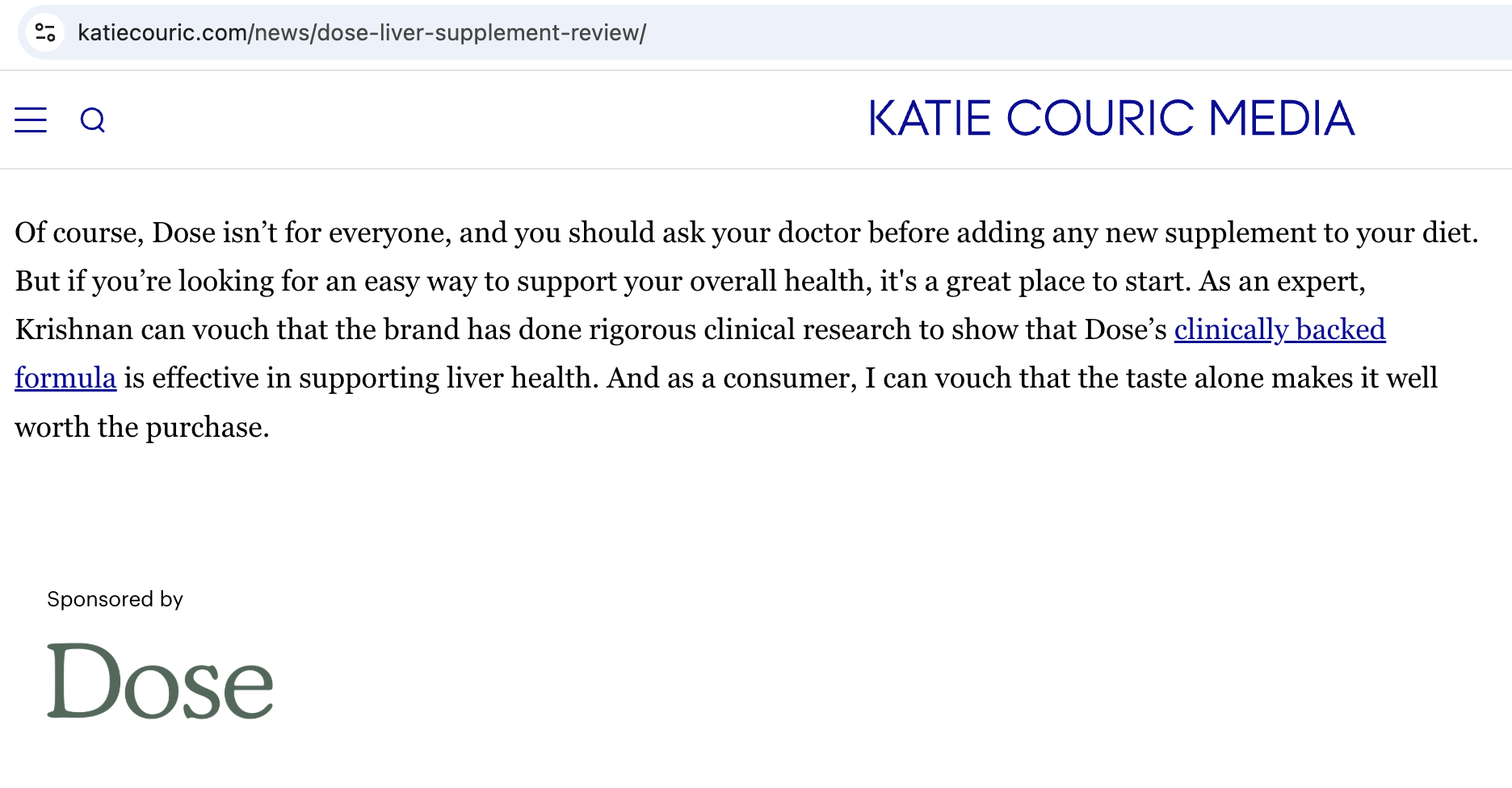
“As an expert, Krishnan can vouch that the brand has done rigorous clinical research,” the article squeals, “to show that Dose’s clinically backed formula is effective in supporting liver health.”
What the article does not disclose is that Krishnan is a member of Dose’s scientific advisory board. At the bottom of the piece, an icon reveals that it was “sponsored by Dose,” and the penny dropped for this reporter.
So it’s an ad. Who cares?
As with Hyman’s email, you may ask: What’s the big deal? Anybody with a nose for b.s. would quickly determine that this fluff piece wasn’t a New York Times investigation. And that’s a fair point. What’s also fair is treating your readers, who are your customers, with enough respect to be transparent in your operations. In this case, that means putting the sponsorship notification at the top of the post, so readers can decide for themselves what value, if any, to give a piece of marketing schtick masquerading as reporting.
Transparency doesn’t sell supplements, apparently.
3 | A university dementia study opts for misleading clickbait headlines
Could diet soda increase dementia risk? That was the head-turning headline of a recent article by the University of Miami’s medical school (or probably more accurately, the school’s marketing department) to stoke attention to its new analysis.
When a university medical school publishes research, there’s a very reasonable expectation of accuracy, without which public trust in even that institution will quickly fade. I’ve written previously about Stanford aging research that didn’t quite back up what the medical school’s press release claimed.
But I haven’t before seen a university medical school so blatantly imply a potential spit-out-your-diet-soda conclusion—drinking Diet Coke could bring on dementia—before acknowledging a few paragraphs later that, in fact, it doesn’t.
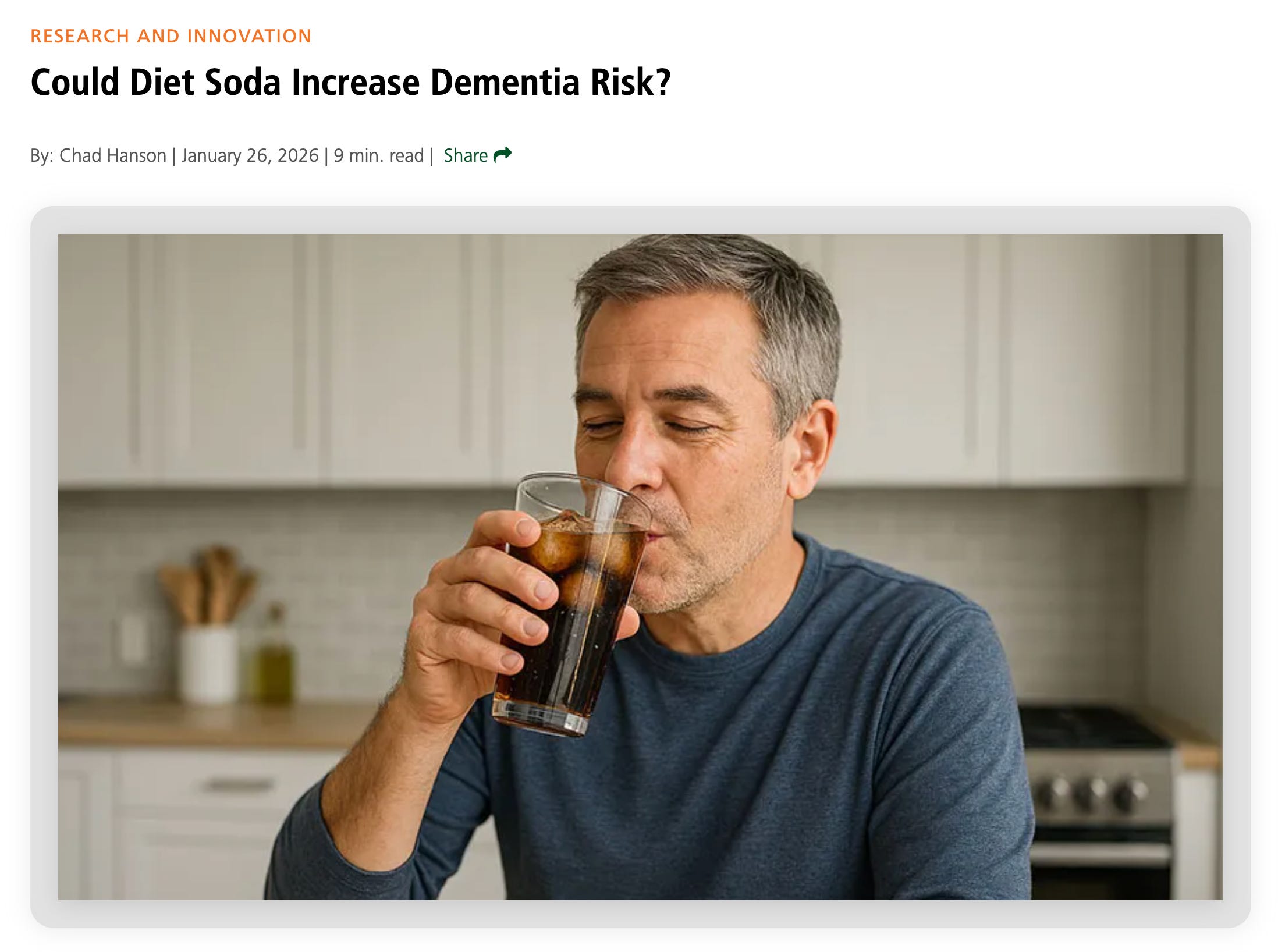
“A new analysis…suggests that drinking diet soda every day may be linked to a higher risk of developing dementia,” the article, published Jan. 26 by Miami’s Miller School of Medicine, reported. Some 15 paragraphs later, the article casually mentions that:
”41% of high diet soda consumers in the study had diabetes, compared with 18% of the rest of the cohort.
“When researchers repeated the analysis excluding participants with obesity or diabetes, the association between diet soda and dementia disappeared.”
Translation: Nevermind! Nothing to see here, folks. Thanks for coming.
That’s why I believe it’s necessary to publish analyses of poor or disingenuous longevity and wellness marketing intentionally disguised as honest reporting. In this case, a peer-reviewed research paper published in the Journal of Alzheimer's Disease stood up a straw-man argument with a juicy headline before essentially knocking it down.
Yet another reason why longevity literacy matters now more than ever.
The two largest, most credible studies show that people who naturally have higher C15:0 in their blood tend to have lower rates of heart disease and diabetes, but those people are eating full-fat dairy, not taking a synthetic capsule, and the association could reflect dozens of other dietary habits.
I hope you will continue this kind of reporting. Kudos.
This is great reporting, Paul! I’m so happy that I’ve met you here on Substack. I really admire your curiosity and how fair you are in your investigations. Your idea of “longevity literacy“ is a vital one, sadly. You really should trademark the idea. Mark Hyman is one of the most brazen and embarrassing, which says a lot given how shameless the field is. And sadly, a lot of medical centers, including academic ones have jumped on the promotion bandwagon, eager to get clicks and attention.