


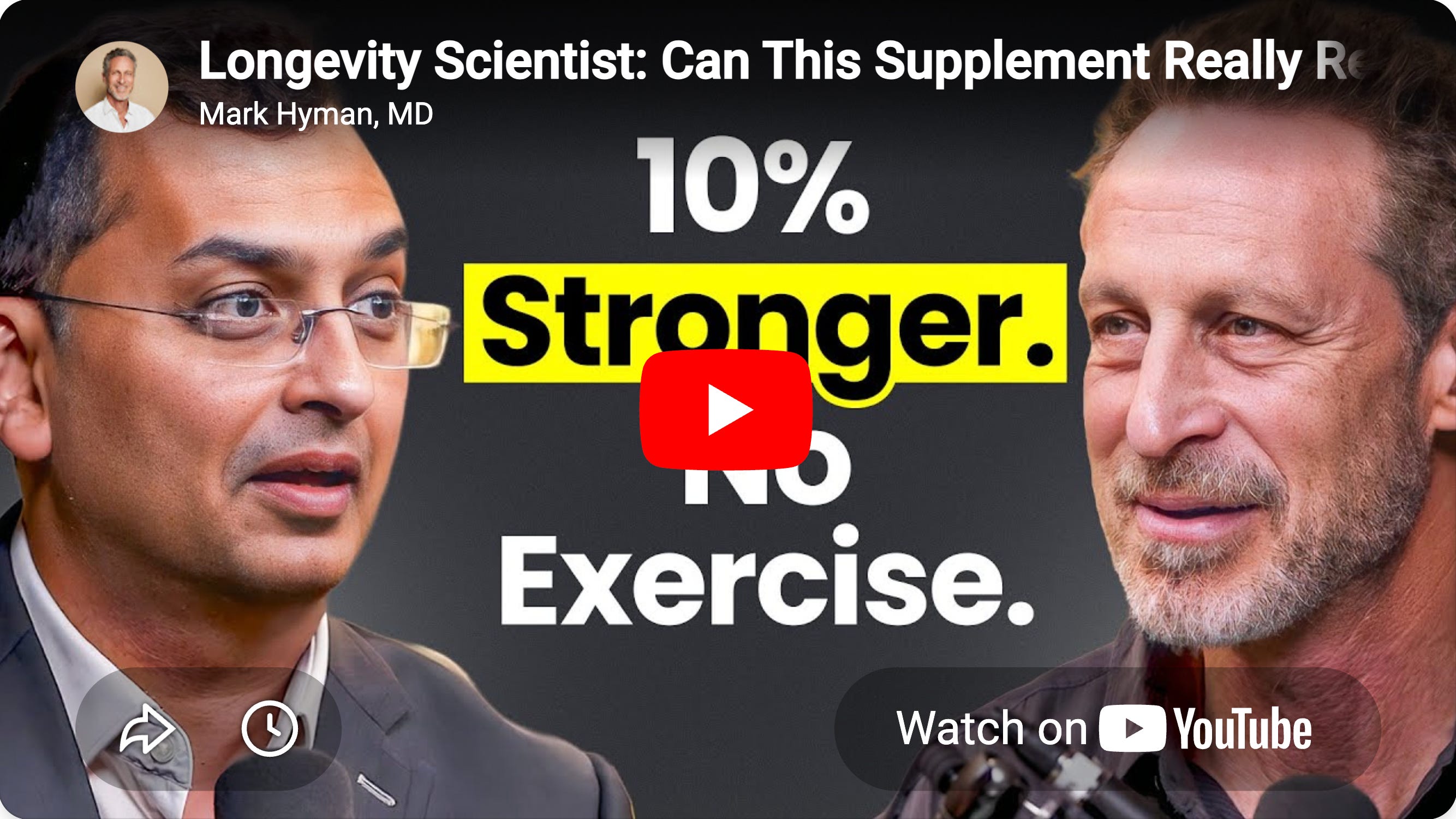
Several states restrict or prohibit doctors from promoting products they have undisclosed financial interests in. But in the above 2025 podcast, Dr. Mark Hyman and Dr. Anurag Singh, who is introduced only as an “immunology scientist,” promote Mitopure, a branded Urolithin A supplement, without disclosing that Singh is the chief medical officer of the company selling Mitopure online, or that Hyman earns commissions for marketing it on his own website.
In February, I wrote an article, “Is your longevity doctor scamming you?” that reveals how Dr. Mark Hyman regularly urges his newsletter readers to buy longevity supplements that he has an undisclosed financial interest in promoting. Which raises a bigger question.
Can doctors legally pitch supplements for money?
This article examines the legality of licensed medical professionals promoting longevity supplements in which they have an undisclosed financial interest. In response to my questions, the medical boards of California and Ohio said they would open investigations into Hyman’s marketing practices. Massachusetts may do the same but declined to answer my direct question about whether it would. In Texas, a spokesman for the state medical board said it only investigates complaints formally submitted through its online form or the mail.
lon·gev·i·ty chis·el·er, n. someone who intentionally promotes unproven anti-aging products, claims or research for personal or professional gain.
Each state’s response is reported in detail below. But first, a brief backgrounder on state laws governing doctors, legally and ethically.
In case you missed it:
How states regulate doctors
Every U.S. state regulates doctors and sets rules governing their conduct and business practices. State medical boards enforce punishments when licensed professionals disobey the rules. If a board determines that a doctor violated state laws or regulations, it may issue enforcement actions or recommend criminal charges.
Dr. Hyman’s misstatements about unproven supplements
EDITOR’S NOTE: I reached out to Dr. Hyman and his website’s support staff by email last week, indicating I was planning to write about his email claims about fatty15 and Mitopure, and asking whether he believed his marketing of supplements violated laws in states where he is licensed to practice medicine. He did not respond.
fatty15: a clinically unproven supplement Hyman presents as proven
My previous article, from February, described how one of Hyman’s email newsletters had urged his readers to buy a supplement, fatty15, that he described as backed by rigorous research. He didn’t disclose that the majority of the research he cited was done by the company selling the supplement, that the research showed no evidence that fatty15 worked in humans, and that Hyman was paid by the company to promote the supplement.
Mitopure: a mitochonrial supplement Hyman earns money from on the sly
Two months later, on April 21, Hyman sent out an email pushing another supplement, Mitopure, that he also appears to have an undisclosed financial interest in promoting. Hyman markets the supplement through his website, drhyman.com, and the company that sells Mitopure online features Hyman on his own partner program web page (www.timeline.com/partners/mark-news). That email also misrepresents the scientific support for Mitopure and its benefits for people:
every study of Mitopure on its branded webpage was funded by Amazentis, the company that sells it, and was authored by its employees, board members or scientific advisors.1
the two muscle trials behind the strength claims both failed the main test the studies were designed to answer. In fact, the placebo worked just as well. Hyman’s email presents Mitopure’s evidence as settled science when the research reports describe themselves as only proof-of-concept studies needing confirmation.2
In a podcast3 last year, Hyman interviewed the chief medical officer of the company that sells Mitopure online, naming the product 10 times without disclosing Singh’s relationship to it or Hyman’s role as a Mitopure marketing affiliate that earns commissions from sales of the supplement through his website, drhyman.com.
Four state medical boards respond to my questions
I asked the state medical boards in California, Texas, Massachusetts and Ohio if Hyman’s promotions of supplements are violations of their laws or professional codes of conduct.
Each state medical board responded to my questions with varying levels of specificity and transparency. Two states—California and Ohio—indicated outright that they regarded my inquiry as an official complaint that they would investigate. Texas and Massachusetts didn’t explicitly say they took my questions as a formal complaint, but the language of their replies indicated that they likely did.
Here’s how each state replied to questions about Hyman’s actions in regard to their laws.
California
California law prohibits physicians from receiving any compensation as an inducement for referring patients, clients or customers to any person or entity, under Business and Professions Code §650(a). A 2001 California Attorney General Opinion concluded that a clinician's profit-sharing arrangement to promote a third party's nutritional products to patients violates that statute. B&P §17500 separately prohibits false or misleading statements in connection with the sale of goods.
California’s response to my questions: In response to my questions, the Medical Board of California opened an inquiry into Hyman’s practices. “Your message has been forwarded to the Central Complaint Unit for review,” a spokeswoman for the board wrote in an email reply. (The Board accepts complaints via any medium, including email, mail, telephone, website form, or in person.)
California’s Department of Justice, similarly, indicated that it regarded my list of specific questions about Hyman’s promotion of fatty15 as a complaint to be investigated.
Ohio
Ohio law uniquely allows its medical board to discipline physicians for violating the AMA’s own ethics code, incorporated into state law under ORC §4731.22(B)(18). AMA Opinion 9.6.4 expressly defines “selling” health-related products to include “endorsing a product that the patient may order or purchase elsewhere that results in remuneration for the physician” — and requires full disclosure of the financial arrangement with the manufacturer. Ohio also separately bars false or misleading advertising under ORC §4731.22(B)(5), which the statute defines to include any statement that misleads “because of a failure to disclose material facts” or that creates “false or unjustified expectations of favorable results.”
Ohio’s response to my questions: In response to my questions, the Medical Board of Ohio also indicated that it had opened an inquiry into Hyman’s practices. “If the board is made aware of allegations, it has a legal responsibility to follow its formal investigatory process,” a board spokeswoman said in an email.
Anyone can file a complaint to Ohio’s medical board. There is no statute of limitations.
Massachusetts
Massachusetts law includes the most specific rules in the country governing physicians selling outside products. The state’s Board of Registration in Medicine (BORIM) Policy 05-01 "Sale of Goods from Physicians' Offices," prohibits physicians from selling products "in a manner that has the potential to exploit patients, including but not limited to exclusive distributorships or personal branding." The policy also bars physicians from using "their office or their professional relationship with patients to promote any business venture." The policy explicitly cites and quotes AMA Code of Ethics Section 8.063—now renumbered Opinion 9.6.4—the same AMA opinion Ohio incorporates into its disciplinary statute. A separate anti-kickback statute, M.G.L. c. 175H, makes it unlawful to receive compensation as an inducement for recommending goods, although its applicability to consumer-paid supplements is limited because the statute is tied to goods reimbursable by health insurers.
Massachusetts’s response to my questions: It appears as if Massachusetts may have also have opened its own inquiry into Hyman, to determine if it should pursue a full investigation. After one spokeswoman for the state’s Department of Public Health dismissed my specific questions about Hyman’s promotion of fatty15 as “hypotheticals,” a second spokeswoman said in a follow-up email that the state board “cannot make a determination based on a complaint alone”—which indicates that the agency regarded my questions as a complaint that would receive “a preliminary screening” to determine whether it will pursue an investigation.
If the board does uncover what it considers a violation, deciding if Hyman deserves punishment would likely take months of bureaucracy.4
Texas
Texas law regulates physician advertising under 22 TAC §164.3, which deems an advertisement false or misleading if it fails to disclose that it is a paid-for presentation, or contains a testimonial without required disclaimers as to the credentials of the person giving it.
Texas’s response to my questions: The Texas Medical Board told me that “the board does consider newsletters, websites, flyers, etc. to constitute advertising.” That means Hyman's emails and website are subject to Texas's prohibition on undisclosed paid-for presentations. The board’s spokesman, Spencer Miller-Payne, said the board does not regard my specific questions about Dr. Hyman, or media reporting generally, as a complaint it would investigate. Complaints must be submitted formally online or by mail.
“If a complaint was received regarding a licensee’s advertising in violation of board rules,” Miller-Payne wrote, “we would follow our standard process, which may include informal resolution, dismissal, or formal disciplinary action.”
Anyone can file a complaint to the Texas Medical Board.
The MitoImmune study (Denk 2025) is the closest to independent; it was investigator-initiated by an academic group at Goethe University. But according to the study’s ethics disclosure, Amazentis, the Swiss maker of Mitopure, funded the study, supplied the product, contributed four co-authors and paid the senior academic author consulting fees.
To quote the 2022 research report, in Cell Reports Medicine, by Singh, et al, “One of the main limitations of the study is that the primary endpoint of the study, [peak power output], was not significantly different between the [Urolithin A] groups versus the placebo group.“ Also: “Another limitation of the study is the finding that some biological pathways were not significantly modulated by UA at all doses.” In other words, the supplement didn't reliably change the biological processes it was supposed to change.
“If, after a thorough investigation, it is determined that the physician violated the Board’s regulations or policies, counsel will prepare a Statement of Allegations. A Statement of Allegations contains the facts and bases of discipline that Complaint Counsel feels can be provided at an evidentiary hearing before the Division of Administrative Law Appeals (DALA). If the Board issues the Statement of Allegations, the matter is referred to DALA for litigation. After the matter is adjudicated at DALA, the DALA Magistrate will issue a Recommended Decision for the Board’s consideration. It is at this point the Board can move forward with findings.” — spokeswoman for the Mass. Dept of Public Health
He’s on the list of pseudoscientists. We all need to do our due diligence and not just believe everything we’re fed. I realise if we hear the same thing over and over and over again we begin to believe it. This is a time not to.
Wow I’m writing about Mitopure this week too (had never heard of it until a few weeks ago). A skincare company is now using it in cream form. Great article. I need to figure out if derms need to be held to this standard. So many of them shill products and don’t disclose