


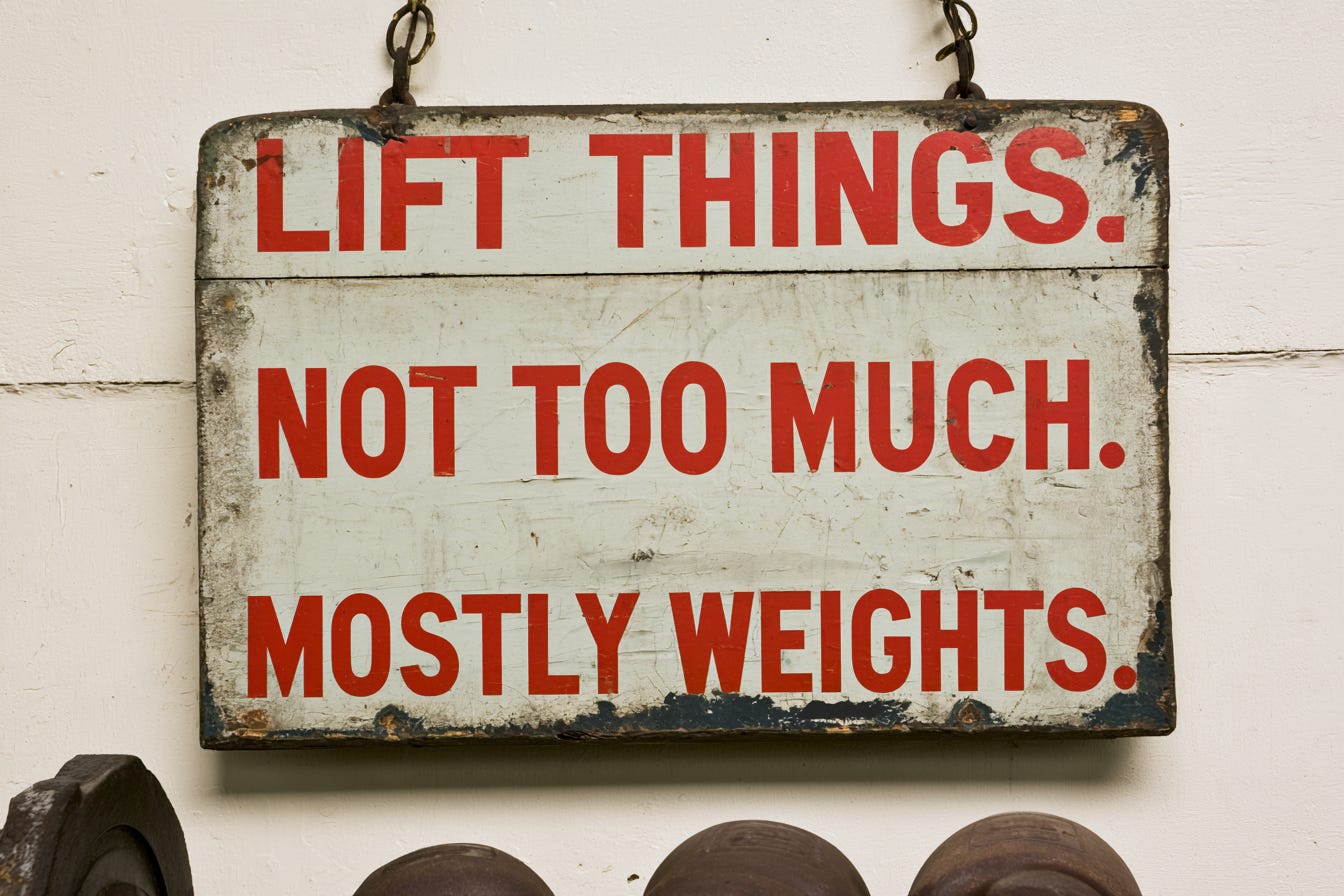

In case you’re wondering, the answer is yes! Today’s headline indeed intentionally cribs Michael Pollan’s now-famous 2007 edict, “Eat food. Not too much. Mostly plants.” Which we should shamelessly co-opt to proclaim:
Lift things. Not too much. Mostly weights.
Those seven words, arguably as powerful as Pollan’s (four of the seven are his), are a simple and effective roadmap for living healthier for longer.
Let’s examine what each of these three short sentences really means, in practice, and how to mainline each into a durable habit.

1 | Lift things.
At the start of his 2007 essay, Pollan explained why he included “Eat food,” despite its apparent obviousness. His emphasis, he said, was on the second word, food, because, as he wrote, “Once, food was all you could eat, but today there are lots of other edible foodlike substances in the supermarket”—aka ultra-processed deathfood.
Similarly, I’d like to emphasize the second word in “Lift things.” Because everything you lift counts. It doesn’t need to be weights at a gym (although we’ll get to that point in a minute). It could be:
weights at home that you’ve placed in areas that remind you to lift them for a few reps several times a day
a couple gallon milk jugs filled with water
one of those 99¢ recycled plastic shopping bags loaded up with cans of lentils
firewood or a small tree stump
an old-school vacuum cleaner you carry up and down the stairs
giant bags of rice
a car tire (or the spare in your trunk)
wet laundry in a basket
a weighted vest
the dog or medium-sized child1
The more of a beginner lifter of things you are, the more common household things can serve as your gateway drug to lifting things. Milk jugs filled with water can augment many body weight exercises, like squats, lunges and shoulder presses. Bags of rice loaded into a backpack turn a walk into a weighted workout.
So find a way to lift a thing. Any thing at all. Grocery bags carried to the car = workout, if that’s where you need to start. If you can develop the simple habit of lifting a thing or two every day, you put yourself on a path to lift more things and then more things and, in a short time, you’re lifting things that are heavier and heavier.
One thing I know from 48 years of strength training is that progress, no matter how incremental, begets progress. Every set of reps is like a door to somewhere new. So lift a thing, any thing at all, and see what doors begin opening for you.
2 | Not too much.
In his seminal essay, Pollan explains that “Not too much” is a necessary caution because overeating is rampant in the United States. Instead he pointed to the Okinawan practice of “Hara Hachi Bu”: eat until you are 80 percent full.
“To make the ‘eat less’ message a bit more palatable,” Pollan wrote, “consider that quality may have a bearing on quantity: I don’t know about you, but the better the quality of the food I eat, the less of it I need to feel satisfied.”
If we were to apply that concept to strength training, we’d say the higher quality workout you create for yourself, the less of it you need to achieve your goals. Five or 10 minutes working out without distraction produces a greater return than going to the gym for an hour and looking at your phone for a third of it.
Just resist the cultural message that going heavy is always better. For people just starting out, you don’t need to lift heavy or lift anything for more than a few minutes a day.
As with eating not too much, a palatable way to find satisfaction in lifting not too much is to make that lower-threshold workout count for more—through better technique, lighter weight, more reps, eccentric training and shorter rests between sets.
Don’t get caught up in the advice that muscle building requires going heavy. It doesn’t. Especially if you’re just starting out. Light and steady opens those doors I referenced above. Light weights work if the last few reps of each set feel hard. Going heavy carries unnecessary risks for people who are new or newish to strength training.
An unexpected injury can put you back weeks or months, and erase all kinds of tangible and intangible gains—physical, emotional and mental. That’s why I rarely go beyond 80 percent of my max weights now; there’s just no need for that. Am I trying to get huge or build greater neuromuscular fitness for the long run, in which balance, strength and power and agility all serve to keep me upright, moving forward and injury free?
3 | Mostly weights.
One reason Pollan cites for eating mostly plants: “eating a plant-based diet, you’ll be consuming far fewer calories, since plant foods (except seeds) are typically less ‘energy dense’ than the other things you might eat.”
Weights have a different advantage. They’re each stamped with a number, so you know exactly what you’re lifting, and you can move up in small, measured steps—10 pounds, then 12, then 15. You can’t do that with a milk jug or a bag of rice, and curling a vacuum cleaner can get awkward. Weights are also shaped to grip securely, which matters more as you go progressively heavier. Weights are easy and affordable to buy.
Investing in low-friction access to kettlebells or dumbbells calibrated to your
ability
strength goals
willingness to pick them up most days
and margins of safety
puts you on a track to faster, more noticeable gains than most household items you can manufacture into things to lift.
In my house, I have a sandbag in the living room (for weighted squats while watching Chicago Bears highlights), 40-pound dumbbells by my desk (for sets of eccentric curls or floor chest presses) and a 30-pound heavy ball in the bedroom, to remind me that 20 Russian twist reps during my nighttime stretch routine take all of 30 seconds.
So, when I say lift “mostly weights” I’m saying it in a context of a progression:
from zero minutes of weekly strength training
to, say, 35 minutes per week (ie, 5 minutes a day) of lifting small weights or heavy household items like those I listed above—and, in the process, knocking on those new doors along the way that will surely open if you give your muscles and brain a chance to feel the benefits of resistance training
to 60 minutes a week of lifting those heavy things
to 70 minutes a week lifting mostly weights2 that you find a way to have low-friction, enthusiastic access to
Summing up
The reason those blue-zone-famous, 99-year-old Sardinian goat farmers are as healthy as they are isn’t because they’re weight training. They’re just living an active, somewhat physically rigorous life, filled with human-powered movement, steep stairs and heart- and brain-healthy food. Their daily lives load their muscles. Ours mostly don’t, so weights fill the gap.
Model them, and not the legion of shirtless muscleheads on YouTube. You don’t need a full gym workout every day, to spend money on memberships and devices or to lift very heavy. You just need to
Lift things. Not too much. Mostly weights.
with permission from child and parent
by which I mean anything heavy, including sandbags, tractor tires, macebells or another person