


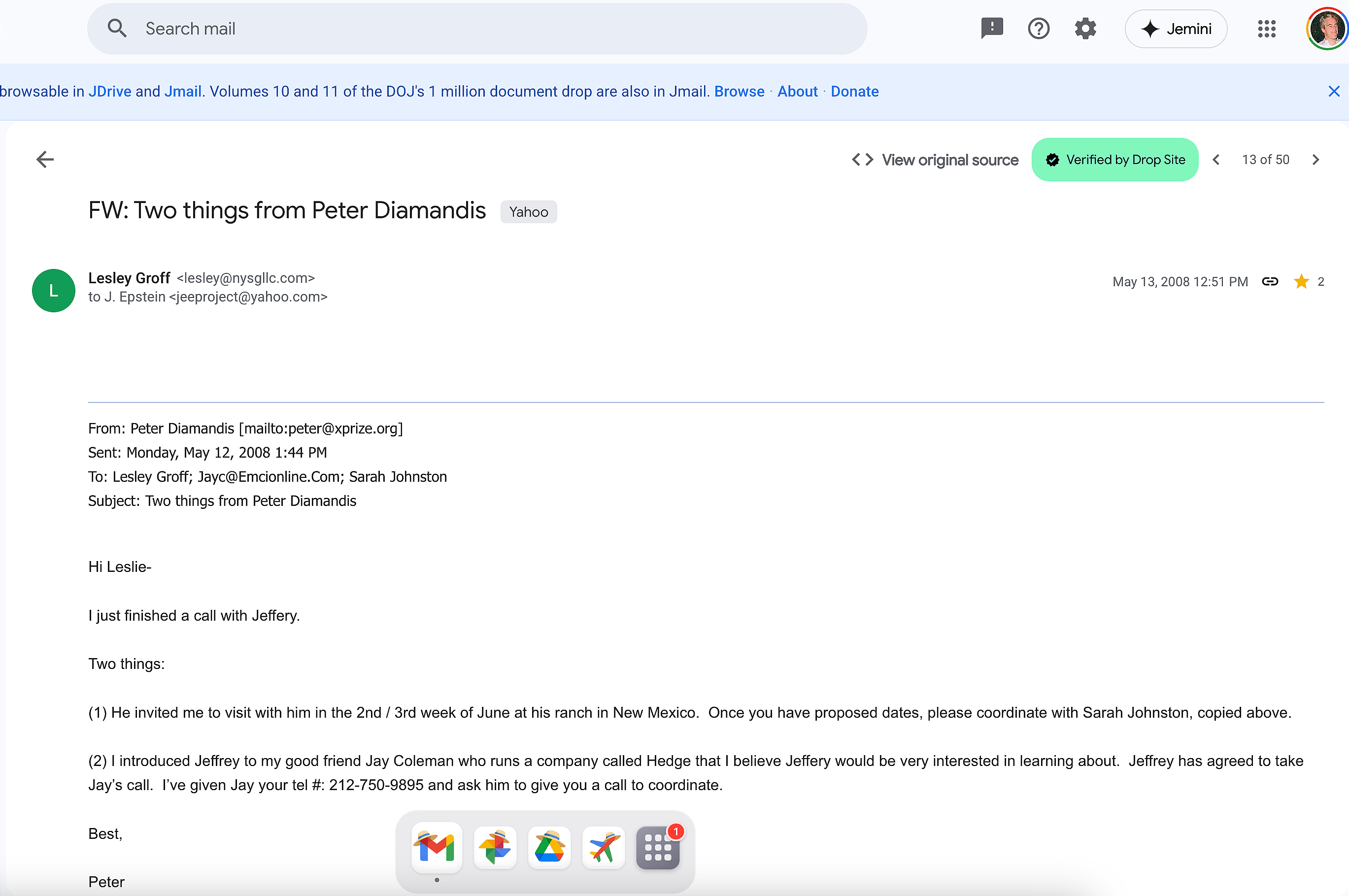
This article was updated on Feb. 10 to include Diamandis’s attempt to visit Epstein’s New Mexico ranch in 2008 and his 2014 interactions with Epstein at a TED conference, according to documents that are not in the Justice Department’s files. They contradict Diamandis’s statement that he was “introduced” to Epstein only in 2013.
Peter Attia isn’t the only notable longevity-wellness industry figure who went out his way to engage with registered sex offender Jeffrey Epstein after Epstein pleaded guilty to procuring a child for prostitution.
Peter H. Diamandis, the founder and executive chairman of the XPRIZE Foundation and the co-founder (along with Tony Robbins) of a longevity clinic that charges more than $10,000 for its most basic membership, pursued a connection to Epstein over at least a six-year span, from 2008 to 2014, records show. Notably, Diamandis says he “was introduced” to Epstein in 2013, though emails show him arranging an in-person visit with Epstein five years earlier.
As of this writing, Diamandis has not offered a public explanation of the disparity.
Why this matters: the longevity industry’s integrity problem
In the billion-dollar wellness industry, transparency and sound judgment matter—because they’re often in questionable supply. Diamandis, who earned a Harvard medical degree, is one of the most prominent evangelists and entrepreneurs in the longevity-industrial complex. He charges up to $250,000 to give a speech, so clearly his words and actions matter greatly to a lot of people. He co-founded two venture-backed companies; Fountain Life, with Robbins, and Human Longevity Inc., that sell premium diagnostics and concierge health services to wealthy clients, marketed around the idea that, if you can pay enough, aging can be slowed or reversed.
Ambition is admirable, but so is speaking candidly to the people paying you. At a time when the longevity industry is bloated with misdirection, false claims and shaded truths, the people at the top should practice more transparency, not less.
Diamandis & Epstein: unanswered questions
In May 2008, Diamandis wrote an email to Epstein’s assistant connecting Epstein to a business associate of Diamandis’s and asking for “proposed dates” to meet at Epstein’s New Mexico ranch, documents show. The email was sent about seven weeks before Epstein pleaded guilty to procuring a child for prostitution and began serving his jail sentence in Florida, on June 30, 2008.
Whether the men actually met in person that year is not clear. (You can peruse the Jmail trove of all Epstein files, including many not included in the Justice Department’s file, in a format vastly more searchable than the government’s.)
In April 2009, while Epstein remained incarcerated but was allowed to leave jail from 8am to 8pm six days a week, Diamandis emailed him directly seeking a “catchup.”
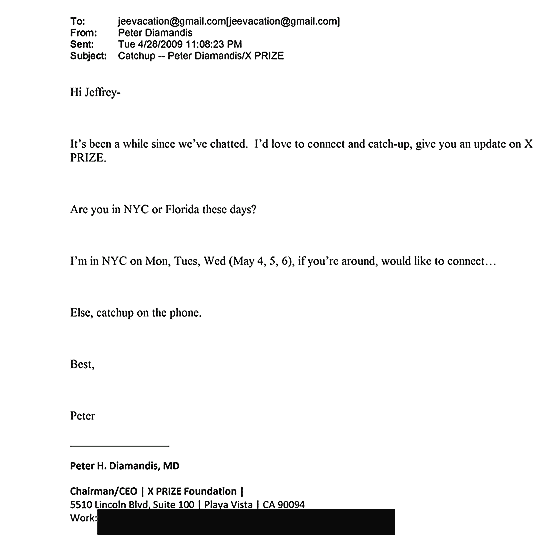
“Hi Jeffrey- It’s been a while since we chatted,” Diamandis wrote. “I’d love to connect and catch-up,” he added. “Are you in NYC or Florida these days?”
There is no indication in any public record thus far that Diamandis’s connection to Epstein went beyond business interests.
Diamandis’s response to this article
A day after this article first published, on Feb. 4, Diamandis responded with a statement in two parts that minimize his connection to Epstein and contradict the historical record of their six-year correspondence, most of which occurred after Epstein’s public reputation has become odious to many.
Diamandis says he was “introduced” to Epstein in May 2013 by his book publisher, who later urged him to meet with Epstein to discuss an XPRIZE donation. “I had a single fundraising meeting with Epstein about XPRIZE,” Diamandis says in the first part of his statement. “That’s it.” He also says, “Had I known more about him, I would have never pursued a meeting.”
In the second part of his statement Diamandis says his introduction to Epstein occurred at “TED Monterey,” facilitated by the publisher, John Brockman, during a group dinner. “We introduced at that time but we didn’t connect beyond an initial introduction,” Diamandis wrote. “It was later that Brockman suggested that I approach Epstein for XPRIZE Funding, which I did.”
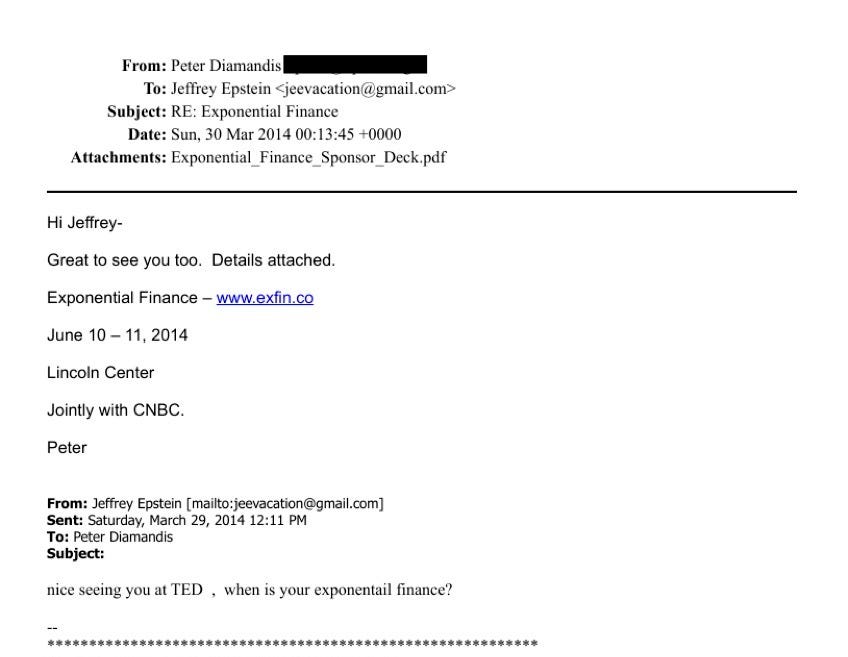
But emails show Diamandis had wanted to visit Epstein at his New Mexico ranch as early as 2008 and had asked Epstein to reconnect and catch up in 2009. Moreover, the Brockman group dinners occurred at the main TED conference, which in 2013 wasn’t in Monterey. Further, an email exchange between Diamandis and Epstein in March 2014 (see below), suggest they had interacted at the big TED event in Vancouver that year, not 2013.
Notably, by 2014, TED conference organizers had barred Epstein from attending, so he held meetings in hallways and a hotel lobby—and apparently also attended Brockman’s dinners.
“Hi Jeffrey- Great to see you too.”
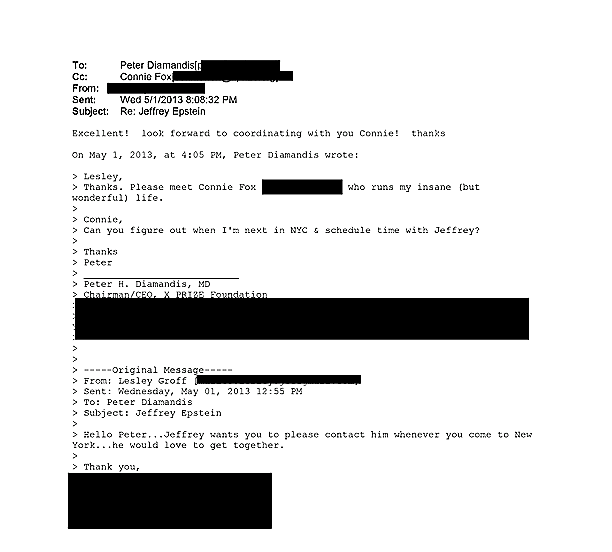
By May 2013, Diamandis’s and Epstein’s mutual interest in meeting was clear. “Jeffrey wants you to please contact him whenever you come to New York….he would love to get together,” Epstein’s assistant wrote to Diamandis in May 2013. Diamandis replied the same day, asking his assistant to “figure out when I’m next in NYC & schedule time with Jeffrey.” On June 9, 2014, Diamandis was scheduled to see Epstein for an hour-long meeting, these documents show.
This is a note I published on Feb. 10 after coming across the Jmail rendering of further emails between Diamandis and Epstein.
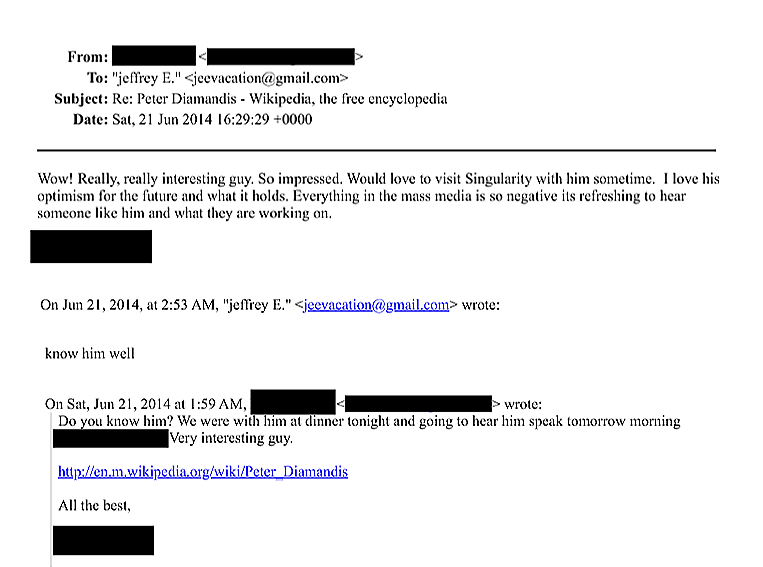
Epstein later wrote to another acquaintance about Diamandis: “know him well.”
In an email sent a couple weeks before meeting Diamandis at a TED conference and three months before the two men arranged to meet in New York, Epstein referred to Diamandis as a “bullshitter.”
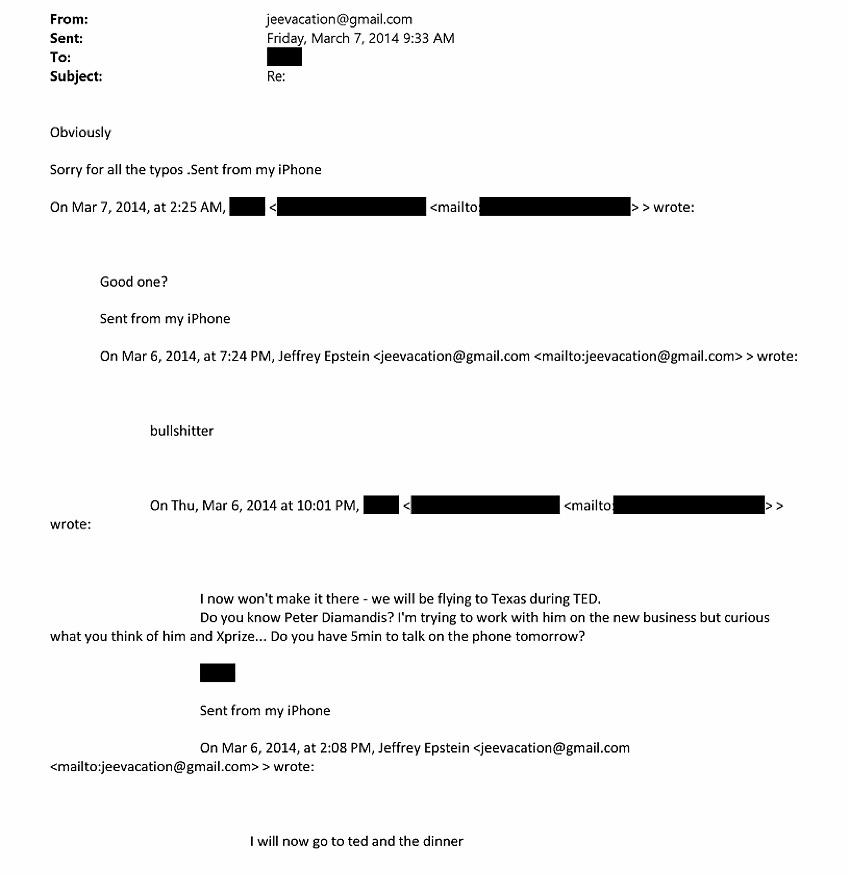
Only a fraction of the more than 270 documents in the government’s Epstein files that include Diamandis’s name are personal correspondences between the men or their assistants. Many are versions of the same emails.
Other health and wellness entrepreneurs in Epstein’s orbit
The overall longevity market, encompassing complementary and alternative medicines, gene sequencing, and anti-aging therapies and products, generated $65 billion in revenue in 2023 and is projected to reach $314 billion by 2030.1
The two Peters—Attia and Diamandis—were hardly the only luminaries in the longevity-wellness industrial complex to have associated with Epstein.
So did Bryan Johnson, the wax-skinned tech bro who wants people to pay him $1 million to avoid death. So did Katie Couric, who attended (now arrested former) Prince Andrew’s birthday party—and rearranged weekend plans to have tea at Epstein’s New York City home—17 months after he was released from prison. So did Deepak Chopra, who met with Epstein at least 12 times between 2016 and late 2018, during which time Chopra published two NYT best-selling self-help books, including “The Healing Self: A Revolutionary New Plan to Supercharge Your Immunity and Stay Well for Life.” So did George Church, a Harvard genetics professor and longevity business entrepreneur who, along with two Harvard colleagues, once proposed Epstein fund a “pleasure genome initiative” exploring neural correlates of pleasure, and who shared meals with Epstein as late as 2014.
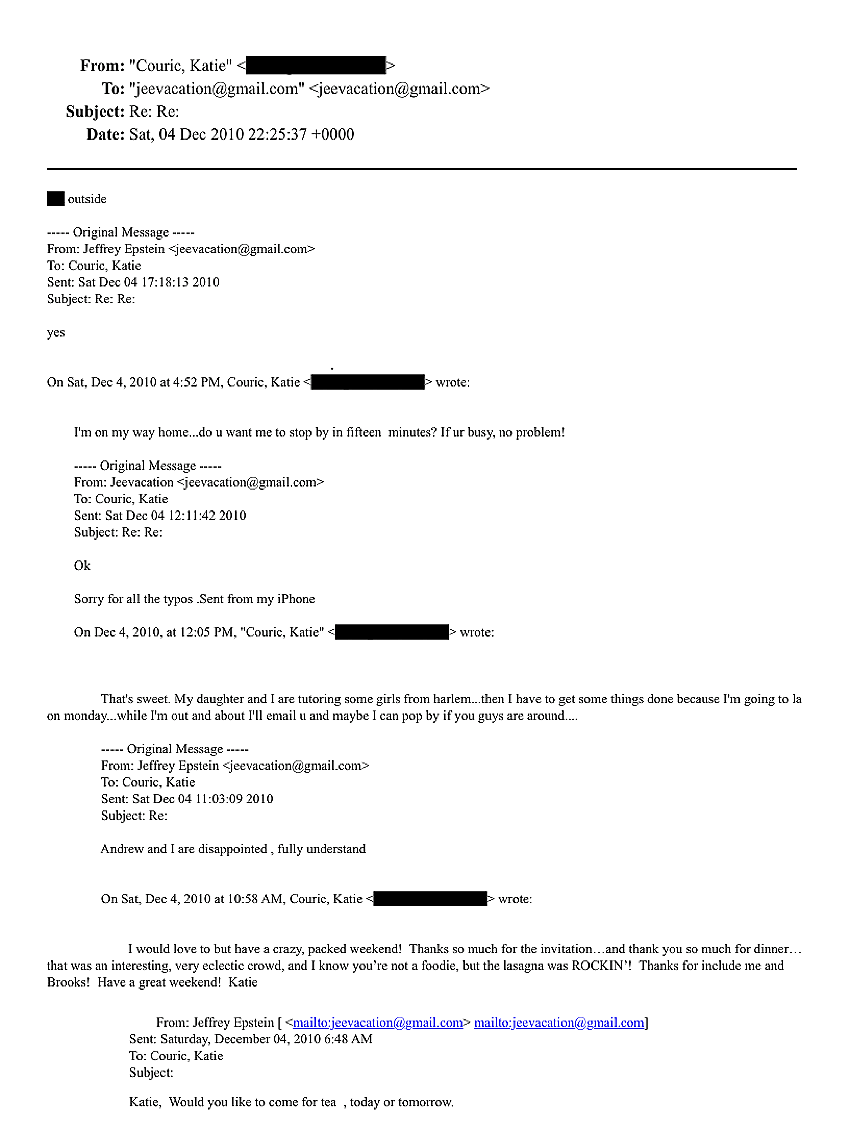
The list goes on. Each of the above names has offered what feel like regretful if also professionally vetted apologies or explanations for their interactions with Epstein.
A few thoughts on Peter Attia’s relationship to Epstein
What distinguishes Attia’s relationship with Epstein from all the others is that:
he wrote to Epstein with crude comments about women’s bodies
he has wrestled with deep emotional issues that he described with admirable candor in his best-selling 2023 book, Outlive: The Science and Art of Longevity
unlike almost everyone else with a direct, personal connection to Epstein, he’s made no excuses for his interactions with the man
A day before this article published, Attia, who is 52, posted a lengthy statement on X (fitting, considering Elon owns the often vile, increasingly toxic platform and is also featured in Epstein’s emails) to his staff, explaining his relationship with Epstein and not attempting to defend his crude sexualized remarks. You can read Attia’s statement here.
The cancellations begin
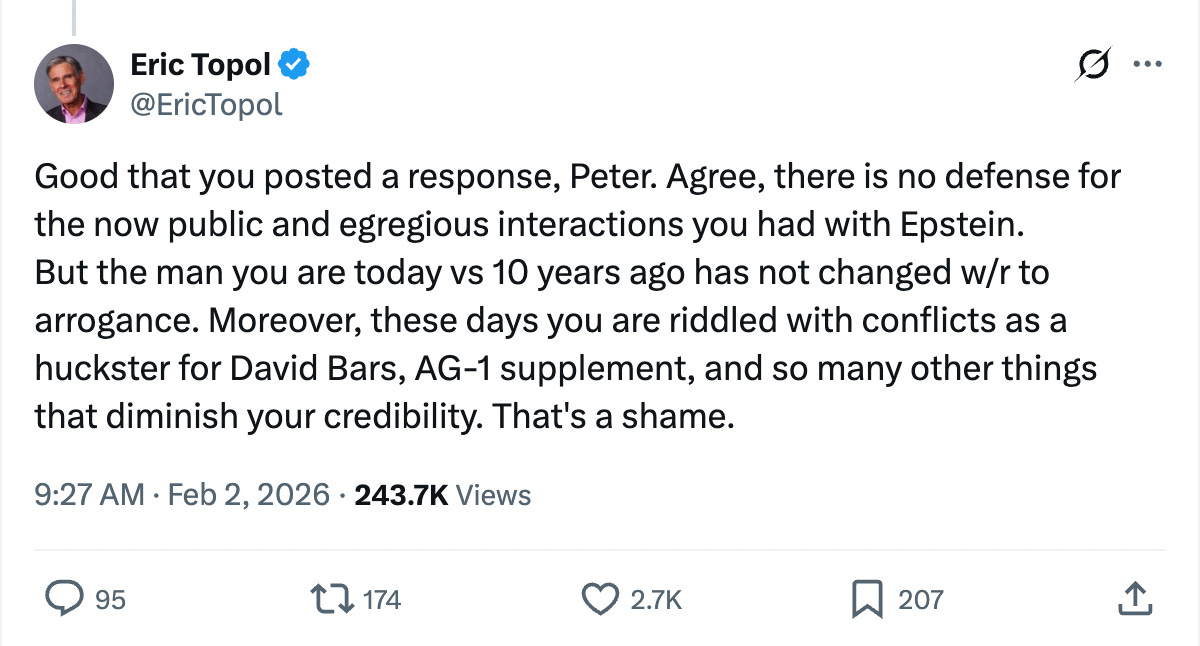
Attia, who CBS News just hired a week ago as a special health-wellness-longevity guru-slash-correspondent, is not expected to hold that job for much longer. For many people, the Epstein revelations were the disappointing icing on the proverbial cake—a layer cake of Attia product affiliations (like the overpriced David protein bar, which until Monday had paid Attia to be its chief science officer) and business ventures (like his high-end longevity clinic chain, Biograph, which he launched from stealth with a venture capitalist a year ago) that create real or perceived conflicts of interest.
The heartbreaking failure
Then there’s the most damning, heartbreaking Attia failure of all, which he himself disclosed on page 379 of his book, in a chapter titled “Work in Progress”: In July 2017, during a business trip to New York, Attia received a panicked call from his wife: their one-month-old son had stopped breathing and nearly died before being revived with CPR, and was in an ambulance to the ICU. His wife pleaded with him to come home. But instead, Attia wrote, he stayed in New York—for another 10 days—because of what he called “important” (his quotes) work.
That work, it turns out, involved a few meetings with Epstein, according to the time stamps on Attia’s emails released by the government. He chose that work over his family—his desperate, fragile family in a world of pain. It’s hard to fathom.
What happens next?
Peter Attia is almost certainly now in the process of disappearing, voluntarily or otherwise, from our collective longevity consciousness. At least for a while. (Peter Diamandis may lose a few speaking engagements but is not likely to disappear, is my guess.) Does that mean that Attia’s book, Outlive, which contains a lot of objectively valuable explanatory and clinical information about living better for longer, should no longer be read or discussed, due to the extreme failures of its author?
At a time when many Americans see equally poor, if not worse behavior from many other public figures in entertainment, academia and, especially, government, time will tell.
https://apexleaders.com/trend-reports/the-fast-growing-longevity-industry-holds-strong-promise-for-investors/
Excellent reporting and analysis, Paul. The Epstein affair is a profound and ongoing moral failure. Those who sought proximity to him for status or advantage bear responsibility for enabling that environment and should be judged accordingly. But the conduct of physicians who associated with him is particularly troubling, given the ethical obligations of our profession. I deeply appreciated @erictopol's response to Peter Attia which addressed this issue directly and explicitly challenged Attia's hucksterism. It's just one more example of the ongoing decay in pubic trust.
I found Attia about 3 years ago, just before Outlive was published. As a 77 year old at that time, I found a lot of good info which inspired me to improve my fitness. I also found stuff that made no sense. As with everything I read on the health space and other areas, I took what made sense and used it. The rest I discarded. Because of his disgusting Epstein entanglement, especially the family issues with his son, does that mean I should be discard what is of value? Unfortunately he and lots of other longevity gurus have achieved almost God like stature. Perhaps this will cause some to question their undying loyalty to those on the pedestal. But in our 30 second tik Tok world, I have my doubts as tomorrow we'll be on to the next worst thing. Great article as usual, much appreciated.