


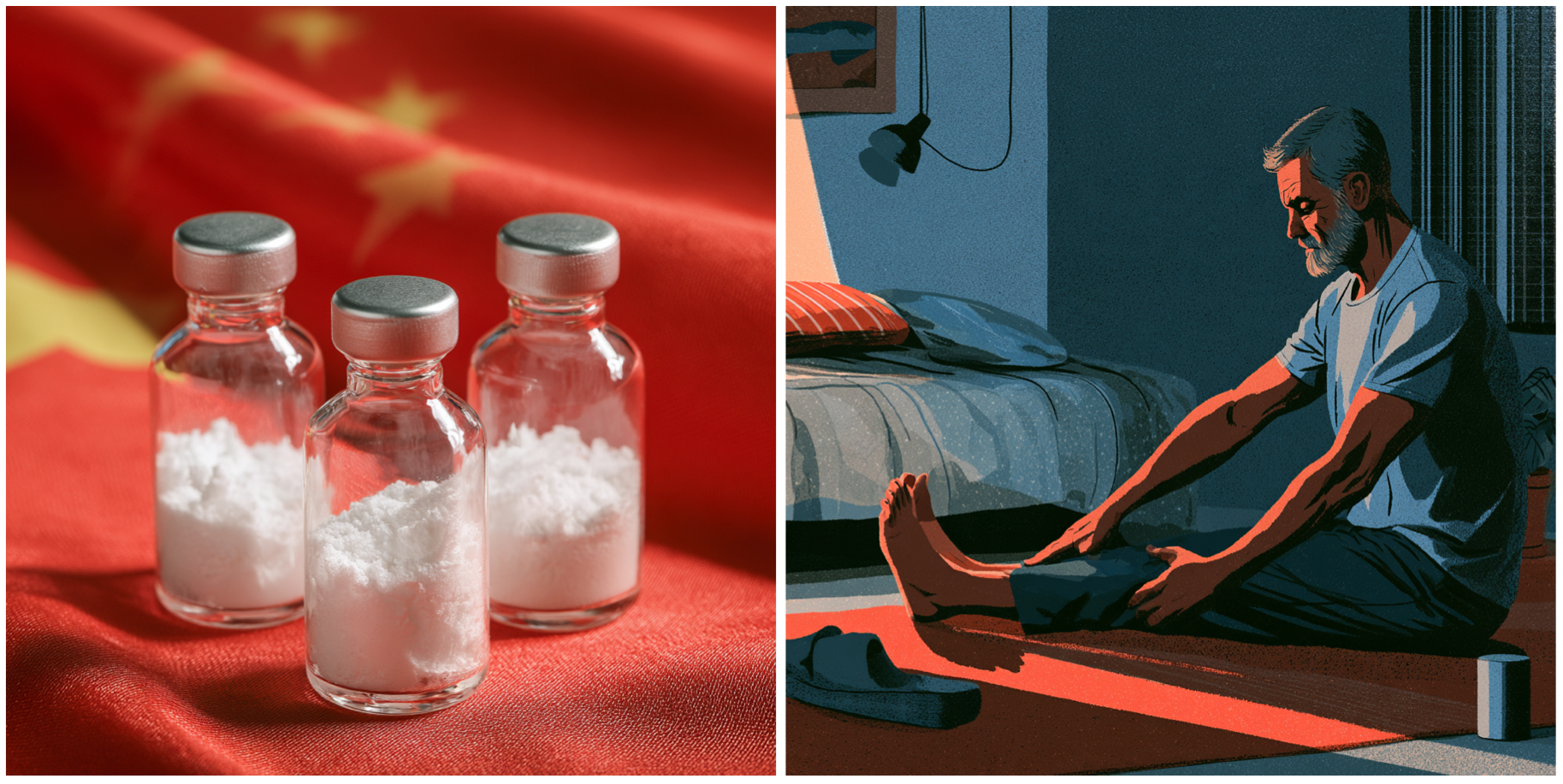

Today, a pair of reckonings from different genres that each have potential to disrupt your well-being, for better or worse. Don’t sleep on either of them.
The deadly circus of bootleg peptides
Earlier this month, The Wall Street Journal published a headline that captured the dangerous depth of the international obsession with peptides as panaceas: “Chinese Makers of Fentanyl Ingredients Now Sell Bootleg Peptides to Americans” (gift link!). You can read the article, but the headline says it all. The upshot is:
If Asian drug dealers have concluded that pushing peptides on Americans is a good business move, the peptide fever has probably reached a new, dangerous level.
Not all manufactured peptides are bad, of course. Some GLP-1s (the p in GLP-1 stands for peptide) have been shown in large clinical trials to treat type 2 diabetes1 and obesity2, and semaglutide (the active ingredient in Ozempic and Wegovy) also lowers the risk of heart attack and stroke in people with heart disease and excess weight3.
Let’s review what peptides are, what they do and why they’re the fentanyl of the “worried well.” (Admittedly a slight, if intentional, exaggeration.)
What are peptides and why do people inject, snort and swallow them?
Peptides are short chains of amino acids, which, in turn, are the building blocks of proteins. Your own body makes thousands of peptides, including insulin and many hormones. Most lab-made versions, including GLP-1s, are injected because stomach acid and digestive enzymes break peptides down before they can be absorbed, though a few, like Semax, are sold as nasal sprays, and some sellers offer capsules.
Related read:

People take unapproved peptides hoping they’ll help heal injuries faster, build muscle, lose fat, sleep better or slow aging—claims that rest mostly on animal studies and the word of the influencers and clinics selling them. Including longevity chiselers like Andrew Huberman.
lon·gev·i·ty chis·el·er, n. someone who intentionally promotes unproven wellness claims or misrepresents facts for financial gain, often unacknowledged.
I’ve criticized Huberman in these columns for venturing far beyond his neuroscience scope of expertise to recommend health and anti-aging nostrums that he often gets paid (but doesn’t acknowledge outright) to promote. The screenshot below is a classic example of his contempt for his audience’s right to transparency about the limits of his podcast guests’ expertise.
Three “buyer beware” media reports on peptides from the previous two weeks:
Recent peptide harm and death reports
KFF Health News, Oct. 13: BPC-157 users who say they were hurt
Dylan Meetze, a weightlifter, bought BPC-157 sold for laboratory research only and fell ill after three days spraying it up his nose. The story also says FDA scientists flagged signs of liver toxicity in rats and dogs injected with BPC-157 in a 2020 study. Note: These are personal accounts, not proof that the peptide caused the illness. The article notes the Huberman effect in action: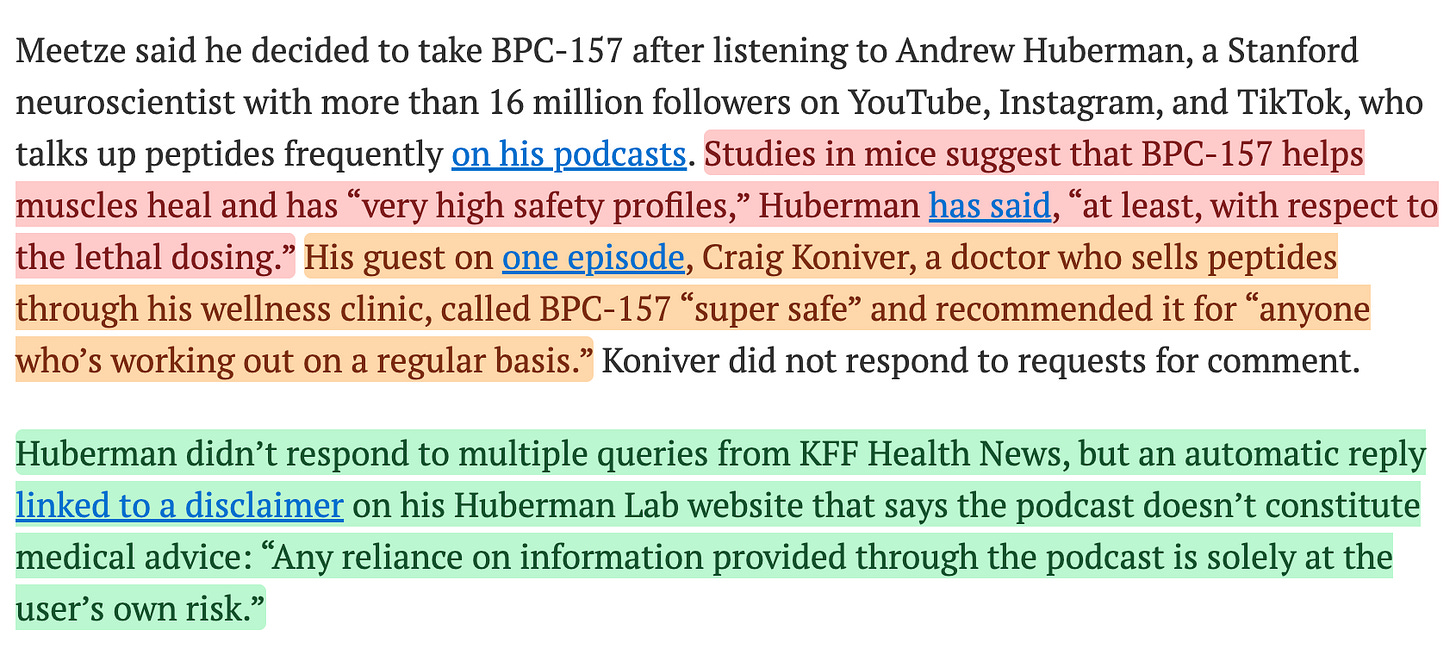
From a KFF Health News article, Oct. 13, 2026: Huberman’s typical chisel is to talk up a medical treatment but deny that it’s medical advice. CBS News, Oct. 21: A Brooklyn bodega sells fake peptides full of bacteria
A $90 vial from a Brooklyn bodega was labeled for research use only. A University of Iowa scientist found no peptide in it, just phenylacetic acid, a filler found in fragrances and lip balm. A second test found 13 colonies of bacteria.NSW Health (Australia), Oct. 19: a surge in emergency room visits
The state that includes Sydney counted 1,180 emergency department visits mentioning unapproved peptide use between July 1, 2025, and Sept. 30, 2026. Monthly visits went from five to more than 217. NSW Health also said clinicians had reported serious illness, including kidney damage and liver injury.
The bottom line: If you’re peptide curious, consult with a doctor or nurse practitioner—someone with a verifiable medical license—and understand what the latest and most credible research says about the risks and potential benefits.
The importance of minding your hamstrings
This part of today’s post comes straight from my own lived experience. That experience, over the past decade or so, involves aggressive strength or sports training and waking up with uncomfortable lower-back pain that almost always goes away, or is greatly relieved, by a simple night-time and morning hamstring stretch, described below.
As I’ve aged into and through my fifties, I’ve become a big believer in limber hamstrings as a foundation of maintaining neuromuscular fitness and either avoiding lower-back pain altogether or at least keeping it quarantined to a manageable minimum.
Yes, I’m a very small sample size. Yes, the results may be only correlated and not causative. But I hear the same thing from other older athletes: regular flexibility work on hamstrings keeps everything else below your belly button noticeably pain free and in sync. This is true regardless of how naturally stretchy or tight your hamstrings are.
Tight hamstrings change how you bend, stressing your lower spine
Your hamstrings are three muscles running from the bones you sit on to just below the back of the knee, and they cross two joints: your hips and your knees.
Decades of sitting shorten hamstrings. When they’re short, they hold the pelvis back as you bend forward, so your lower spine does more of the bending. A 2024 review of 14 randomized trials found that people with lower-back pain who stretched their hamstrings reported less pain and disability than those given usual treatment alone.
The trials were small and uneven; in the trials that reported ages, no one was older than 60. But the results consistently point the same way. Which is more than most back-pain advice can say.
The case for stretching hamstrings at night is more specific.
In a Dutch trial of 80 adults over 55 with night leg cramps, those who stretched their calves and hamstrings every night just before bed for six weeks cut their cramps by 1.2 more per night than those who didn’t stretch, and the cramps that remained hurt less. A separate pooled analysis of nearly 2,800 adults found that people who scored worse on the sit-and-reach test had stiffer arteries, with the gap clearest in older adults.
That’s a correlation, not causation; no one has shown that stretching your hamstrings softens your arteries. Still, the routine takes five minutes, needs no equipment, and you’re already lying down.
How I keep my hamstrings limber—especially after lower-body workouts
I’m not 100% adherent to this routine, but I’m always reminded that when I’m not, my lower back feels creakier the following day. Or days. This routine requires few words to explain:
Before bed, I foam roll my glutes (ie, butt), each one, on each side, hitting the hotspots that invariably exist in and around my hip flexors. The more hours per day I spend sitting, the more a storm tends to gather in my lower back and pelvis.
I then foam roll my hamstrings, which doesn’t feel like it’s doing much. But I believe it’s akin to putting a dime in the piggy bank every day: At least you’re doing something positive.
After foam rolling my lower back and doing these extremely satisfying and limbering poses and stretches (paying subscribers can view the entire routine), I end with a very simple coda:
I sit on the floor, legs straight in front of me, feet about a foot apart, and I grab my toes. Or, if I can’t reach toes, I grab ankles. If they’re also out of reach, I grab as low on my shins as I can. And I hold for 10 seconds. Just 10 lousy seconds.
Then I do it again, and often I find that I can reach my toes. In that case, I move my feet with my hands, back and forth, left and right, a few times.
In the morning, before I go downstairs to make coffee, I force myself to do No. 4 above, once again. It’s not fun. I huff and puff, often. It kinda sucks, to be honest. That is, until I stand up and I can feel the stress on my lower back gone or dissipated.
Maybe that’s just me, and you won’t feel the same relief. But I’m betting you will. That said, it’s worth reiterating that moving your body, even for a few minutes a day, is the best way to keep it agile, responsive and limber. But even then, building a daily flexibility routine for lower and upper body is something I consider a must-do to avoid costly physical breakdowns that can lead to emotional, nutritional and other breakdowns that can be stressful to overcome.
What’s your bedtime stretching and flexibility routine? Share it in a comment.
Sorli C, Harashima S, Tsoukas GM, et al. “Efficacy and safety of once-weekly semaglutide monotherapy versus placebo in patients with type 2 diabetes (SUSTAIN 1).” Lancet Diabetes & Endocrinology. 2017;5(4):251-260. doi:10.1016/S2213-8587(17)30013-X
Wilding JPH, Batterham RL, Calanna S, et al. “Once-Weekly Semaglutide in Adults with Overweight or Obesity.” New England Journal of Medicine. 2021;384(11):989-1002. doi:10.1056/NEJMoa2032183
Lincoff AM, Brown-Frandsen K, Colhoun HM, et al. “Semaglutide and Cardiovascular Outcomes in Obesity without Diabetes.” New England Journal of Medicine. 2023;389(24):2221-2232. doi:10.1056/NEJMoa2307563