


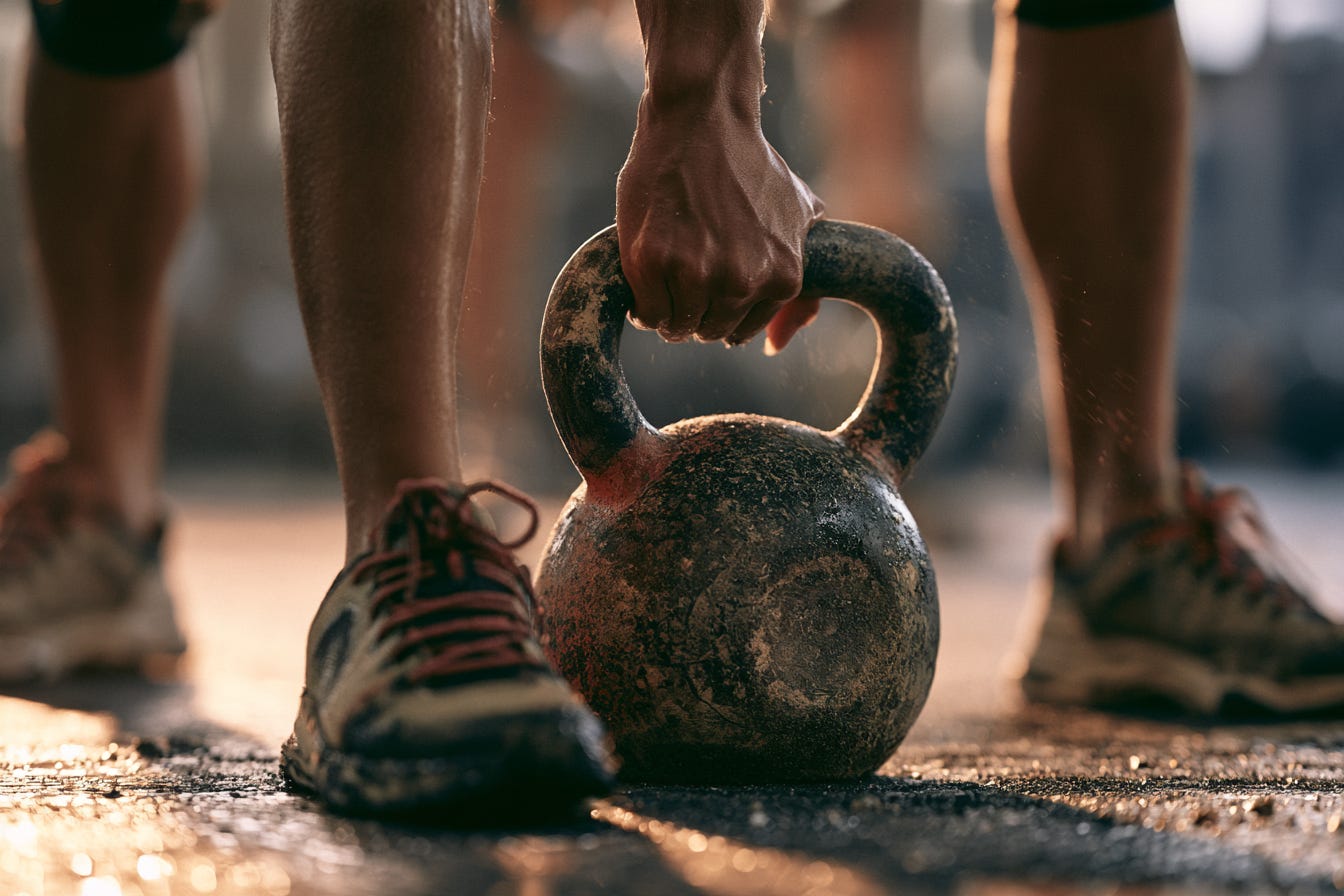

Why do you lift heavy things? Is it to get stronger? Or carve more defined muscles? Or become more powerful?
Which answer you choose (and there are more than just three) matters more than you may think, for reasons that go beyond how to train differently for each.
Muscle strength, size and power may sound interchangeable, but they’re not. Especially after 55 or 60, they become three distinct physical qualities, each trained differently, for different reasons, and each declining on its own schedule.
In this article, you get:
my personal take on the evolution from size/strength to power/speed
prescriptions for achieving each goal: strength, size & power
3-5 example workouts for building strength, size & power
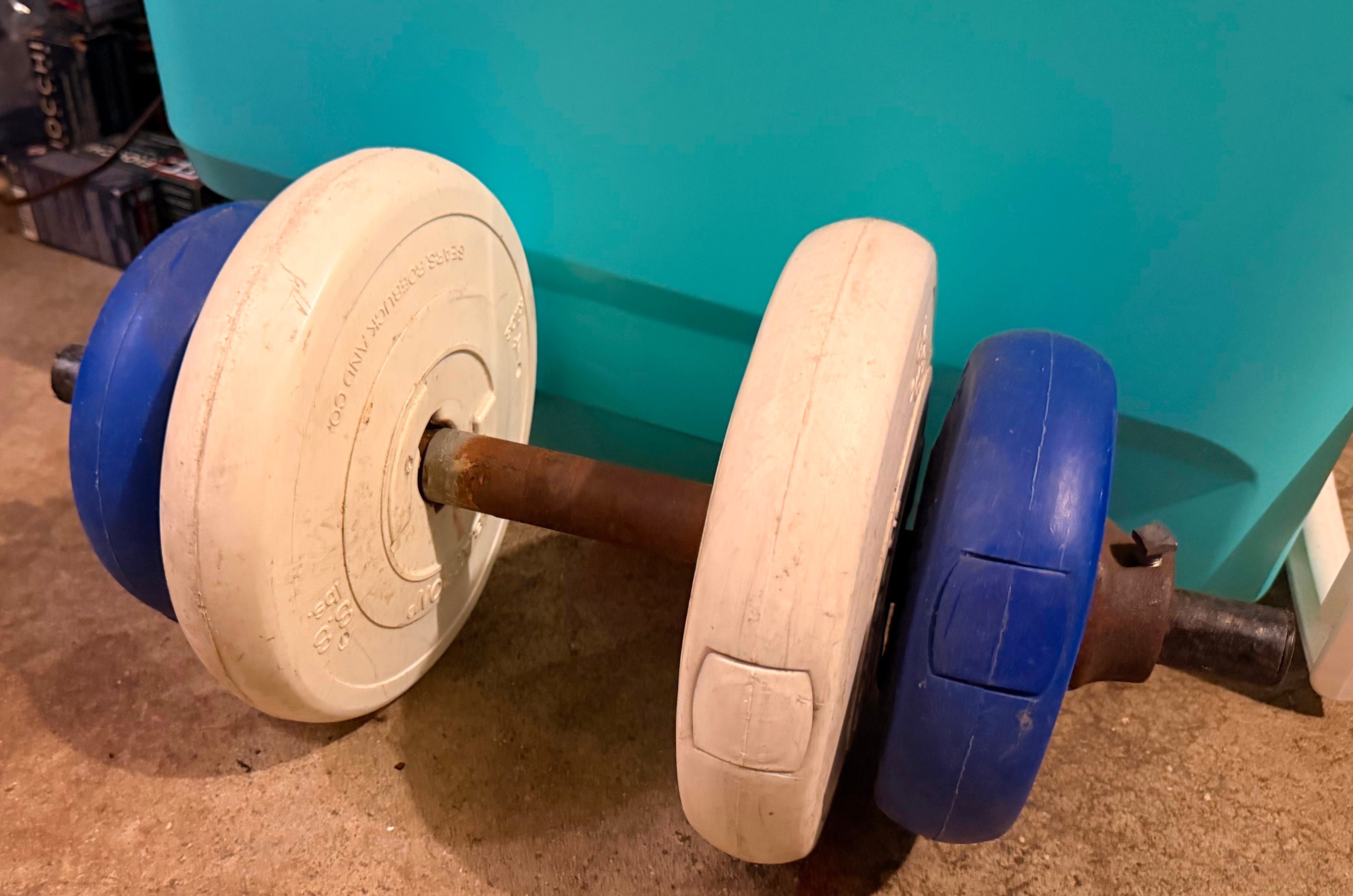
a photo of my rusted 1978 Sears Roebuck & Co. plastic dumbbell
Muscle power, for example, declines more rapidly in older adulthood than muscle strength. That matters because while strength is inarguably good to have, building power—especially in your lower body and core—is what keeps you agile, quick and able to catch yourself from tripping into that first, fateful, potentially nasty fall.
Related read: The case for quitting bar squat (and 6 better workouts)
(Falls in later life are among the most reliable predictors of future falls, which are strongly correlated to the end of independent living and greater mortality risk.)
It’s certainly possible to develop muscle size, strength and power at the same time, if you train frequently enough with the proper discipline. For most people, though, it isn’t likely. So let’s break down the comparative advantages of each kind of training, regardless of whether you’re an aging gym rat or lifting your first dumbbell.
In case you missed it…
The different reasons to develop strength vs. size vs. power
Strength is the maximum force a muscle can produce at any speed. It’s the heaviest weight you can lift once.
Power is force delivered quickly. A kettlebell swing is power. So is a fast pushup, or even standing up from a low chair. Sprinting is pure power. Catching yourself mid-stumble is power that can pay a major health dividend.
Size is the amount of muscle you carry.
For anyone past 50 or 60, each goal has its case.
Strength keeps you lifting luggage, grandchildren and yourself swiftly off the floor, and loads your bones in ways that keep them strong.
Size gives you a protein reserve to draw on during illness or injury rehab, when the body can cannibalize muscle.
Power declines faster than either of the others with age, and it governs the movements that keep you independent: stairs, curbs and recoveries from trips and athletic fatigue.

My personal take on training for size, strength or power
“Zielbauer, I’m gonna beat your ass before summer”
I’ve been training with weights since 7th grade, when John Allen, a giant 12-year-old burnout, promised to rearrange my face before the end of the school year. In response, I started working out in the basement with sand-filled plastic weights from a kit made by Sears Roebuck & Co.
The importance of power in older adulthood
I didn’t know what I was so awkwardly training for, other than to survive John Allen’s threat (which he promptly forgot). But over most of the next 47 years, I trained maniacally for size and strength. Only after around age 58 did developing more power, speed and agility become one of my top fitness goals.
That’s because though muscle size and strength make you look and feel great, physical power is the main ingredient in maintaining walking speed, moving quickly with control and, crucially, reacquiring lost balance in a fraction of a second.
Related read: The case for quitting bench press (and 6 better workouts)

Specific exercises to train for muscle size, strength and power, and the research behind them
There’s plenty of research to support that thesis, which I’ll get into below, along with my thoughts on how to train for muscle size, strength and power. I also offer specific exercises that help you achieve each outcome.
If your goal is strength: lift heavy
Worth repeating: No one over 50 needs to lift heavy. You can look and feel great by moderating the reps—and I say this with a “go heavy” mindset that doesn’t always serve my best interests. But if you want to get the strongest you can possibly be, lift heavy.
The best long-term evidence for this comes from the 2024 LISA trial in Denmark, a randomized controlled study of 451 adults at retirement age: