



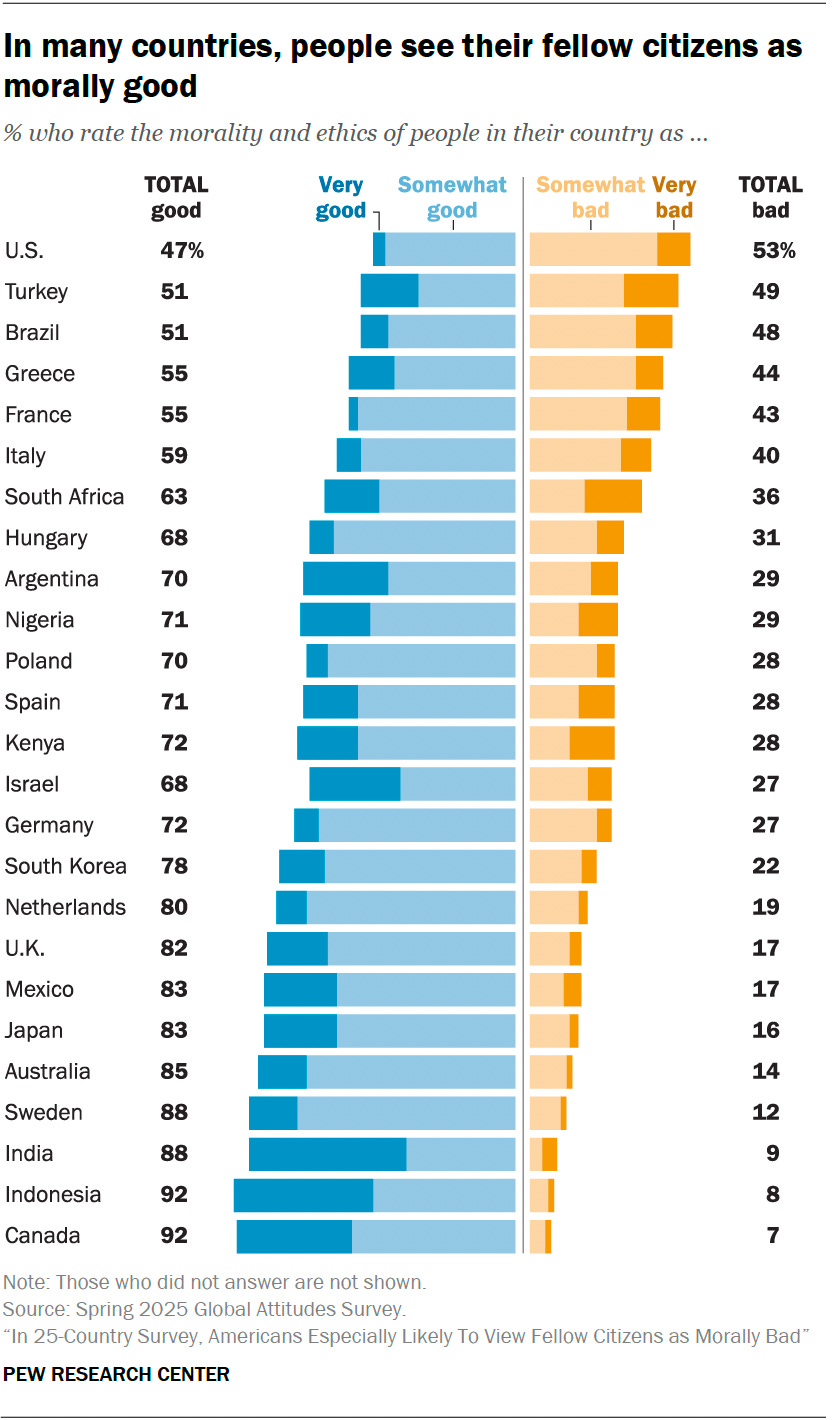
The U.S. is the only country where a majority of people view other folks as moral failures. Yes, you read that right.
A majority of Americans believe that the morality and ethics of other people are “bad” instead of good, according to a Pew Research survey published last month.1
Second-worst place in this 25-nation canvass of moral judgement belongs to Turkey (aka the Republic of Türkiye), where 49% of survey respondents said other residents are moral and ethical failures. Behind Turkey were—in declining order of rates at which people view their compatriots as amoral turds—Brazil, Greece, France, Italy, South Africa, Hungary, Argentina and Nigeria.
Canada, adorably, had the lowest percentage of people (7%) who think poorly of others (a rate seven times lower than Americans.) Canada! So cute! 🤗
If I sound a little cynical, I apologize. As a Gen Xer, part of me can’t help it, and the other part of me isn’t really sorry.
The power—amid pessimism—of tumbling into kindness
If this survey—the first of its kind by Pew—isn’t depressing enough, consider that it was conducted more than a year ago, before the wheels started to feel like they were, if not falling off this big American bus of ours, then at least starting to shudder.
Whatever your level of cynicism toward other folks around the country nowadays, I raise this survey on AGING with STRENGTH to make a simple point, and perhaps issue a simple, uncynical plea, about the importance of growing older with kindness.
The silver lining
It won’t be easy. But here’s a very slight but notable silver lining in the Pew survey: Older Americans (age 40 and up) were less likely than younger Americans to judge others as morally bad. Not by that much—50% vs 57%—but relatively speaking, it’s a good sign that age may, indeed, preserve our abilities to presume positive intent among others.
People over 40 have lived through enough—enough political cycles, enough national crises, enough personal betrayals and reconciliations—to know that moral judgment of entire populations is a blunt instrument. The 57% of younger Americans calling their fellow citizens morally contemptible are a generation that has grown up on digital screens. People who've been around longer came of age looking at other people, listening to other people and, just maybe, have had more actual humans in their lives who complicate making any sweeping moral verdict.
Coming of age in analog > coming of age digital
If you’re a Boomer, your get-on-with-it-already reputation is legendary, so no surprise there. But if you’re Gen X, you came of age in a culture that prided itself on irony and detachment, yet here you are, marginally more willing than the generations after you to give your neighbors the benefit of the doubt. Whatever that says about what people learn as they age—about the limits of judgment, the complexity of other people's lives, the cost of sustained contempt—it's worth sitting with.
Sitting with it is one way to let the kindness rise higher in your gut, in your mind, and push down the quick judgments we’re all growing uncomfortably comfortable making about folks who reside outside our respective bubbles, be they cultural, political, socio-economic, geographical, professional, creative or—speaking for myself here—athletic.
Tumbling is hard at this age. Kindness may be harder
Kindness doesn’t always seem like a coveted, admired or possible virtue these days. I’m not great at displaying it, in traffic, at the end of a hard week, in the face of the anonymous dumpster fire that is social media these days. I’m convinced by its difficulty that it’s an essential element of aging, because we’re all becoming creatures of greater habits, to one extent or another.
Let’s make being good to one another, and ourselves, one of those enduring habits.
https://www.pewresearch.org/religion/2026/03/05/in-25-country-survey-americans-especially-likely-to-view-fellow-citizens-as-morally-bad
That's a sobering analysis. Love your take on it. I honestly don't understand how people are so judgmental of others, or don't see the kindness all around them. I think they just don't know where to look, or maybe their lives don't have a lot of threads. Being the parent of three busy kids, and one with a disability, has helped push me into lots of spaces I wouldn't ordinarily go, I guess. I see kindness everywhere, every day. The hotel cook who welcomes the homeless vet into the dining area and fixes his coffee every morning. The suit-fitter at Men's Warehouse who was so patient with my son and gave him agency to speak for himself. The women in our community who are always ready to cook meals for those who are sick or hurting. Teens who volunteer their time to help kids with disabilities. Everywhere, Everything All at Once. Just look harder.
I almost jumped in after you mentioned Canada then I realised you were Joshing. The problem with kindness, older women have found in recent years, is that people start taking liberties. In light of which I suggest supplementing kindness with gratitude for the ordinary riches many of us have. Formerly, for many years, a cynical grumbler I have seen the light.