




The New York Times published a recent article, “Why Weight Lifting Is Good for Your Heart” (gift link), that caught my attention. Not because it was news to me but, rather, because a well-known surgeon on Substack blocked me after making essentially the same argument. Why cancel someone for seeking professional clarity?
It’s fine. I’ve been blocked by a few doctors (and fake people) on Substack for asking questions they didn’t like—usually about whether their columns were AI-generated. I believe doctors, because of the weight a medical license holds, especially owe their readers clarity when the words under their bylines were assembled by a machine.
But this wasn’t that—or so I thought. Reading that NYT article’s subheading about how strength training is “surprisingly good cardio” took me back to early April, when Howard Luks, an orthopedic surgeon whose work I followed, published a lengthy Substack note that declared weight training “doesn’t count as cardio.”
Those two statements—one by a doctor who is not a sports cardiologist and one by a newspaper that interviewed a sports cardiologist and two exercise scientists—contradict one another. (Luks’s note, read in its entirety, undermines itself by making incompatible arguments, which led to the online exchange that precipitated our Substack breakup.)
In fact, neither is accurate.

How weight training can improve cardiorespiratory fitness
My personal experience, after close to five decades of strength training that now centers on high-intensity, HIIT-like workouts with weights, is that weight training can absolutely produce a cardio benefit. Not as much as, say, beach sprints or jumping rope, of course, but certainly more than “doesn’t count.” Especially given the way I’ve been working out the last several years, with supersets.
Related read: Supersets for strength, cardio & more fat burning
Supersets involve doing two or three different resistance exercises, usually with moderate loads, with minimal rest in between. They feel more like running with a weighted vest than lifting heavy to failure. Anyone who says this type of strength training isn’t incapable of producing a cardiovascular benefit doesn’t, with all due respect, know what they’re talking about.
That’s not just me talking; it’s the research—going back many years.
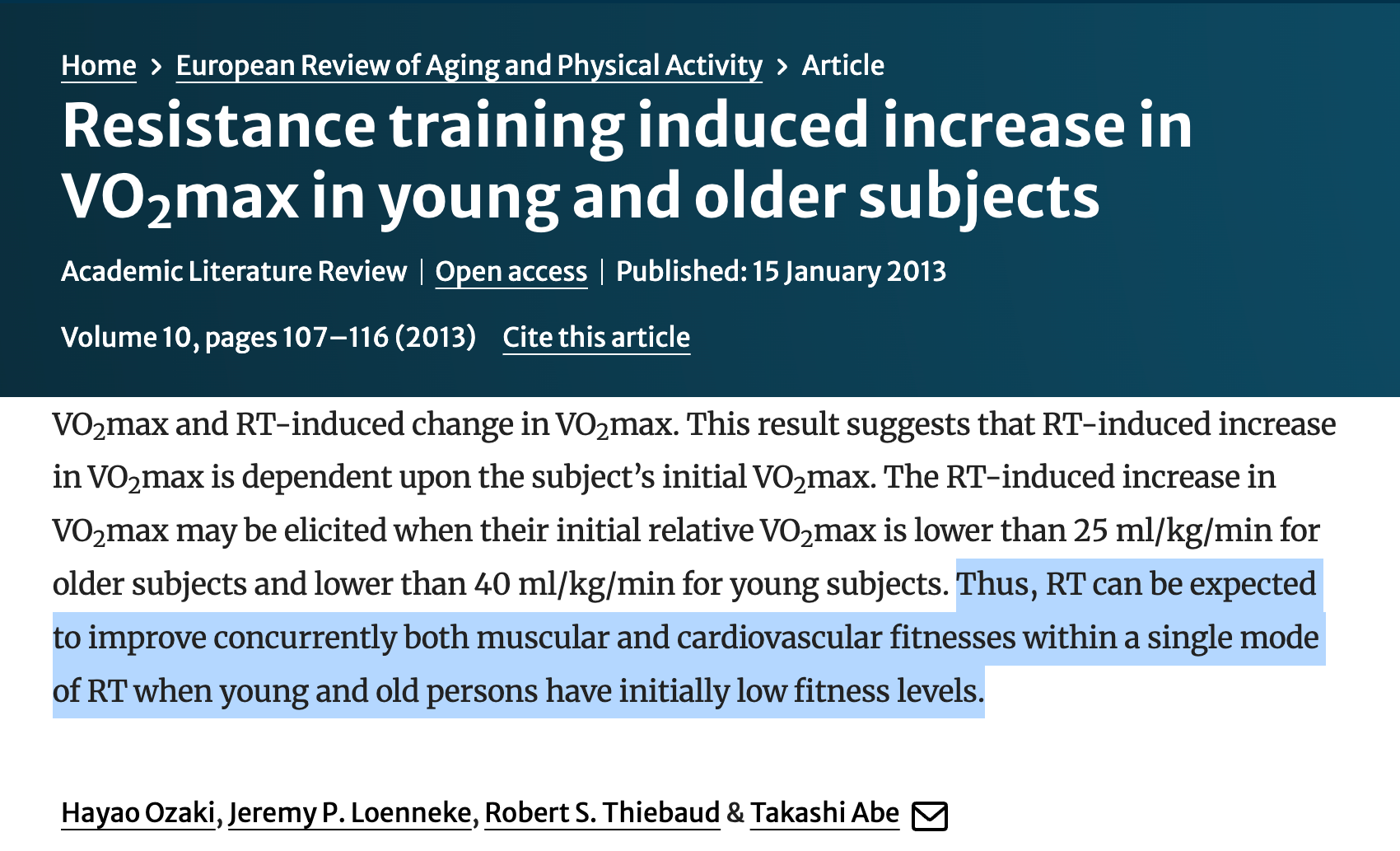
A 2021 meta-analysis of 45 separate papers found that circuit-based resistance training “has been shown to be an effective method for improving body composition, cardiorespiratory fitness, and strength of the lower and upper limbs.”1 Such training, this analysis found, led participants to a 4.3% drop in fat mass, a 1.9% gain in muscle mass, and a 6.3% rise in VO2 max.
The American Heart Association, in a 2023 scientific statement on the subject, wrote: “In healthy older adults, [resistance training] improves muscle strength and power and results in increased mobility, physical function, and cardiorespiratory fitness” (Italics mine). So to say weight training doesn’t count as cardio is incorrect.
Challenging a prolific Substack doctor
In a comment to his April 2 note, I asked Dr. Luks, who generates large volumes of online longevity-related content that go well beyond orthopedics, whether he’d overstated the “doesn’t count as cardio” thesis. While strength training doesn’t replace cardio for heart health, I wrote in our 8-comment exchange, surely it provides what I called a modest cardio benefit—especially for people who don’t exercise much.
Dr. Luks’s responded in detail to each of my 4 comments (see screenshot below) with a lot of words that, curiously, didn’t answer the question straight on.
Wary of confronting a surgeon on a medical topic about which I had no clinical expertise, I had also asked a cardiologist on Substack to examine that note and a lengthier post Dr. Luks had written on the same subject, which includes a curious claim at the top: “Lifting alone builds a heart designed for power, but not for endurance or longevity.”
A confounding and contradictory argument, and then a block
That statement simply doesn’t reflect the evidence. Lifting, even by itself, helps build a heart for longevity, and plenty of clinical data shows it can contribute to cardiorespiratory fitness. (The full post, which feels a bit like a ham sandwich of half-baked arguments and subtle contradictions, says as much. And in his April 2 note promoting the post, Dr. Luks says lifting “doesn’t count as cardio” but then closes by saying “both training types build a healthier heart.”) The AHA statement I linked above reports that lifting alone is linked to an 18% to 29% lower risk of death compared with no exercise.
Support my reporting on the Longevity Industrial Complex by buying me a coffee
Part of the reason for the incoherent argument may be that at least the free portion of Dr. Luks’s article is AI generated, according to GPTZero. As is his Substack note topping and promoting it, GPTZero also says. AI text analyzers are not always 100% accurate but the best ones tend to not be 100% wrong. Late last year, in response to a question I’d asked for an article I was writing on doctors who use AI without telling readers, Dr. Luks had denied publishing AI-generated posts when I’d asked him about it.
The cardiologist on Substack whom I’d asked for a reality check said Luks’s note “is partially accurate but overstated. He is absolutely right that resistance and aerobic training produce different cardiac adaptations, but mischaracterizes resistance training as lacking cardiovascular benefit.”
The cardiologist added: “Characterizing resistance training as merely producing ‘concentric hypertrophy’ without cardiovascular benefit is an oversimplification that doesn’t reflect the substantial mortality and morbidity reductions associated with resistance training.”
Within a day or two of questioning Dr. Luks, I was blocked and my comments from our exchange below his April 2 note were deleted, as happens when you get blocked. Slightly surprising but c’est la vie.

Why this matters
My point in relating this episode is not about a personality clash or Substack quarrel but about the importance of not automatically accepting arguments, even clinical ones, that appear to contradict real-world experience or rely on undisciplined, AI analyses. And the importance of asking thoughtful, genuine questions of self-proclaimed longevity-industry experts when their assertions don’t match the data.
Transparency matters. And a medical license confers a special responsibility to a public you’re selling online advice to. Noblesse oblige.
How a New York Times article overstates the evidence
While Dr. Luks misstates resistance training’s role in providing a cardiorespiratory benefit, the Oct. 9 New York Times article subheading carelessly overshoots the evidence to assert that lifting weights is “surprisingly good cardio.”
Would that it were true.
The study the article cites measured heart attacks and strokes, not aerobic fitness, and the rest of the evidence doesn’t support that claim. An editor should have noticed the mismatch. Indeed, back when I was in the The Times newsroom (a clause I write fully aware of its ability to make me sound like an analog-era grump), the copy desk, staffed by professionals whose job was to catch and correct mistakes large and small, would have caught that one.
A simple online search would have raised a flag. The AHA statement I cited above, for example, calls lifting’s aerobic fitness gains “small to moderate” and refers to its benefits as “modest.” The NYT article correctly concedes that lifting does less for aerobic capacity in people who are already fit, and that they need to keep running, cycling or swimming.
“Surprisingly good cardio,” though, promises more than the evidence or the article delivers.
What did you think of this post? Let me know in a comment.
Ramos-Campo DJ, Andreu Caravaca L, Martínez-Rodríguez A, Rubio-Arias JÁ. Effects of Resistance Circuit-Based Training on Body Composition, Strength and Cardiorespiratory Fitness: A Systematic Review and Meta-Analysis. Biology (Basel). 2021 Apr 28;10(5):377. doi: 10.3390/biology10050377. PMID: 33924785; PMCID: PMC8145598.
I'm a 90 year old woman who does modified weight lifting, hikes up steep trails, and does Pilates once a week and works with a trainer once a week. I think your article is fair and important. From my experience, a balanced regimen works best but what I do does not come from doctors--no matter how experienced--it comes from me knowing my body and my luck in finding great people with whom to work.
Another really excellent piece, Paul. Very well written. Thanks!