




Here’s the story of my biceps reattachment surgery in January 2022. And the lesson that I took from it that I think is worth sharing, which is if you think something’s wrong, don’t take your doctor’s (or your nurse practitioners’) word for it that it’s okay and it can wait.
Sometimes it can’t wait. And this is what happened to me because in, I don’t know, November of 2021—months before the surgery actually ended up happening.
I had torn my left biceps. It didn’t feel it didn’t hurt, but I could hear the the biceps actually tear. It sounded like a potato sack, like a burlap sack kind of ripping. And it felt a little weird in my left arm, but it didn’t hurt outright. It just kind of ached.
I did it, by the way, in the process of rolling my then six- or seven-year-old daughter off of my outstretched arms into the pool. I was standing in a pool and she loved playing “the log” that would roll off my my arms. So I would gather her up like a bundle of firewood and then roll her off my arms into the water. She loved that. And it was fun until I tore my biceps, rolling this forty fifty pound person off of my arms.
Shortly thereafter, I could see in my left biceps the Popeye syndrome. They call it Popeye arm or something, where you can see the biceps, which is torn, start to retreat up toward your shoulder. It’s like a a bunch of muscle gathering because the tendons no longer holding the muscle to that joint in the elbow.
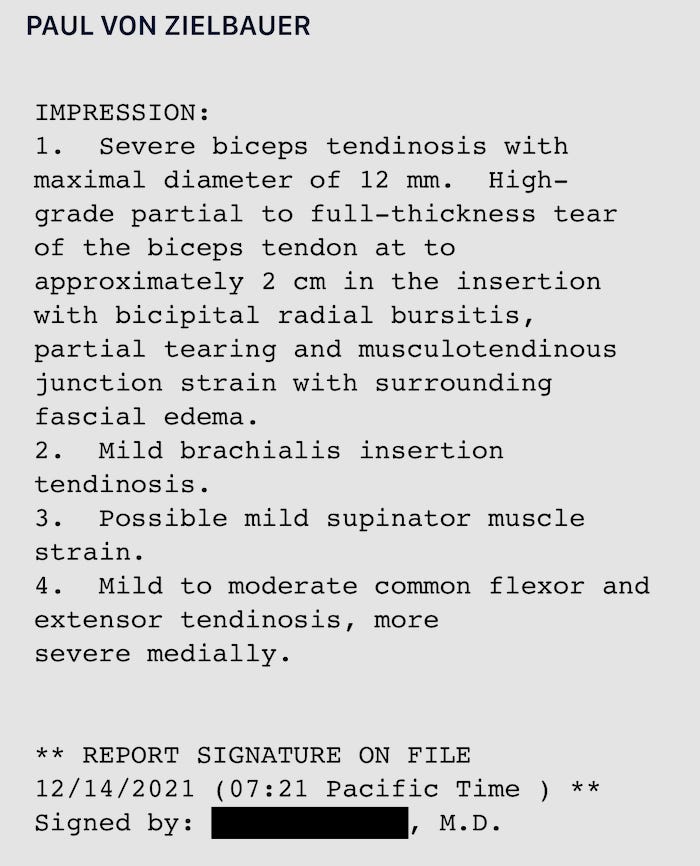
And so I went to see a doctor.
I had insurance through Kaiser at the time through my employer, and I saw not a surgeon, even though my appointment was with a surgeon — and this is lesson 1 — I instead saw a nurse practitioner because the surgeon was busy, the nurse practitioner said. Very nice lady. I liked her a lot. I thought she gave me good attention while I was there. She told me to hold off, basically. I’m abbreviating all of these conversations, but it was just like, “It’s okay, there’s no danger, you don’t need to get anything done right away. Let’s wait and see.”
So weeks go by and I’m texting to this nurse practitioner asking, “Hey, do you think we should do something about this?”
Eventually I sent in a photograph that I took of my own arm, and I used the photo app and my iPhone to circle the area of my lower biceps where it seemed like there was beginning to have some real separation between the elbow joint and where the muscle starts, that was much different than my right arm, which I also sent a photo of, for comparison.
Shortly thereafter—again, this is weeks after my initial consultation and appointment with the nurse practitioner, which was supposed to have been with the surgeon—and so after I sent those photos in, I got a call somewhat urgent, not panicked, just sort of with intent, saying, “Yeah, we gotta schedule you for surgery.”
I would say within 10 days of a follow-up appointment with an actual surgeon, after I had sent in those photos, I quickly got the appointment with a surgeon who confirmed what the photos should certainly indicated, which was there was a full tear that needed replacement.
Because if you don’t repair a biceps tendon tear, the muscle retreats up further and further. And as the surgeon explained to me, it gets harder and harder over time to pull that muscle or that tendon back down, cut off the ends that have atrophied, and then reattach the nearest good tissue down to your elbow again.
I’m not being medical in my explanation, but you get the picture.

So time was of the essence because the further it retreats up, the harder it is to pull down and then you have to then maybe more of the tendon kind of atrophies to the point where they have to cut it away in order to get to good tissue that can be, for lack of a better phrase, sewn back onto that lower elbow joint.
So we got into surgery and the surgeon who did my surgery wasn’t the surgeon I’d seen after sending in those photos, but that’s okay. This was, you know, it was a high-quality surgeon, highly successful surgery. It worked out.
I was in a brace for a few weeks, but the point of this story is that when things don’t feel right or don’t look right or both, it’s worth sending in some pictures to your medical staff because at that point there’s evidence that they need to act on.
The care team was good and Kaiser did a good job, with the exception of just kind of blowing off—again, not the technical term—my initial consultation with the N.P. wasn’t quite…they didn’t follow up as much as I would have certainly have liked, and as much as of course the evidence ended up bearing out that they should have.
And so when you when you take matters into your own hands in the the right way, sending in some photos and asking, demanding, them to respond, you will often—I think, even in our healthcare system, which is full of gaps and just misses things…it makes it just that much harder to miss.
My dad had a saying when he was alive, he always said, the squeaky wheel gets the grease. And that applies to a lot of things in life, but it certainly applies to making sure that you get the health care you need.


